Results by title
9 books match the query 'Whites in literature'
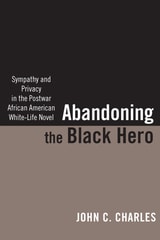
Abandoning the Black Hero
Sympathy and Privacy in the Postwar African American White-Life NovelCharles, John C
Rutgers University Press, 2012
Abandoning the Black Hero is the first book to examine the postwar African American white-life novel—novels with white protagonists written by African Americans. These fascinating works have been understudied despite having been written by such defining figures in the tradition as Richard Wright, Zora Neale Hurston, James Baldwin, Ann Petry, and Chester Himes, as well as lesser known but formerly best-selling authors Willard Motley and Frank Yerby.
John C. Charles argues that these fictions have been overlooked because they deviate from two critical suppositions: that black literature is always about black life and that when it represents whiteness, it must attack white supremacy. The authors are, however, quite sympathetic in the treatment of their white protagonists, which Charles contends should be read not as a failure of racial pride but instead as a strategy for claiming creative freedom, expansive moral authority, and critical agency.
In an era when “Negro writers” were expected to protest, their sympathetic treatment of white suffering grants these authors a degree of racial privacy previously unavailable to them. White writers, after all, have the privilege of racial privacy because they are never pressured to write only about white life. Charles reveals that the freedom to abandon the “Negro problem” encouraged these authors to explore a range of new genres and themes, generating a strikingly diverse body of novels that significantly revise our understanding of mid-twentieth-century black writing.

Black and White Strangers
Race and American Literary RealismKenneth W. Warren
University of Chicago Press, 1993
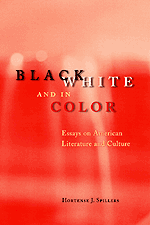
Black, White, and in Color
Essays on American Literature and CultureHortense J. Spillers
University of Chicago Press, 2003
Black, White, and in Color offers a long-awaited collection of major essays by Hortense Spillers, one of the most influential and inspiring black critics of the past twenty years. Spanning her work from the early 1980s, in which she pioneered a broadly poststructuralist approach to African American literature, and extending through her turn to cultural studies in the 1990s, these essays display her passionate commitment to reading as a fundamentally political act-one pivotal to rewriting the humanist project.
Spillers is best known for her race-centered revision of psychoanalytic theory and for her subtle account of the relationships between race and gender. She has also given literary criticism some of its most powerful readings of individual authors, represented here in seminal essays on Ralph Ellison, Gwendolyn Brooks, and William Faulkner. Ultimately, the essays collected in Black, White, and in Color all share Spillers's signature style: heady, eclectic, and astonishingly productive of new ideas. Anyone interested in African American culture and literature will want to read them.

Broken Silences
Interviews with Black and White Women WritersEdited by Shirley M Jordan
Rutgers University Press, 1993
In these 20 interviews with women writers of fiction, Jordan, who teaches at Hampton University in Virginia, attempts to plumb the relations between black and white women in fiction and in life, and to explore the creative process. Although the book suffers from lengthy discussions of somewhat obscure work, the interviewees, most of whom have portrayed female characters of a race other than their own, offer intriguing, often conflicting observations about the primacy of race, gender or class. Kaye Gibbons ( Ellen Foster ) suggests that rural locations offer commonality to black and white Southern women; Marita Golden ( Long Distance Life ) observes that white writers emphasize female beauty while black writers focus on character. This book may be a useful supplement to literature courses.
From Library Journal
The message derived from the candid and articulate women interviewed here is, as Belva Plain states, "you learn as you live together." Editor Jordan (Hampton Univ., Virginia) has opened a dialog on writing and race relations by publishing these interviews with 20 significant contemporary black and white women writers, from Alice Childress and Joyce Carol Oates to Mildred Pitts Walker. The substance of these writers' thoughts is that the commonality of women's experience informs the genuine portrayal of a character as much as does the writer's understanding of her blackness or whiteness. This special book, so different from others that examine the writing process, is likely to stimulate dialog among women and to provoke serious study of many excellent women writers working today. Recommended for all collections supporting the study of literature, women's studies, and race relations.
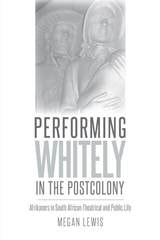
Performing Whitely in the Postcolony
Afrikaners in South African Theatrical and Public LifeMegan Lewis
University of Iowa Press, 2016
Performing Whitely examines the multiple speech acts, political acts, and theatrical acts of the Afrikaner volk or nation in theatrical and public life, including pageants, museum sites, film, and popular music as well as theatrical productions. Lewis explores the diverse ways in which Afrikaners perform whitely, and the tactics they use, including nostalgia, melodrama, queering, abjection, and kitsch. She first investigates the way that apartheid’s architects leveraged whiteness in support of their nation-building efforts in the early twentieth century. In addition to re-enacting national pilgrimages of colonial-era migrations and building massive monuments at home, Afrikaner nationalists took their show to the United States, staging critical events of the Boer War at the 1904 St. Louis Exposition. A case study of the South African experience, Performing Whitely also offers parables for global whitenesses in the postcolonial era.
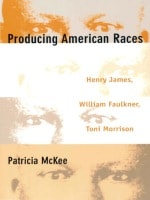
Producing American Races
Henry James, William Faulkner, Toni MorrisonPatricia McKee
Duke University Press, 1999
McKee provides close readings of six novels—James’s The Wings of the Dove and The Golden Bowl, Faulkner’s The Sound and the Fury and Light in August, and Morrison’s Sula and Jazz—interspersed with excursions into Lacanian and Freudian theory, critical race theory, epistemology, and theories of visuality. In James and Faulkner, she finds, race is represented visually through media that highlight ways of seeing and being seen. Written in the early twentieth century, the novels of James and Faulkner reveal how whiteness depended on visual culture even before film and television became its predominant media. In Morrison, the culture is aural and oral—and often about the absence of the visual. Because Morrison’s African American communities produce identity in nonvisual, even anti-visual terms, McKee argues, they refute not just white representations of black persons as objects but also visual orders of representation that have constructed whites as subjects and blacks as objects.
With a theoretical approach that both complements and transcends current scholarship about race—and especially whiteness—Producing American Races will engage scholars in American literature, critical race theory, African American studies, and cultural studies. It will also be of value to those interested in the novel as a political and aesthetic form.
The Color of Sex
Whiteness, Heterosexuality, and the Fictions of White SupremacyMason Stokes
Duke University Press, 2001
The Color of Sex reveals what happens when race and sexuality meet, when white desire encounters its own ambivalence. As Stokes argues, whiteness and heterosexuality exist in anxious relation to one another. Mutually invested in “the normal,” they support each other in their desperate insistence on the cultural logic of exclusion. At the same time, however, they threaten one another in their attempt to create and sustain a white future, since reproducing whiteness necessarily involves the risk of contamination
Charting the curious movements of this “white heterosexuality,” The Color of Sex inaugurates a new moment in our ongoing attempt to understand the frenzied interplay of race and sexuality in America. As such, it will appeal to scholars interested in race theory, sexuality studies, and American history, culture, and literature.
The White Trash Menace and Hemispheric Fiction
Ramón E. Soto-Crespo
The Ohio State University Press, 2020
Traces, Codes, and Clues
Reading Race in Crime FictionReddy, Maureen T
Rutgers University Press, 2002
Detective fiction featuring white women and people of color such as Barbara Neelys Blanche White and Walter Mosleys Easy Rawlinshas become tremendously popular. Although they are considered "light reading," mysteries also hold important cultural and social "clues." Much recent scholarly work has demonstrated that race is both a cultural fiction not a biological reality and a central organizing principle of experience. Popular writers are likely to reflect the conventions of their own historical situations.
In Traces, Codes, and Clues: Reading Race in Crime Fiction, Maureen T. Reddy explores the ways in which crime fiction manipulates cultural constructions such as race and gender to inscribe dominant cultural discourses. She notes that even those writers who appear to set out to revise outdated conventions repeatedly reproduce the genres most conservative elements. The greatest obstacle to transforming crime fiction, Reddy states, is the fact that the genre itself is deeply embedded in the discourse of white (and male) superiority. There is, therefore, an absolute necessity to break away from that discourse through reversal or other strategies in order to produce work that defies, and thus helps readers to defy, the dominant ideology of race.