Results by title
58 books match the query 'Whitman, Walt' and 3 start with a
A Democratic Enlightenment
The Reconciliation Image, Aesthetic Education, Possible PoliticsMorton Schoolman
Duke University Press, 2020
In A Democratic Enlightenment Morton Schoolman proposes aesthetic education through film as a way to redress the political violence inflicted on difference that society constructs as its racialized, gendered, Semitic, and sexualized other. Drawing on Voltaire, Diderot, and Schiller, Schoolman reconstructs the genealogical history of what he calls the reconciliation image—a visual model of a democratic ideal of reconciliation he then theorizes through Whitman's prose and poetry and Adorno's aesthetic theory. Analyzing The Help (2011) and Gentleman's Agreement (1947), Schoolman shows how film produces a more advanced image of reconciliation than those originally created by modernist artworks. Each film depicts violence toward racial and ethnic difference while also displaying a reconciliation image that aesthetically educates the public about how the violence of constructing difference as otherness can be overcome. Mounting a democratic enlightenment, the reconciliation image in film illuminates a possible politics for challenging the rise of nationalism's violence toward differences in all their diversity.
[more]
A Place for Humility
Whitman, Dickinson, and the Natural WorldChristine Gerhardt
University of Iowa Press, 2014
Emily Dickinson and Walt Whitman are widely acknowledged as two of America’s foremost nature poets, primarily due to their explorations of natural phenomena as evocative symbols for cultural developments, individual experiences, and poetry itself. Yet for all their metaphorical suggestiveness, Dickinson’s and Whitman’s poems about the natural world neither preclude nor erase nature’s relevance as an actual living environment. In their respective poetic projects, the earth matters both figuratively, as a realm of the imagination, and also as the physical ground that is profoundly affected by human action. This double perspective, and the ways in which it intersects with their formal innovations, points beyond their traditional status as curiously disparate icons of American nature poetry. That both of them not only approach nature as an important subject in its own right, but also address human-nature relationships in ethical terms, invests their work with important environmental overtones.
Dickinson and Whitman developed their environmentally suggestive poetics at roughly the same historical moment, at a time when a major shift was occurring in American culture’s view and understanding of the natural world. Just as they were achieving poetic maturity, the dominant view of wilderness was beginning to shift from obstacle or exploitable resource to an endangered treasure in need of conservation and preservation.
A Place for Humility examines Dickinson’s and Whitman’s poetry in conjunction with this important change in American environmental perception, exploring the links between their poetic projects within the context of developing nineteenth-century environmental thought. Christine Gerhardt argues that each author's poetry participates in this shift in different but related ways, and that their involvement with their culture’s growing environmental sensibilities constitutes an important connection between their disparate poetic projects. There may be few direct links between Dickinson’s “letter to the World” and Whitman’s “language experiment,” but via a web of environmentally-oriented discourses, their poetry engages in a cultural conversation about the natural world and the possibilities and limitations of writing about it—a conversation in which their thematic and formal choices meet on a surprising number of levels.
[more]
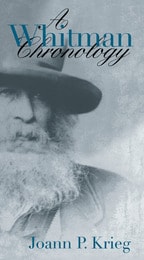
A Whitman Chronology
Joann P. Krieg
University of Iowa Press, 1998
All Whitman scholars have encountered the frustration of trying to track down an event in Whitman's life—the last time he saw Peter Doyle, when he moved to his own home on Mickle Street in Camden, when he met Oscar Wilde. The records of these events in Whitman's long life are buried in seven volumes of his abundant correspondence, in nine volumes of his conversations with Horace Traubel, in nine volumes of his notebooks and manuscripts, and in countless writings produced by his friends and admirers. To fulfill a long-felt need for order among this embarrassment of riches, Joann Krieg has crafted this detailed chronology of Whitman's life.
A Whitman Chronology clarifies the facts of Whitman's life by offering a year-by-year and, where possible, day-by-day account of his private and public life. Where conflicting interpretations exist, Krieg recognizes them and cites the differences; she also directs readers to fuller descriptions of noteworthy events. She offers brief synopses of Whitman's fiction and of his major prose works, giving distinguishing information about each of the six editions of Leaves of Grass. By intertwining the events of his life and work—but without cumbersome layers of speculation—she reveals the close alliance between Whitman's personal involvements and his literary achievements.
[more]