Results by title
2 books match the query 'Who Owns'

Love Letter To Who Owns The Heavens
Corey Van Landingham
Tupelo Press, 2021
Love Letter to Who Owns the Heavens considers the way that the absence of touch—in acts of war via the drone, in acts of love via the sext, in aesthetics itself—abstracts the human body, transforming it into a proxy for the real.
“What love poem / could be written when men can no longer / look up?” this book asks, always in a state of flux between doubt and belief—in wars, in gods, in fathers, in love. Through epistolary addresses to these figures of power and others, these poems attempt to make bodies concrete and dangerous, immediate and addressable, once again.
“What love poem / could be written when men can no longer / look up?” this book asks, always in a state of flux between doubt and belief—in wars, in gods, in fathers, in love. Through epistolary addresses to these figures of power and others, these poems attempt to make bodies concrete and dangerous, immediate and addressable, once again.
[more]
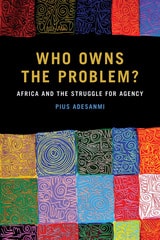
Who Owns the Problem?
Africa and the Struggle for AgencyPius Adesanmi
Michigan State University Press, 2020
How may we conceptualize Africa in the driver’s seat of her own destiny in the twenty-first century? How practically may her cultures become the foundation and driving force of her innovation, development, and growth in the age of the global knowledge economy? How may the Africanist disciplines in the humanities, the social sciences, and the natural sciences be revamped to rise up to these challenges through new imaginaries of intersectional reflection? This book assembles lectures given by Pius Adesanmi that address these questions. Adesanmi sought to create an African world of signification in which verbal artistry interpellates performer and audience in a heuristic process of knowledge production. The narrative and delivery of his arguments, the antiphonal call and response, and the aspects of Yoruba oratory and verbal resources all combine with diction and borrowings from Nigerian popular culture to create a distinct African performative mode. This mode becomes a form of resistance, specifically against the pressure to conform to Western ideals of the packaging, standardization, and delivery of knowledge. Together, these short essays preserve the
committed and passionate voice of an African writer lost far too soon. Adesanmi urges his readers to commit themselves to Africa’s cultural agency.
committed and passionate voice of an African writer lost far too soon. Adesanmi urges his readers to commit themselves to Africa’s cultural agency.
[more]