Results by title
5 books match the query 'Why It Matters'
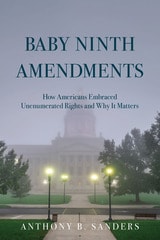
Baby Ninth Amendments
How Americans Embraced Unenumerated Rights and Why It MattersAnthony B. Sanders
University of Michigan Press, 2023
Listing every right that a constitution should protect is hard. American constitution drafters often list a few famous rights such as freedom of speech, protection against unreasonable searches and seizures, and free exercise of religion, plus a handful of others. However, we do not need to enumerate every liberty because there is another way to protect them: an "etcetera clause." It states that there are other rights beyond those specifically listed: "The enumeration in the Constitution, of certain rights, shall not be construed to deny or disparage others retained by the people." Yet scholars are divided on whether the Ninth Amendment itself actually does protect unenumerated rights, and the Supreme Court has almost entirely ignored it. Regardless of what the Ninth Amendment means, two-thirds of state constitutions have equivalent provisions, or "Baby Ninth Amendments," worded similarly to the Ninth Amendment.
This book is the story of how the "Baby Ninths" came to be and what they mean. Unlike the controversy surrounding the Ninth Amendment, the meaning of the Baby Ninths is straightforward: they protect individual rights that are not otherwise enumerated. They are an "etcetera, etcetera" at the end of a bill of rights. This book argues that state judges should do their duty and live up to their own constitutions to protect the rights "retained by the people" that these "etcetera clauses" are designed to guarantee. The fact that Americans have adopted these provisions so many times in so many states demonstrates that unenumerated rights are not only protected by state constitutions, but that they are popular. Unenumerated rights are not a weird exception to American constitutional law. They are at the center of it. We should start treating constitutions accordingly.
Baby Ninth Amendments
How Americans Embraced Unenumerated Rights and Why It MattersAnthony B. Sanders
University of Michigan Press, 2023
Listing every right that a constitution should protect is hard. American constitution drafters often list a few famous rights such as freedom of speech, protection against unreasonable searches and seizures, and free exercise of religion, plus a handful of others. However, we do not need to enumerate every liberty because there is another way to protect them: an "etcetera clause." It states that there are other rights beyond those specifically listed: "The enumeration in the Constitution, of certain rights, shall not be construed to deny or disparage others retained by the people." Yet scholars are divided on whether the Ninth Amendment itself actually does protect unenumerated rights, and the Supreme Court has almost entirely ignored it. Regardless of what the Ninth Amendment means, two-thirds of state constitutions have equivalent provisions, or "Baby Ninth Amendments," worded similarly to the Ninth Amendment.
This book is the story of how the "Baby Ninths" came to be and what they mean. Unlike the controversy surrounding the Ninth Amendment, the meaning of the Baby Ninths is straightforward: they protect individual rights that are not otherwise enumerated. They are an "etcetera, etcetera" at the end of a bill of rights. This book argues that state judges should do their duty and live up to their own constitutions to protect the rights "retained by the people" that these "etcetera clauses" are designed to guarantee. The fact that Americans have adopted these provisions so many times in so many states demonstrates that unenumerated rights are not only protected by state constitutions, but that they are popular. Unenumerated rights are not a weird exception to American constitutional law. They are at the center of it. We should start treating constitutions accordingly.
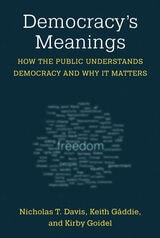
Democracy's Meanings
How the Public Understands Democracy and Why It MattersNicholas T. Davis, Keith Gåddie, and Kirby Goidel
University of Michigan Press, 2022
Democracy’s Meanings challenges conventional wisdom regarding how the public thinks about and evaluates democracy. Mining both political theory and more than 75 years of public opinion data, the book argues that Americans think about democracy in ways that go beyond voting or elected representation. Instead, citizens have rich and substantive views about the material conditions that democracy should produce, which draw from their beliefs about equality, fairness, and justice.
The authors construct a typology of views about democracy. Procedural views of democracy take a minimalistic quality. While voting and fair treatment are important to this vision of democracy, ideas about equality are mostly limited to civil liberties. In contrast, social views of democracy incorporate both civil and economic equality; according to people with these views, democracy ought to meet the basic social and material needs of citizens. Complementing these two groups are moderate and indifferent views about democracy. While moderate views sit somewhere in between procedural and social perspectives regarding the role of democracy in producing social and economic equality, indifferent views of democracy involve disaffection toward it. For a small group of apathetic citizens, democracy is an ambiguous and ill-defined concept.
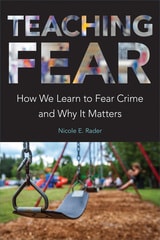
Teaching Fear
How We Learn to Fear Crime and Why It MattersNicole E. Rader
Temple University Press, 2023
Where do lessons of “stranger danger” and safety come from—and do they apply differently for women? A gender-fear paradox shows that although women are less likely to be victims of most crimes (sexual assault aside), their fear of crime is greater. Moreover, girls and women—especially White women—are taught to fear the wrong things and given impossible tools to prevent victimization. In Teaching Fear, Nicole Rader zooms in on the social learning process, tracing the ways that families, schools, and the media have become obsessed with crime myths, especially regarding girls and women.
Based on in-depth research and family studies, Rader reveals the dubious and dangerous origins of many of the most prominent safety guidelines that teach young girls to be more afraid of crime. These guidelines carry over to adulthood, influencing women’s behaviors and the way they order their worlds, with dangerous consequences. As women teach their learned behavior and conditioned fear to others, gendered crime myths are recirculated from generation to generation, making them a staple in our society.
Teaching Fear includes suggestions for taking precautionary measures and crime prevention strategies. Rader also provides guidance for instilling safety values and demonstrating how we can “teach fear better” to break this cycle and truly create greater security.
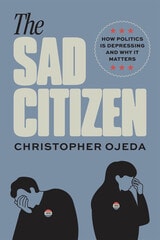
The Sad Citizen
How Politics Is Depressing and Why It MattersChristopher Ojeda
University of Chicago Press, 2025
For many citizens, politics is depressing. How has this come to be the norm? And, how is it influencing democracy?
From rising polarization to climate change, today’s politics are leaving many Western democracies in the throes of malaise. While anger, anxiety, and fear are loud emotions that powerfully activate voters, depression is quiet, demobilizing, and less visible as a result. Yet its pervasiveness is cause for concern: after all, democracy should empower citizens.
In The Sad Citizen, Christopher Ojeda draws on wide-ranging data from the United States and beyond to explain how politics is depressing, why this matters, and what we can do about it. Integrating insights from political science, sociology, psychology, and other fields, The Sad Citizen exposes the unhappy underbelly of contemporary politics and offers fresh ideas to strengthen democracy and help citizens cope with the stress of politics.