Results by title
4 books match the query 'Wildlife conservationists'
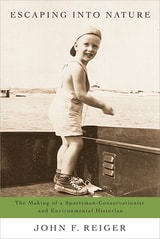
Escaping into Nature
The Making of a Sportsman-Conservationist and Environmental HistorianJohn F. Reiger
Oregon State University Press, 2013
In Escaping into Nature, prominent wildlife conservationist and environmental historian John Reiger shares his story of an angler and hunter who found a cause and a calling and combined them for his life’s work.
John Reiger’s outdoor adventures as a young man primed him for the teachings of the great sportsmen-conservationists of the past, particularly George Bird Grinnell, Theodore Roosevelt, and Aldo Leopold. Inspired by these conservation giants, Reiger left the security of a tenured professorship to serve as executive director of the Connecticut Audubon Society where he, sometimes controversially, put his ideals into practice. Later, he resumed his academic career to illuminate the lives of early wildlife conservationists, visionaries who continue to inspire us to care deeply about the future of the natural world.
Abused psychologically within his family in his early years, Reiger found solace in nature. Though he first entered the outdoors as an escape from his unpleasant circumstances, he soon found the study and pursuit of insects, fishes, and birds to be exciting ends in themselves. He came to believe that it was only by participating in the life and death of other creatures that one could learn to truly value the natural world, be a part of it, and be inspired to work for its conservation.
John Reiger’s autobiography is also the story of his own developing fascination with America’s past, especially as it relates to human interaction with the natural world; his desire to share that passion with others; and his experiences on the road to becoming a nationally recognized scholar. The twists and turns of that journey, and his accounts of the people—and of the wild creatures—who helped him along the way, will appeal to history enthusiasts and nature lovers alike.
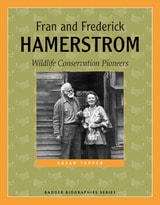
Fran and Frederick Hamerstrom
Wildlife Conservation PioneersSusan Tupper
Wisconsin Historical Society Press, 2016
Learn how Fran and Frederick Hamerstrom worked to save the greater prairie chicken from extinction in the Wisconsin Historical Society Press’s new book for young readers, "Fran and Frederick Hamerstrom: Wildlife Conservation Pioneers." Fran and Frederick grew up in New England, and married in 1935. They both loved nature and wanted to dedicate their lives to understanding and preserving wildlife. As students of the famous naturalist, Aldo Leopold, they learned about new ways for humans to think about saving land for animals. Fran was a brave, outgoing woman who cared more about interacting with animals than wearing pretty dresses. Frederick was a calm, thoughtful man who loved to study and conduct research. Together, they spent over thirty years mentoring many future scientists, and working to save the greater prairie chicken, and other animals, from extinction. "Fran and Frederick Hamerstrom: Wildlife Conservation Pioneers" is the newest addition to the Society Press’s Badger Biographies Series.
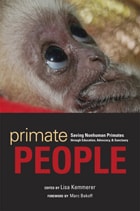
Primate People
Saving Nonhuman Primates through Education, Advocacy, and SanctuaryLisa Kemmerer
University of Utah Press, 2012
In the last 30 years the bushmeat trade has led to the slaughter of nearly 90 percent of West Africa’s bonobos, perhaps our closest relatives, and has recently driven Miss Waldron’s red colobus monkey to extinction. Earth was once rich with primates, but every species—except one—is now extinct or endangered because of one primate—Homo sapiens. How have our economic and cultural practices pushed our cousins toward destruction? Would we care more about their fate if we knew something of their individual lives and sufferings? Would we help them if we understood how our choices threaten their existence? This anthology helps to answer these questions.
The first section of Primate People introduces forces that threaten nonhuman primates, such as the entertainment and “pet” industries, the bushmeat trade, habitat destruction, and logging. The second section exposes the exploitation of primates in research facilities, including the painful memories of an undercover agent, and suggests models of more enlightened scientific methods. The final section tells the stories of those who lobby for change, educate communities, and tenderly care for our displaced cousins in sanctuaries.
Sometimes shocking and disturbing, sometimes poignant and encouraging, Primate People always draws the reader into the lives of nonhuman primates. Activists around the world reveal the antics and pleasures of monkeys, the tendencies and idiosyncrasies of chimpanzees, and the sufferings and fears of macaques. Charming, difficult, sensitive—these testimonies demonstrate that nonhuman primates and human beings are, indeed, closely related. Woven into the anthology’s lucid narratives are the stories of how we harm and create the conditions that endanger primates, and what we can and must do to prevent their ongoing suffering and fast-approaching extinction.
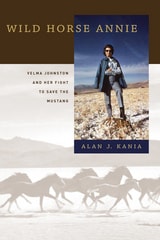
Wild Horse Annie
Velma Johnston and Her Fight to Save the MustangAlan J. Kania
University of Nevada Press, 2013
Wild horses have been a subject of bitter controversy in the West for decades. To some, they are symbols of the West’s wild, free heritage. To others, they are rapacious grazers that destroy habitat and compete with domestic livestock and indigenous wildlife for scanty food and water. For years, free-ranging horses and burros were rounded up and shipped to slaughterhouses to be killed and turned into pet food. This practice provided an income for the “mustangers” who trapped and sold them, but it also involved horrendous cruelty and abuse of the animals.
Velma Johnston, who became known as “Wild Horse Annie,” undertook to stop the removal of wild horses and burros from US public lands and protect them from the worst aspects of mustanging. Her campaign attracted nationwide attention, as it led her from her rural Nevada County to state offices and finally to Washington, DC. Author Alan J. Kania worked closely with Johnston for seven years, and his biography provides unique insight into Wild Horse Annie’s life and her efforts to save the West’s wild horse herds through the passage of protective legislation.