Results by title
3 books match the query 'Wildness'
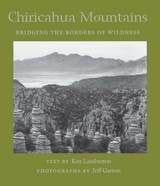
Chiricahua Mountains
Bridging the Borders of WildnessText by Ken Lamberton; Photographs by Jeff Garton
University of Arizona Press, 2003
For many, these mountains represent the Apache stronghold of Geronimo. For others, they are a birdwatcher's paradise. But the Chiricahua Mountains of southeastern Arizona are more than this. They are a classic "sky island" of the desert, a rich storehouse of biologic diversity. On a journey undertaken in search of a pair of rare short-tailed hawks, Ken Lamberton takes readers on an excursion through these mountains, from their riparian canyons to their highest peaks. The Chiricahuas comprise the largest single range in southern Arizona, crisscrossed by more than 300 miles of trails. Lamberton is your guide along these trails, and his knowledge of the mountains and their natural history makes him a perfect hiking companion while Jeff Garton's stunning photographs enrich your visit.
Lamberton shares insights about the geology, habitats, and diversity of wildlife in a place of such isolation that species must either adapt or become extinct. The Chiricahuas are one link in a chain of mountains connecting the Rockies to the Sierra Madre Occidental in Mexico, and some Madrean species reach the northernmost extension of their ranges here: birds like sulphur-bellied flycatchers, mammals like jaguarundis, and trees like the Apache pine. But this is not an untraveled wilderness. We learn why the Chiricahuas are so popular with birders, who flock to these mountains from around the world in the hopes of spotting some of the nearly four hundred avian species found here. We also learn something of the Chiricahua's rich human culture, from Apache warriors to European settlers.
Gracing the text are more than a dozen black-and-white photographs by Jeff Garton that offer views of the Chiricahuas different from those usually found in tourist brochures: landscapes and riparian settings, rock formations and plant studies that give readers a lasting impression of the beauty and tranquility of this wilderness. Together words and images convey an intimate view of one of the Southwest's most exotic locations—stronghold, paradise, and everlasting island in the vast and rolling desert.
[more]

Wildness
Jack Halberstam and Tavia Nyong'o, special issue editors
Duke University Press, 2018
The concept of wildness within queer studies has generated new vocabularies for historicizing and theorizing modes of embodiment and categories of experience that lie beyond the conventional, institutionally produced, and modern classifications used to describe and explain gender and sexual variance. Wildness can refer to profusions of plant life, to animal worlds, to crazed and unscripted human behaviors, to the unknown and the uncharted, as well as to wandering and wayward sensibilities, alternative understandings of freedom and power, and to intense moods and unstable environments. Wildness has functioned as the Other to civilization and plays a distinct role in the racialized fantasies of violence and chaos that underpin white settler colonial imaginaries. It has also named a realm of activity that lies beyond the domestic and institutional, a realm that confronts medical, legal, and governmental efforts to order, catalogue, and know various forms of life. Contributors to this issue explore the meaning, function, and challenges presented by the wild and wildness now and in the past, focusing on how wildness relates to new directions in queer studies, animal studies, and the study of embodied difference.
Contributors: Vanessa Agard-Jones, Jayna Brown, Jodi A. Byrd, Mel Y. Chen, Jack Halberstam, Saidiya Hartman, Lamonda Horton-Stallings, Zakkiyyah Jackson, Martin F. Manalansan IV, Fred Moten, José E. Muñoz, Tavia Nyong’o, Julietta Singh, Riley Snorton, Wu Tsang, Dinesh Wadiwei
Contributors: Vanessa Agard-Jones, Jayna Brown, Jodi A. Byrd, Mel Y. Chen, Jack Halberstam, Saidiya Hartman, Lamonda Horton-Stallings, Zakkiyyah Jackson, Martin F. Manalansan IV, Fred Moten, José E. Muñoz, Tavia Nyong’o, Julietta Singh, Riley Snorton, Wu Tsang, Dinesh Wadiwei
[more]
Wildness
Relations of People and PlaceEdited by Gavin Van Horn and John Hausdoerffer
University of Chicago Press, 2017
Whether referring to a place, a nonhuman animal or plant, or a state of mind, wild indicates autonomy and agency, a will to be, a unique expression of life. Yet two contrasting ideas about wild nature permeate contemporary discussions: either that nature is most wild in the absence of a defiling human presence, or that nature is completely humanized and nothing is truly wild.
This book charts a different path. Exploring how people can become attuned to the wild community of life and also contribute to the well-being of the wild places in which we live, work, and play, Wildness brings together esteemed authors from a variety of landscapes, cultures, and backgrounds to share their stories about the interdependence of everyday human lifeways and wildness. As they show, far from being an all or nothing proposition, wildness exists in variations and degrees that range from cultivated soils to multigenerational forests to sunflowers pushing through cracks in a city alley. Spanning diverse geographies, these essays celebrate the continuum of wildness, revealing the many ways in which human communities can nurture, adapt to, and thrive alongside their wild nonhuman kin.
From the contoured lands of Wisconsin’s Driftless region to remote Alaska, from the amazing adaptations of animals and plants living in the concrete jungle to indigenous lands and harvest ceremonies, from backyards to reclaimed urban industrial sites, from microcosms to bioregions and atmospheres, manifestations of wildness are everywhere. With this book, we gain insight into what wildness is and could be, as well as how it might be recovered in our lives—and with it, how we might unearth a more profound, wilder understanding of what it means to be human.
Wildness: Relations of People and Place is published in association with the Center for Humans and Nature, an organization that brings together some of the brightest minds to explore and promote human responsibilities to each other and the whole community of life. Visit the Center for Humans and Nature's Wildness website for upcoming events and a series of related short films.
[more]