Results by title
4 books match the query 'Williams, Michael'

Call Me by Your Name
Perspectives on the FilmEdited by Edward Lamberti and Michael Williams
Intellect Books, 2026
This edited collection explores how Luca Guadagnino’s film Call Me by Your Name speaks powerfully to questions of contemporary sexual identity and romance.
Adapted by James Ivory from André Aciman’s novel and directed by Luca Guadagnino, the film Call Me by Your Name has been passionately received among audiences and critics ever since its 2017 release. A love story between seventeen-year-old Elio (Timothée Chalamet) and graduate student Oliver (Armie Hammer) set in 1983 “somewhere in northern Italy,” Call Me by Your Name presents a gay relationship in a romantic idyll seemingly untroubled by outside pressures, prejudices, or tragedy.
While this means it offers audiences welcome opportunities to swoon in front of an LGBTQ+ romance that equals classic heterosexual romances onscreen, its relevance or political significance today may not be immediately apparent. This edited collection points out the ways in which the film is abundantly infused with narrative, thematic, and stylistic elements that can be interpreted as speaking powerfully to contemporary audiences on questions of sexual identity. How does this love story explore wider tensions that exist between the specific and the general, between the open and the hidden, and between the past and the present? The contributors to this collection provide stimulating and contemplative responses to this question.

Communism, Religion, and Revolt in Banten in the Early Twentieth Century
Mis Sea#86Michael Williams
Ohio University Press, 1990
Twice in this century popular revolts against colonial rule have occured in the Banten district of West Java. These revolts, conducted largely under an Islamic leadership, also proclaimed themselves Communist. Islamic Communism is seemingly a paradox. This is especially the case when one considers that probably no religion has proved more resistant to Communist ideology than Islam.
Michael Williams here details the complicated history of the Bantenese revolts in the twentieth century and probes the ideological riddle of Islamic Communism. Modern history is replete with examples of regions with a long history of organizing themselves politically to resist intrusion on their territory, resources, and people. This book establishes that in Indonesia, the Bantenese were among the most practiced exponents of resistance.
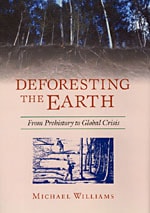
Deforesting the Earth
From Prehistory to Global CrisisMichael Williams
University of Chicago Press, 2002
Michael Williams surveys ten thousand years of history to trace how, why, and when human-induced deforestation has shaped economies, societies, and landscapes around the world. Beginning with the return of the forests to Europe, North America, and the tropics after the Ice Ages, Williams traces the impact of human-set fires for gathering and hunting, land clearing for agriculture, and other activities from the Paleolithic through the classical world and the Middle Ages. He then continues the story from the 1500s to the early 1900s, focusing on forest clearing both within Europe and by European imperialists and industrialists abroad, in such places as the New World and India, China, Japan, and Latin America. Finally, he covers the present-day and alarming escalation of deforestation, with the ever-increasing human population placing a possibly unsupportable burden on the world's forests.
Accessible and nonsensationalist, Deforesting the Earth provides the historical and geographical background we need for a deeper understanding of deforestation's tremendous impact on the environment and the people who inhabit it.
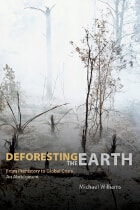
Deforesting the Earth
From Prehistory to Global Crisis, An AbridgmentMichael Williams
University of Chicago Press, 2006
Published in 2002, Deforesting the Earth was a landmark study of the history and geography of deforestation. Now available as an abridgment, this edition retains the breadth of the original while rendering its arguments accessible to a general readership.
Deforestation—the thinning, changing, and wholesale clearing of forests for fuel, shelter, and agriculture—is among the most important ways humans have transformed the environment. Surveying ten thousand years to trace human-induced deforestation’s effect on economies, societies, and landscapes around the world, Deforesting the Earth is the preeminent history of this process and its consequences.
Beginning with the return of the forests after the ice age to Europe, North America, and the tropics, Michael Williams traces the impact of human-set fires for gathering and hunting, land clearing for agriculture, and other activities from the Paleolithic age through the classical world and the medieval period. He then focuses on forest clearing both within Europe and by European imperialists and industrialists abroad, from the 1500s to the early 1900s, in such places as the New World, India, and Latin America, and considers indigenous clearing in India, China, and Japan. Finally, he covers the current alarming escalation of deforestation, with our ever-increasing human population placing a potentially unsupportable burden on the world’s forests.