Results by title
7 books match the query 'Williams, Tennessee'
Blue Roses
Tennessee Williams, Memory, and the Queer ArchiveDaniel Ciba
University of Iowa Press, 2026
Blue Song
St. Louis in the Life and Work of Tennessee WilliamsHenry I. Schvey
University of Missouri Press, 2022
The question of this paradox lies at the heart of this book, an attempt not so much to correct the record about Williams’s well-chronicled dislike of the city, but rather to reveal how the city was absolutely indispensable to his formation and development both as a person and artist. Unlike the prevailing scholarly narrative that suggests that Williams discovered himself artistically and sexually in the deep South and New Orleans, Blue Song reveals that Williams remained emotionally tethered to St. Louis for a host of reasons for the rest of his life.

Dramatizing Dementia
Madness In The Plays Of Tennessee WilliamsJacqueline O'Connor
University of Wisconsin Press, 1997
Early Stories by Tennessee Williams
Tennessee Williams
University of Iowa Press, 2025
In notes for each story, additional context is provided regarding locations, occupations, and individuals. All of this enriches a critical understanding of Tennessee Williams’s major works such as The Glass Menagerie, A Streetcar Named Desire, Cat on a Hot Tin Roof, Night of the Iguana, and Suddenly Last Summer.
Hollywood's Tennessee
The Williams Films and Postwar AmericaBy R. Barton Palmer and William Robert Bray
University of Texas Press, 2009
No American dramatist has had more plays adapted than Tennessee Williams, and few modern dramatists have witnessed as much controversy during the adaptation process. His Hollywood legacy, captured in such screen adaptations as A Streetcar Named Desire, Cat on a Hot Tin Roof, and Suddenly, Last Summer, reflects the sea change in American culture in the mid-twentieth century. Placing this body of work within relevant contexts ranging from gender and sexuality to censorship, modernism, art cinema, and the Southern Renaissance, Hollywood's Tennessee draws on rarely examined archival research to recast Williams's significance.
Providing not only cultural context, the authors also bring to light the details of the arduous screenwriting process Williams experienced, with special emphasis on the Production Code Administration—the powerful censorship office that drew high-profile criticism during the 1950s—and Williams's innovative efforts to bend the code. Going well beyond the scripts themselves, Hollywood's Tennessee showcases findings culled from poster and billboard art, pressbooks, and other production and advertising material. The result is a sweeping account of how Williams's adapted plays were crafted, marketed, and received, as well as the lasting implications of this history for commercial filmmakers and their audiences.
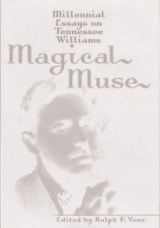
Magical Muse
Millennial Essays on Tennessee WilliamsEdited by Ralph F. Voss
University of Alabama Press, 2002
Like Faulkner before him, Tennessee Williams gave universal appeal to southern characters and settings. His major plays, from Cat on a Hot Tin Roof and The Glass Menagerie to A Streetcar Named Desire and Night of the Iguana, continue to capture America's popular imagination, a significant legacy. Though he died in 1983, only recently have Williams's papers become available to the public, bringing to light a number of intriguing discoveries—letters, drafts, and several unpublished and unproduced plays. These recent developments make a reassessment of Williams's life and work both timely and needed.
The essays in this collection originated as presentations at the 27th annual Alabama Symposium on English and American Literature at The University of Alabama in 1999. The book addresses a wide range of topics, among them the influence of popular culture on Williams's plays, and, in turn, his influence on popular culture; his relationship to Hollywood and his struggles with censorship, Hollywood standards, and the competing vision of directors such as Elia Kazan; his depictions of gender and sexuality; and issues raised by recently discovered plays.
Anyone interested in American literature and drama will find this collection of fresh, accessible essays a rewarding perspective on the life, work, and legacy of one of the bright stars of American theatre.
Mimetic Disillusion
Eugene O'Neill, Tennessee Williams, and U.S. Dramatic RealismAnne Fleche
University of Alabama Press, 1997
Reimagining American dramatic realism through the lenses of mimesis, theory, and theatrical innovation.
This volume focuses on two major writers of the 1930s and 1940s—Eugene O'Neill and Tennessee Williams—one whose writing career was just ending and the other whose career was just beginning. In new readings of their major works from this period, Long Day's Journey into Night, The Iceman Cometh, The Glass Menagerie, and A Streetcar Named Desire, Fleche develops connections to the writings of Jacques Derrida, Paul de Man, and Michel Foucault, among others, and discusses poststructuralism in the light of modern writers such as Bertolt Brecht, Antonin Artaud, and Walter Benjamin. Fleche also extends this discussion to the work of two contemporary playwrights, Adrienne Kennedy and Tony Kushner. The aim of Mimetic Disillusion is not to reject "mimetic" and "realistic" readings but to explore the rich complexities of these two ideas and the fruit of their ongoing relevance to U.S. theatre.