Results by title
3 books match the query 'Wilson, Edward O.'
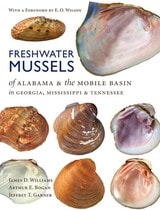
Freshwater Mussels of Alabama and the Mobile Basin in Georgia, Mississippi, and Tennessee
James D. Williams
University of Alabama Press, 2008
The authors offer encyclopedic entries on each of the 178 mussel species currently identified in Alabama and the Mobile River Basin—the scientific and common names; a morphological description as well as color photographs of the shell appearance; analysis of the soft anatomy; information about ecology, biology, and conservation status; and a color distribution map. With an extensive glossary of terms and full index, plus additional material on the archaeological record, a history of commercial uses of mussels, and the work of significant biologists studying these species, this volume is a long overdue and invaluable resource, not only for scholars of aquatic biology and zoology but also conservationists interested in the preservation of ecological diversity and protection of inland environments.

Shaping Science with Rhetoric
The Cases of Dobzhansky, Schrodinger, and WilsonLeah Ceccarelli
University of Chicago Press, 2001
In Shaping Science with Rhetoric, Leah Ceccarelli addresses such questions through close readings of three scientific monographs in their historical contexts—Theodosius Dobzhansky's Genetics and the Origin of Species (1937), which inspired the "modern synthesis" of evolutionary biology; Erwin Schrödinger's What Is Life? (1944), which catalyzed the field of molecular biology; and Edward O. Wilson's Consilience (1998), a so far not entirely successful attempt to unite the social and biological sciences. She examines the rhetorical strategies used in each book and evaluates which worked best, based on the reviews and scientific papers that followed in their wake.
Ceccarelli's work will be important for anyone interested in how interdisciplinary fields are formed, from historians and rhetoricians of science to scientists themselves.
Southern Wonder
Alabama's Surprising BiodiversityR. Scot Duncan
University of Alabama Press, 2013
WINNER, REED AWARD FOR ENVIRONMENTAL WRITING GIVEN BY THE SOUTHERN ENVIRONMENTAL LAW CENTER
Southern Wonder explores Alabama’s amazing biological diversity, the reasons for the large number of species in the state, and the importance of their preservation.
Alabama ranks fifth in the nation in number of species of plants and animals found in the state, surpassed only by the much larger western states of California,Texas, Arizona, and New Mexico. When all the species of birds, trees, mammals, reptiles, amphibians, fishes, wildflowers, dragonflies, tiger beetles, and ants are tallied, Alabama harbors more species than 90 percent of the other states in the United States. Alabamais particularly rich in aquatic biodiversity, leading the nation in species of freshwater fishes, turtles, mussels, crayfish, snails, damselflies, and carnivorous plants. The state also hosts an exceptional number of endemic species—those not found beyond its borders—ranking seventh in the nation with 144 species. The state’s 4,533 species, with more being inventoried and discovered each year, are supported by no less than 64 distinct ecological systems—each a unique blend of soil, water, sunlight, heat, and natural disturbance regimes. Habitats include dry forests, moist forests, swamp forests, sunny prairies, grassy barrens, scorching glades, rolling dunes, and bogs filled with pitcher plants and sundews. The state also includes a region of subterranean ecosystems that are more elaborate and species rich than any other place on the continent.
Although Alabama is teeming with life, the state’s prominence as a refuge for plants and animals is poorly appreciated. Even among Alabama’s citizens, few outside a small circle of biologists, advocates, and other naturalists understand the special quality of the state’s natural heritage. R. Scot Duncan rectifies this situation in Southern Wonder by providing a well-written, comprehensive overview that the general public, policy makers, and teachers can understand and use. Readers are taken on an exploratory journey of the state’s varied landscapes—from the Tennessee River Valley to the coastal dunes—and are introduced to remarkable species, such as the cave salamander and the beach mouse. By interweaving the disciplines of ecology, evolution, meteorology, and geology into an accessible whole, Duncan explains clearly why Alabama is so biotically rich and champions efforts for its careful preservation.
Published in Cooperation with The Nature Conservancy