Results by title

4 books match the query 'Wilson, Elizabeth A.'
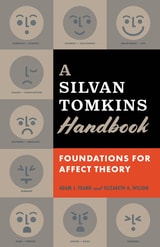
cover of A Silvan Tomkins Handbook: Foundations for Affect Theory

A Silvan Tomkins Handbook

Foundations for Affect Theory

Adam J. Frank

University of Minnesota Press, 2020

An accessible guide to the work of American psychologist and affect theorist Silvan Tomkins


The brilliant and complex theories of psychologist Silvan Tomkins (1911–1991) have inspired the turn to affect in the humanities, social sciences, and elsewhere. Nevertheless, these theories are not well understood. A Silvan Tomkins Handbook makes his theories portable across a range of interdisciplinary contexts and accessible to a wide variety of contemporary scholars and students of affect. 

A Silvan Tomkins Handbook provides readers with a clear outline of Tomkins’s affect theory as he developed it in his four-volume masterwork Affect Imagery Consciousness. It shows how his key terms and conceptual innovations can be used to build robust frameworks for theorizing affect and emotion. In addition to clarifying his affect theory, the Handbook emphasizes Tomkins’s other significant contributions, from his broad theories of imagery and consciousness to more focused concepts of scenes and scripts. With their extensive experience engaging and teaching Tomkins’s work, Adam J. Frank and Elizabeth A. Wilson provide a user-friendly guide for readers who want to know more about the foundations of affect studies.

[more]
cover of Gut Feminism

Gut Feminism

Elizabeth A. Wilson

Duke University Press, 2015

In Gut Feminism Elizabeth A. Wilson urges feminists to rethink their resistance to biological and pharmaceutical data. Turning her attention to the gut and depression, she asks what conceptual and methodological innovations become possible when feminist theory isn’t so instinctively antibiological. She examines research on anti-depressants, placebos, transference, phantasy, eating disorders and suicidality with two goals in mind: to show how pharmaceutical data can be useful for feminist theory, and to address the necessary role of aggression in feminist politics. Gut Feminism’s provocative challenge to feminist theory is that it would be more powerful if it could attend to biological data and tolerate its own capacity for harm.
[more]
cover of Psychosomatic: Feminism and the Neurological Body

Psychosomatic

Feminism and the Neurological Body

Elizabeth A. Wilson

Duke University Press, 2004
How can scientific theories contribute to contemporary accounts of embodiment in the humanities and social sciences? In particular, how does neuroscientific research facilitate new approaches to theories of mind and body? Feminists have frequently criticized the neurosciences for biological reductionism, yet, Elizabeth A. Wilson argues, neurological theories—especially certain accounts of depression, sexuality, and emotion—are useful to feminist theories of the body. Rather than pointing toward the conventionalizing tendencies of the neurosciences, Wilson emphasizes their capacity for reinvention and transformation. Focusing on the details of neuronal connections, subcortical pathways, and reflex actions, she suggests that the central and peripheral nervous systems are powerfully allied with sexuality, the affects, emotional states, cognitive appetites, and other organs and bodies in ways not fully appreciated in the feminist literature. Whether reflecting on Simon LeVay’s hypothesis about the brains of gay men, Peter Kramer’s model of depression, or Charles Darwin’s account of trembling and blushing, Wilson is able to show how the neurosciences can be used to reinvigorate feminist theories of the body.
[more]
cover of Queer Theory without Antinormativity

Queer Theory without Antinormativity

Robyn Wiegman and Elizabeth A. Wilson, special issue editors

Duke University Press, 0

The tyrannies of sexual normativity have been widely denounced in queer theory. Heteronormativity, homonormativity, family values, marriage, and monogamy have all been objects of sustained queer critique, most often in purely oppositional form: as antinormativity. The contributors to this special issue ask a seemingly simple question of this critical code: can queer theory proceed without a primary allegiance to antinormativity? These essays offer an affirmative answer either by rethinking normativity or eschewing it altogether in order to redirect the intellectual and political energies of the field. 
[more]