Results by title
5 books match the query 'Wilson, Rob'
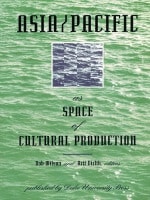
Asia/Pacific as Space of Cultural Production
Rob Wilson and Arif Dirlik, eds.
Duke University Press, 1995
From New Zealand to Japan, Taiwan to Hawaii, this innovative volume presents essays, poems, and memoirs by prominent Asia/Pacific writers that resist appropriation by transnational capitalism through the articulation of autonomous local identities and counter-histories of place and community. In addition, cultural critics spanning several locations and disciplines deconstruct representations—particularly those on film and in novels—that perpetuate Asia/Pacific as a realm of EuroAmerican fantasy.
This collection, a much expanded edition of boundary 2, offers a new perception of the Asia/Pacific region by presenting the Pacific not as a paradise or vast emptiness, but as a place where living, struggling peoples have constructed contemporary identities out of a long history of hegemony and resistance. Asia/Pacific as Space of Cultural Production will prove stimulating to readers with an interest in the Asia/Pacific region, and to scholars in the fields of Asian, American, Pacific, postcolonial, and cultural studies.
Contributors. Joseph P. Balaz, Chris Bongie, William A. Callahan, Thomas Carmichael, Leo Ching, Chiu Yen Liang (Fred), Chungmoo Choi, Christopher L. Connery, Arif Dirlik, John Fielder, Miriam Fuchs, Epeli Hau`ofa, Lawson Fusao Inada, M. Consuelo León W., Katharyne Mitchell, Masao Miyoshi, Steve Olive, Theophil Saret Reuney, Peter Schwenger, Subramani, Terese Svoboda, Jeffrey Tobin, Haunani-Kay Trask, John Whittier Treat, Tsushima Yuko, Albert Wendt, Rob Wilson
Critique and Cosmos
After Misao MiyoshiRob Wilson and Paul A. Bové, special issue editors
Duke University Press, 0
Contributors. Tsering Wangmo Dhompa, Arif Dirlik, Harry Harootunian, Reginald Jackson, Mary Layoun, Christine L. Marran, George Solt, Keijiro Suga, Stefan Tanaka, Chih-ming Wang, Rob Wilson
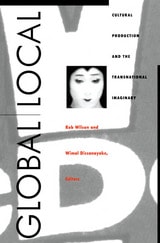
Global/Local
Cultural Production and the Transnational ImaginaryRob Wilson and Wimal Dissanayake, eds.
Duke University Press, 1996
Ranging across issues involving film, literature, and theory, as well as history, politics, economics, sociology, and anthropology, these deeply interdisciplinary essays explore the interwoven forces of globalism and localism in a variety of cultural settings, with a particular emphasis on the Asia-Pacific region. Powerful readings of the new image culture, transnational film genre, and the politics of spectacle are offered as is a critique of globalization as the latest guise of colonization. Articles that unravel the complex links between the global and local in terms of the unfolding narrative of capital are joined by work that illuminates phenomena as diverse as "yellow cab" interracial sex in Japan, machinic desire in Robocop movies, and the Pacific Rim city. An interview with Fredric Jameson by Paik Nak-Chung on globalization and Pacific Rim responses is also featured, as is a critical afterword by Paul Bové.
Positioned at the crossroads of an altered global terrain, this volume, the first of its kind, analyzes the evolving transnational imaginary—the full scope of contemporary cultural production by which national identities of political allegiance and economic regulation are being undone, and in which imagined communities are being reshaped at both the global and local levels of everyday existence.
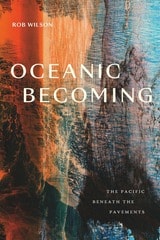
Oceanic Becoming
The Pacific beneath the PavementsRob Wilson
Duke University Press, 2025
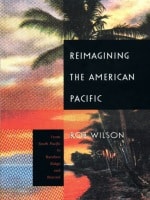
Reimagining the American Pacific
From South Pacific to Bamboo Ridge and BeyondRob Wilson
Duke University Press, 2000
Wilson begins by tracing the arrival of American commerce and culture in the Pacific through missionary and imperial forces in the nineteenth century and the parallel development of Asia/Pacific as an idea. Using an impressive range of texts—from works by Herman Melville, James Michener, Maori and Western Samoan novelists, and Bamboo Ridge poets to Baywatch, films and musicals such as South Pacific and Blue Hawaii, and native Hawaiian shark god poetry—Wilson illustrates what it means for a space to be “regionalized.” Claiming that such places become more open to transnational flows of information, labor, finance, media, and global commodities, he explains how they then become isolated, their borders simultaneously crossed and fixed. In the case of Hawai’i, Wilson argues that culturally innovative, risky forms of symbol making and a broader—more global—vision of local plight are needed to counterbalance the racism and increasing imbalance of cultural capital and goods in the emerging postplantation and tourist-centered economy.
Reimagining the American Pacific leaves the reader with a new understanding of the complex interactions of global and local economies and cultures in a region that, since the 1970s, has been a leading trading partner of the United States. It is an engaging and provocative contribution to the fields of Asian and American studies, as well as those of cultural studies and theory, literary criticism, and popular culture.