Results by title
14 books match the query 'Witness'

A Witness to the Silent Church
Memoirs of Ukrainian Cardinal Josyf SlipyjJosef Slipyj
Catholic University of America Press, 2025
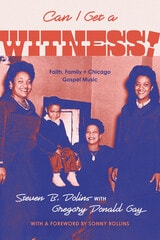
Can I Get a Witness!
Faith, Family, and Chicago Gospel MusicSteven B. Dolins with Gregory Donald Gay
University of Chicago Press, 2026
The remarkable story of pastor Donald Gay and his family’s lasting contributions to gospel music and Chicago culture.
When the preacher Gregory Donald Gay joined his sisters onstage at Carnegie Hall in 1950, on a sold-out bill they shared with Mahalia Jackson and the Clara Ward Singers, he became a participant in a landmark moment: the first concert in the venue to feature entirely gospel music. He was just five years old.
The Gay Sisters—Evelyn, Geraldine, and Mildred—were key figures in gospel’s Golden Age, and their youngest brother had a front-row seat. Evelyn and Geraldine each innovated singular approaches to gospel piano, while Mildred sang. Together, they toured and performed on a series of influential gospel recordings from 1948 to 1973, playing the Apollo Theatre and crossing paths with musical luminaries like Sister Rosetta Tharpe, Sam Cooke, Pops Staples, and Dizzy Gillespie. But despite a hit record and prodigious talent, the Gay Sisters faded from the limelight. In the ensuing years, they weathered personal trials while their mother, Fannie, devoted her attention to another family undertaking: starting a church.
Can I Get a Witness! is a call-and-response between Steven B. Dolins, founder of The Sirens Records, and Donald Gay, who vividly describes his boyhood in Chicago’s Woodlawn neighborhood, his family’s remarkable place in gospel history, his mother’s work as a faith leader, and his own calling as a pastor. The book spotlights the rich contributions of a family remembered not only for the songs they recorded but also for their unwavering kindness to others, a legacy that the legendary Sonny Rollins recounts in a moving foreword.

Creating the Witness
Documenting Genocide on Film, Video, and the InternetLeshu Torchin
University of Minnesota Press, 2012
Since the beginning of the conflict in 2003, more than 300,000 lives have been lost in Darfur. Players of the video game Darfur Is Dying learn this sobering fact and more as they work to ensure the survival of a virtual refugee camp. The video game not only puts players in the position of a struggling refugee, it shows them how they can take action in the real world.
Creating the Witness examines the role of film and the Internet in creating virtual witnesses to genocide over the last one hundred years. The book asks, how do visual media work to produce witnesses—audiences who are drawn into action? The argument is a detailed critique of the notion that there is a seamless trajectory from observing an atrocity to acting in order to intervene. According to Leshu Torchin, it is not enough to have a camera; images of genocide require an ideological framework to reinforce the messages the images are meant to convey. Torchin presents wide-ranging examples of witnessing and genocide, including the Armenian genocide, the Holocaust (engaging film as witness in the context of the Nuremburg trials), and the international human rights organization WITNESS and its sustained efforts to use video to publicize human rights advocacy and compel action.
From a historical and comparative approach, Torchin’s broad survey of media and the social practices around it investigates the development of popular understandings of genocide to achieve recognition and response—both political and judicial—ultimately calling on viewers to act on behalf of human rights.

Invited to Witness
Solidarity Tourism across Occupied PalestineJennifer Lynn Kelly
Duke University Press, 2023
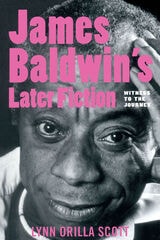
James Baldwin's Later Fiction
Witness to the JourneyLynn O. Scott
Michigan State University Press, 2002
James Baldwin’s Later Fiction examines the decline of Baldwin’s reputation after the middle 1960s, his tepid reception in mainstream and academic venues, and the ways in which critics have often mis-represented and undervalued his work. Scott develops readings of Tell Me How Long the Train’s Been Gone, If Beale Street Could Talk, and Just Above My Head that explore the interconnected themes in Baldwin’s work: the role of the family in sustaining the arts, the price of success in American society, and the struggle of black artists to change the ways that race, sex, and masculinity are represented in American culture.
Scott argues that Baldwin’s later writing crosses the cultural divide between the 1950s and 1960s in response to the civil rights and black power movements. Baldwin’s earlier works, his political activism and sexual politics, and traditions of African American autobiography and fiction all play prominent roles in Scott’s analysis.
St. Austin Review, The Witness and Wisdom of C. S. Lewis, May/June 2019, Vol. 19, No. 3
Joseph Pearce
St. Augustine's Press, 2019
The Force of Witness
Contra FeminicideRosa-Linda Fregoso
Duke University Press, 2023
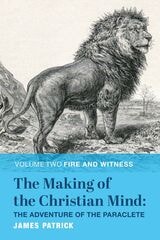
The Making of the Christian Mind
The Adventure of the Paraclete: Volume II: Fire and WitnessJames Patrick
St. Augustine's Press, 2021
The second installment presents the parallel struggle to build heart and mind, as heresy and temporal demands challenge the memory and vitality of what Christians have received. The writing mind in this sense sustains and gives purpose to the heart, pressed under the burden of doubt and worldly expectation. The reader knows that Christianity endures, but how did this happen? Patrick at every turn discloses the role of the Paraclete who remains the unseen protagonist. In this sense, Patrick surprises even those who think they know the story, and no one is safe from being exposed to a bit of the same inspiration that moves the characters in history passed. Indeed, the reader will feel like a part of this same narrative, in a new unwritten chapter but encountering the same Paraclete who has meddled in and marked events with holy breath that even Patrick cannot fully represent.
Highlights of Fire and Witness are Patrick’s presentation of pivotal yet forgotten works such as The Shepherd of Hermes, and his treatment of Origen and Athanasius in their respective social and spiritual contexts. This volume grants the reader a glimpse into a time when resolutions needed to be made and defended with argument, but also with silent witness and the flame of a resolve dimmed not even by death. Patrick’s description of imperial Christianity and the Christian imagination that ultimately fashions the proper image of Christian places is likewise stunning and not to be missed.
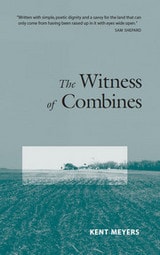
Witness Of Combines
Kent Meyers
University of Minnesota Press, 1998

Witness and Existence
Essays in Honor of Schubert M. OgdenEdited by Philip E. Devenish and George L. Goodwin
University of Chicago Press, 1989
Witness and Existence pays tribute to Ogden by bringing together essays by eminent scholars in New Testament studies and philosophical theology, two fields which directly reflect his methodological concerns and his substantive contributions. The book honors Ogden precisely by engaging the fundamental issues which Ogden himself has taken so seriously.
The first group of essays presents careful analyses of issues basic to the early Christian witness; the second group examines the credibility of the Christian claim about God in terms of human experience. The editors' introductory essay provides the first comprehensive analysis yet to appear of Ogden's theology. A complete bibliography of his published writings is included as an appendix.
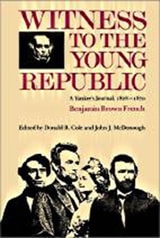
Witness to the Young Republic
A Yankee’s Journal, 1828–1870Benjamin Brown. French
University Press of New England, 2002
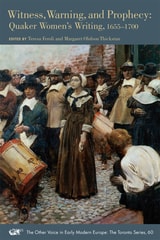
Witness, Warning, and Prophecy
Quaker Women's Writing, 1655-1700Edited by Teresa Feroli and Margaret Olofson Thickstun
Iter Press, 2018
The Other Voice in Early Modern Europe - The Toronto Series: Volume 60
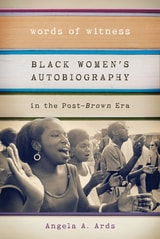
Words of Witness
Black Women's Autobiography in the Post-<i>Brown</i> EraAngela A. Ards
University of Wisconsin Press, 2015
Exploring works by the critically acclaimed June Jordan and Edwidge Danticat, as well as by popular and emerging authors such as Melba Beals, Rosemary Bray, and Eisa Davis, Ards demonstrates how each text asserts countermemories to official—and often nostalgic—understandings of the civil rights and Black Power movements. She situates each writer as activist-citizen, adopting and remaking particular roles—warrior, “the least of these,” immigrant, hip-hop head—to crystallize a range of black feminist responses to urgent but unresolved political issues.
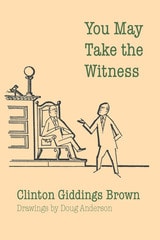
You May Take the Witness
By Clinton Giddings Brown
University of Texas Press, 1955
When Clinton Giddings Brown (1882–1964) retired from a long and successful career as a trial lawyer in San Antonio, Texas, fishing on the Gulf Coast was out—by doctor’s orders. So he sat on the front gallery of his house in San Antonio and fished with a lead pencil in the richly stocked memories of his professional life. “Some days I didn’t get a nibble, but some mornings they were biting fine.”
The resultant and delightful catch is the story of a full, merry, and successful life. From the day in 1906 when “Mr. Clint” hung out his shingle in a little office over his father’s bank, through the long succession of “fine scraps, rough and tumble, no holds barred,” which were the jury cases he tried for defendant corporations in personal-injury damage suits, there was not much about the law and about human nature that he did not have the opportunity to learn.
The first client in the little office was Charlie Ross, a Pullman porter who wanted to make sure that the title on his new house was clear. The fee was $15, and Charlie was his friend for life. In the pages that follow the reader will meet many other unforgettable characters, including Dr. John Brinkley, the man who made a million dollars a year from his goat-gland operation until Dr. Morris Fishbein called him a “quack”; old Jim Wheat, who killed a white man, and Jim’s little grandson Lige, who knew what God would do to him if he told lies in court; Bosco, who forgot his complete paralysis when the lady lure came into the picture; and pretty little Mary, whom the jury loved.
Brown was elected district attorney for Bexar County, Texas, in 1913 and became mayor of San Antonio the following year; in the latter office he served two terms, resigning to join the Army in the First World War. On his return from France he was invited to work with a law firm that represented many large corporations, among them the Public Service Company, which ran San Antonio’s streetcar and bus lines, and the Southern Pacific Railroad. Soon made a partner, he remained with the firm until his retirement, and through a quarter of a century tried about as many jury cases as any other attorney in the city.
You May Take the Witness is a book for anyone who has ever felt the fascination of courtrooms and trials, and who has not? It is also a book in which lawyers will find an excellent refresher course for both mind and spirit. Here are invaluable tips on all the ins-and-outs of jury trial, not from the flat dimensions of a law-school text but from the full, real world of actual trials and the men and women involved. Brown tells how to handle witnesses and to pick juries, when to object and when not to object. The most important lesson of all, he says, is to value the jury and be an honest person before them. “The jury is decent, so you be decent, and ‘be yourself.’”
It is clear that Clinton Giddings Brown succeeded as a lawyer because he succeeded as a human being, just as it is clear that he knows how to tell story after fine story because he enjoyed living each episode of his life to its fullest.