Results by title
11 books match the query 'Wittgenstein'

Aquinas, Wittgenstein, and the Riddle of Spiritual Pedagogy
Matthew Dunch
Catholic University of America Press, 2027
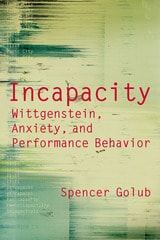
Incapacity
Wittgenstein, Anxiety, and Performance BehaviorSpencer Golub
Northwestern University Press, 2014
In this highly original study of the nature of performance, Spencer Golub uses the insights of Ludwig Wittgenstein into the way language works to analyze the relationship between the linguistic and the visual in the work of a broad range of dramatists, novelists, and filmmakers, among them Richard Foreman, Mac Wellman, Peter Handke, David Mamet, and Alfred Hitchcock. Like Wittgenstein, these artists are concerned with the limits of language’s representational capacity. For Golub, it is these limits that give Wittgenstein’s thought a further, very personal significance—its therapeutic quality with respect to the Obsessive Compulsive Disorder from which he suffers.
Underlying what Golub calls “performance behavior” is Wittgenstein’s notion of “pain behavior”—that which gives public expression to private experience. Golub charts new directions for exploring the relationship between theater and philosophy, and even for scholarly criticism itself.
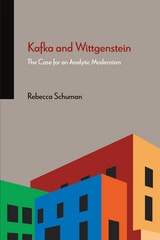
Kafka and Wittgenstein
The Case for an Analytic ModernismRebecca Schuman
Northwestern University Press, 2015
In Kafka and Wittgenstein, Rebecca Schuman undertakes the first ever book-length scholarly examination of Ludwig Wittgenstein’s philosophy of language alongside Franz Kafka’s prose fiction. In groundbreaking readings, she argues that although many readers of Kafka are searching for what his texts mean, in this search we are sorely mistaken. Instead, the problems and illusions we portend to uncover, the im-portant questions we attempt to answer—Is Josef K. guilty? If so, of what? What does Gregor Samsa’s transformed body mean? Is Land-Surveyor K. a real land surveyor?— themselves presuppose a bigger delusion: that such questions can be asked in the first place. Drawing deeply on the entire range of Wittgenstein’s writings, Schuman can-nily sheds new light on the enigmatic Kafka.
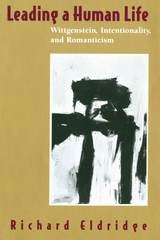
Leading a Human Life
Wittgenstein, Intentionality, and RomanticismRichard Eldridge
University of Chicago Press, 1997
Eldridge sees Wittgenstein as a Romantic protagonist, engaged in an ongoing internal dialogue over the nature of intentional consciousness, ranging over ethics, aesthetics, and philosophy of mind. The picture of the human mind that emerges through this dialogue unsettles behaviorism, cognitivism, and all other scientifically oriented orthodoxies. Leading a human life becomes a creative act, akin to writing a poem, of continuously seeking to overcome both complacency and skepticism. Eldridge's careful reconstruction of the central motive of Wittgenstein's work will influence all subsequent scholarship on it.
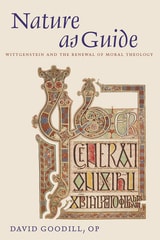
Nature as Guide
Wittgenstein and the Renewal of Moral TheologyDavid Goodill, OP
Catholic University of America Press, 2022
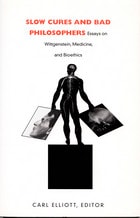
Slow Cures and Bad Philosophers
Essays on Wittgenstein, Medicine, and BioethicsCarl Elliott, ed.
Duke University Press, 2001
As Elliott explains in his introduction, Wittgenstein’s philosophy runs against the grain of most contemporary bioethics scholarship, which all too often ignores the context in which moral problems are situated and pays little attention to narrative, ethnography, and clinical case studies in rendering bioethical judgments. Such anonymous, impersonal, rule-writing directives in which health care workers are advised how to behave is what this volume intends to counteract. Instead, contributors stress the value of focusing on the concrete particulars of moral problems and write in the spirit of Wittgenstein’s belief that philosophy should be useful. Specific topics include the concept of “good dying,” the nature of clinical decision making, the treatment of neurologically damaged patients, the moral treatment of animals, and the challenges of moral particularism.
Inspired by a philosopher who deplored “professional philosophy,” this work brings some startling insights and clarifications to contemporary ethical problems posed by the realities of modern medicine.
Contributors. Larry Churchill, David DeGrazia, Cora Diamond, James Edwards, Carl Elliott, Grant Gillett, Paul Johnston, Margaret Olivia Little, James Lindemann Nelson, Knut Erik Tranoy
Thinking in the Ruins
Wittgenstein and Santayana on ContingencyMichael P. Hodges
Vanderbilt University Press, 2000
Santayana is often regarded as an aesthetician and metaphysician, but Wittgenstein's work is usually seen as antithetical to the philosophical approaches favored by Santayana. In this insightful new study, Michael Hodges and John Lachs argue that behind the striking differences in philosophical style and vocabulary there is a surprising agreement in position. The similarities have largely gone unnoticed because of their divergent styles, different metaphilosophies, and separate spheres of influence. Hodges and Lachs show that Santayana's and Wittgenstein's works express their philosophical responses to contingency. Surprisingly, both thinkers turn to the integrity of human practices to establish a viable philosophical understanding of the human condition.
Both of these important twentieth-century philosophers formed their mature views at a time when the comfortable certainties of Western civilization were crumbling all around them. What they say is similar at least in part because they wished to resist the spread of ruin by relying on the calm sanity of our linguistic and other practices. According to both, it is not living human knowledge but a mistaken philosophical tradition that demands foundations and thus creates intellectual homelessness and displacement. Both thought that, to get our house in order, we have to rethink our social, religious, philosophical, and moral practices outside the context of the search for certainty. This insight and the projects that flowed from it define their philosophical kinship.
Thinking in the Ruins will enhance our understanding of these monumental thinkers' intellectual accomplishments and show how each influenced subsequent American philosophers. The book also serves as a call to philosophers to look beyond traditional classifications to the substance of philosophical thought.
Thinking with Tolstoy and Wittgenstein
Expression, Emotion, and ArtHenry W. Pickford
Northwestern University Press, 2015
In this highly original interdisciplinary study incorporating close readings of literary texts and philosophical argumentation, Henry W. Pickford develops a theory of meaning and expression in art intended to counter the meaning skepticism most commonly associated with the theories of Jacques Derrida.
Pickford arrives at his theory by drawing on the writings of Wittgenstein to develop and modify the insights of Tolstoy’s philosophy of art. Pickford shows how Tolstoy’s encounter with Schopenhauer’s thought on the one hand provided support for his ethical views but on the other hand presented a problem, exemplified in the case of music, for his aesthetic theory, a problem that Tolstoy did not successfully resolve. Wittgenstein’s critical appreciation of Tolstoy’s thinking, however, not only recovers its viability but also constructs a formidable position within contemporary debates concerning theories of emotion, ethics, and aesthetic expression.

Wittgenstein & Critical Theory
Beyond Postmodern Criticism and Toward Descriptive InvestigationsSusan B. Brill
Ohio University Press, 1994
Brill’s work discusses at length the implications of Wittgenstein for literary criticism and theory. The volume specifically investigates the implications of Wittgenstein’s work for a number of contemporary critical orientations (notably poststructualism, feminism, and psychology). In addition, the research includes actual applications of Wittgenstein for literary criticism: diverse literary texts (including a number of poems and stories by Native American authors) are approached via a Wittgensteinian method as a means of discerning which critical approaches might be more or less efficacious. Not only does the book provide a solid introduction to Wittgensteinian philosophy for the critical scholars, but it also provides a clear methodology useful to critics seeking a means to navigate through the entanglement of contemporary criticism and theory.
Brill argues that a reliance upon the philosophy of Ludwig Wittgenstein can enable literary critics to escape the seemingly endless dialectic between modern and postmodern theory. Instead of debating which theory is theoretically best, we need to describe when theories work—and when they do not.
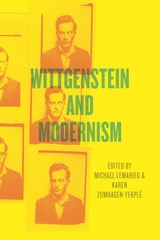
Wittgenstein and Modernism
Edited by Michael LeMahieu and Karen Zumhagen-Yekplé
University of Chicago Press, 2016
Michael LeMahieu Karen Zumhagen-Yekplé bring together scholars in both twentieth-century philosophy and modern literary studies to put Wittgenstein into dialogue with some of modernism’s most iconic figures, including Samuel Beckett, Saul Bellow, Walter Benjamin, Henry James, James Joyce, Franz Kafka, Adolf Loos, Robert Musil, Wallace Stevens, and Virginia Woolf. The contributors touch on two important aspects of Wittgenstein’s work and modernism itself: form and medium. They discuss issues ranging from Wittgenstein and poetics to his use of numbered propositions in the Tractatus as a virtuoso performance of modernist form; from Wittgenstein’s persistence metaphoric use of religion, music, and photography to an exploration of how he and Henry James both negotiated the relationship between the aesthetic and the ethical.
Covering many other fascinating intersections of the philosopher and the arts, this book offers an important bridge across the disciplinary divides that have kept us from a fuller picture of both Wittgenstein and the larger intellectual and cultural movement of which he was a part.
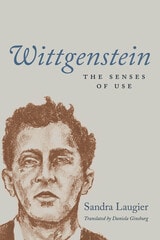
Wittgenstein
The Senses of UseSandra Laugier
University of Chicago Press, 2025
One of philosopher Ludwig Wittgenstein’s most consequential claims was that the meaning of the word, its sense, is its use in language. This deceptively simple claim, the foundation of what became known as ordinary language philosophy, has animated thinkers across disciplinary bounds from metaphysics to ethics and more. In The Senses of Use, Sandra Laugier embarks on a fresh journey through Wittgenstein’s corpus that emphasizes the place of ordinary life and language in its thought. Through his Tractatus Logico-Philosophicus, Philosophical Investigations, and rich posthumously published works, Laugier offers a compelling new look at Wittgenstein as a philosopher of mind.