Results by title
3 books match the query 'Women's Lives'
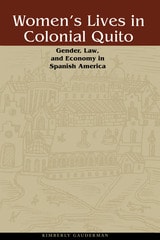
Women's Lives in Colonial Quito
Gender, Law, and Economy in Spanish AmericaBy Kimberly Gauderman
University of Texas Press, 2003
What did it mean to be a woman in colonial Spanish America? Given the many advances in women's rights since the nineteenth century, we might assume that colonial women had few rights and were fully subordinated to male authority in the family and in society—but we'd be wrong. In this provocative study, Kimberly Gauderman undermines the long-accepted patriarchal model of colonial society by uncovering the active participation of indigenous, mestiza, and Spanish women of all social classes in many aspects of civil life in seventeenth-century Quito.
Gauderman draws on records of criminal and civil proceedings, notarial records, and city council records to reveal women's use of legal and extra-legal means to achieve personal and economic goals; their often successful attempts to confront men's physical violence, adultery, lack of financial support, and broken promises of marriage; women's control over property; and their participation in the local, interregional, and international economies. This research clearly demonstrates that authority in colonial society was less hierarchical and more decentralized than the patriarchal model suggests, which gave women substantial control over economic and social resources.
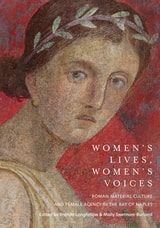
Women's Lives, Women's Voices
Roman Material Culture and Female Agency in the Bay of NaplesEdited by Brenda Longfellow and Molly Swetnam-Burland
University of Texas Press, 2021
Literary evidence is often silent about the lives of women in antiquity, particularly those from the buried cities of Pompeii and Herculaneum. Even when women are considered, they are often seen through the lens of their male counterparts. In this collection, Brenda Longfellow and Molly Swetnam-Burland have gathered an outstanding group of scholars to give voice to both the elite and ordinary women living on the Bay of Naples before the eruption of Vesuvius.
Using visual, architectural, archaeological, and epigraphic evidence, the authors consider how women in the region interacted with their communities through family relationships, businesses, and religious practices, in ways that could complement or complicate their primary social roles as mothers, daughters, and wives. They explore women-run businesses from weaving and innkeeping to prostitution, consider representations of women in portraits and graffiti, and examine how women expressed their identities in the funerary realm. Providing a new model for studying women in the ancient world, Women’s Lives, Women’s Voices brings to light the day-to-day activities of women of all classes in Pompeii and Herculaneum.
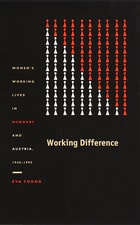
Working Difference
Women's Working Lives in Hungary and Austria, 1945-1995Éva Fodor
Duke University Press, 2003
Fodor brings qualitative and quantitative analyses to bear, combining statistical analyses of survey data, interviews with women managers in both countries, and archival materials including those from the previously classified archives of the Hungarian communist party and transcripts from sessions of the Austrian Parliament. She shows how women's access to power varied in degree and operated through different principles and mechanisms in accordance with the stratification systems of the respective countries. In Hungary women's mobility was curtailed by political means (often involving limited access to communist party membership), while in Austria women's professional advancement was affected by limited access to educational institutions and the labor market. Fodor discusses the legacies of Austria's and Hungary's "gender regimes" following the demise of state socialism and during the process of integration into the European Union.