Results by title
15 books match the query 'Women's health services'

Bodies of Knowledge
Sexuality, Reproduction, and Women's Health in the Second WaveWendy Kline
University of Chicago Press, 2010
Throughout the 1970s and ’80s, women argued that unless they gained access to information about their own bodies, there would be no equality. In Bodies of Knowledge, Wendy Kline considers the ways in which ordinary women worked to position the female body at the center of women’s liberation.
As Kline shows, the struggle to attain this knowledge unified women but also divided them—according to race, class, sexuality, or level of professionalization. Each of the five chapters of Bodies of Knowledge examines a distinct moment or setting of the women’s movement in order to give life to the ideas, expectations, and pitfalls encountered by the advocates of women’s health: the making of Our Bodies, Ourselves (1973); the conflicts surrounding the training and practice of women’s pelvic exams; the emergence of abortion as a feminist issue; the battles over contraceptive regulation at the 1983 Depo-Provera FDA hearings; and the rise of the profession of midwifery. Including an epilogue that considers the experiences of the daughters of 1970s feminists, Bodies of Knowledge is an important contribution to the study of the bodies—that marked the lives—of feminism’s second wave.
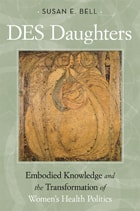
DES Daughters, Embodied Knowledge, and the Transformation of Women's Health Politics in the Late Twentieth Century
Susan E. Bell
Temple University Press, 2009
In DES Daughters, Susan Bell recounts the experiences of this generation of “victims.” In moving, heartfelt narratives, she presents the voices of those women who developed cancer, those who were cancer-free but have concerns about becoming pregnant, and those who suffered other medical and/or reproductive difficulties.
Bell examines the hierarchy of knowledge and power of scientists, doctors, and daughters, tracing the emergence of a feminist health movement. The “embodied knowledge” of these DES daughters prompted them to become advocates and form a social movement that challenged reproductive medical knowledge specifically, but also the politics of women’s health in general. Bell’s important book chronicles the history and future of these grassroots activists born out of illness, suffering, and uncertainty.
For the Public Good
Women, Health, and Equity in Rural IndiaPatricia Antoniello
Vanderbilt University Press, 2020
In one generation, village health workers have progressed from child brides and sequestered wives to knowledgeable health practitioners, valued teachers, and community leaders. Through collective efforts, CRHP has reduced infant and maternal mortality, eliminated some endemic health problems, and advanced economic well-being in villages with women's cooperative lending groups.
This book describes how the recognition and elimination of embedded inequalities—in this case caste discrimination, gender subordination, and class injustice—promote health and well-being and collaboratively establish the public good.
Health Care and Gender
Charlotte Muller
Russell Sage Foundation, 1990
Interrogating Gendered Pathologies
Erin A. Clark
Utah State University Press, 2020
These chapters engage common narratives about the ways in which gender in healthcare is secondary and highlights the stories of people who have battled to prioritize their own bodies through extraordinary difficulties. Employing a multiplicity of voices, the book represents a number of different perspectives on what it might look like to return health and medical data to embodied experience, to consider the effects of gendered and intersectional biomedical norms on lived realities, and to subvert the power of institutions in ways that move us toward biomedical justice.
This collection contributes to the burgeoning field of health and medical rhetorics by rhetorically and theoretically intervening in what are often seen as objective and neutral decisions related to the body and to scientific and medical data about bodies. Interrogating Gendered Pathologies will be of interest to feminist scholars in the field of rhetoric and writing studies, specifically those in the rhetorics of health and medicine, as well as scholars of technical communication, feminist studies, gender studies, technoscience studies, and bioethics.
Contributors: Leslie Anglesey, Mary Assad, Beth Boser, Lillian Campbell, Marleah Dean, Lori Beth De Hertogh, Leandra Hernandez, Elizabeth Horn-Walker, Caitlin Leach, Jordan Liz, Miriam Mara, Cathryn Molloy, Kerri Morris, Maria Novotny, Sage Perdue, Colleen Reilly
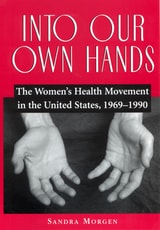
Into Our Own Hands
The Women's Health Movement in the United States, 1969–1990Morgen, Sandra
Rutgers University Press, 2002
Recent history has witnessed a revolution in womens health care. Beginning in the late 1960s, women in communities across the United States challenged medical and male control over womens health. Few people today realize the extent to which these grassroots efforts shifted power and responsibility from the medical establishment into womens hands as health care consumers, providers, and advocates.
Into Our Own Hands traces the womens health care movement in the United States. Richly documented, this study is based on more than a decade of research, including interviews with leading activists; documentary material from feminist health clinics and advocacy organizations; a survey of womens health movement organizations in the early 1990s; and ethnographic fieldwork. Sandra Morgen focuses on the clinics born from this movement, as well as how the movements encounters with organized medicine, the state, and ascendant neoconservative and neoliberal political forces of the 1970s to the1980s shaped the confrontations and accomplishments in womens health care. The book also explores the impact of political struggles over race and class within the movement organizations.
Looking through the Speculum
Examining the Women’s Health MovementJudith A. Houck
University of Chicago Press, 2024
The women’s health movement in the United States, beginning in 1969 and taking hold in the 1970s, was a broad-based movement seeking to increase women’s bodily knowledge, reproductive control, and well-being. It was a political movement that insisted that bodily autonomy provided the key to women’s liberation. It was also an institution-building movement that sought to transform women’s relationships with medicine; it was dedicated to increasing women’s access to affordable health care without the barriers of homophobia, racism, and sexism. But the movement did not only focus on women’s bodies. It also encouraged activists to reimagine their relationships with one another, to develop their relationships in the name of personal and political change, and, eventually, to discover and confront the limitations of the bonds of womanhood.
This book examines historically the emergence, development, travails, and triumphs of the women’s health movement in the United States. By bringing medical history and the history of women’s bodies into our emerging understandings of second-wave feminism, the author sheds light on the understudied efforts to shape health care and reproductive control beyond the hospital and the doctor’s office—in the home, the women’s center, the church basement, the bookshop, and the clinic. Lesbians, straight women, and women of color all play crucial roles in this history. At its center are the politics, institutions, and relationships created by and within the women’s health movement, depicted primarily from the perspective of the activists who shaped its priorities, fought its battles, and grappled with its shortcomings.
Man-Made Medicine
Women’s Health, Public Policy, and ReformKary L. Moss, ed.
Duke University Press, 1996
These essays by physicians, lawyers, activists, and scholars present a rare interdisciplinary approach to a complex set of issues. Gender stereotyping and bias in the collection, analysis, and reporting of scientific data and in the ways health-related news is covered by the media are examined. The exclusion of women from the health care policy-making process and the effect such exclusion has on the determination of priorities among potential areas of research are also explored. With discussions of the plight of specific populations of women whose health care needs are not being sufficiently met—for example, immigrants, prisoners, the mentally ill, or women with HIV/AIDS, disabilities, or reproductive health problems—this book considers matters of race and class within the parameters of gender as it builds a fundamental challenge to the existing health care system. A range of current reform proposals are also evaluated in terms of their potential impact on women.
Suggesting no less than a radical rethinking of women’s medicine, Man-Made Medicine gives essential direction to the discussions that will shape the future of health care in this country. It will be of great interest to a wide audience, including health care advocates, policymakers, scholars, and readers generally concerned with women’s health issues.
Contributors. Ellen Barry, Laurie Beck, Joan Bertin, Janet Calvo, Wendy Chavkin, Kay Dickersin, Abigail English, Elizabeth Fee, Carol Gill, Nancy Krieger, Joyce McConnell, Judy Norsigian, Ann Scales, Susan Stefan, Lauren Schnaper, Catherine Teare
Politics Of Women's Health
Susan Sherwin
Temple University Press, 1998
Rather than focusing on types of medical interventions, The Politics of Women's Health asks what feminist health care ethics looks like if we start with women's experiences and concerns. It begins to unravel two key concepts of women's empowerment -- agency and autonomy -- that apply to all areas of concern to women.
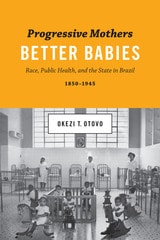
Progressive Mothers, Better Babies
Race, Public Health, and the State in Brazil, 1850-1945By Okezi T. Otovo
University of Texas Press, 2016
In Bahia, Brazil, the decades following emancipation saw the rise of reformers who sought to reshape the citizenry by educating Bahian women in methods for raising “better babies.” The idealized Brazilian would be better equipped to contribute to the labor and organizational needs of a modern nation. Backed by many physicians, politicians, and intellectuals, the resulting welfare programs for mothers and children mirrored complex debates about Brazilian nationality. Examining the local and national contours of this movement, Progressive Mothers, Better Babies investigates families, medical institutions, state-building, and social stratification to trace the resulting policies, which gathered momentum in the aftermath of abolition (1888) and the declaration of the First Republic (1889), culminating during the administration of President Getúlio Vargas (1930–1945).
Exploring the cultural discourses on race, gender, and poverty that permeated medical knowledge and the public health system for almost a century, Okezi T. Otovo draws on extensive archival research to reconstruct the implications for Bahia, where family patronage politics governed poor women’s labor as the mothers who were the focus of medical interventions were often the nannies and nursemaids of society’s wealthier families. The book reveals key transition points as the state of Bahia transformed from being a place where poor families could expect few social services to becoming the home of numerous programs targeting the poorest mothers and their children. Negotiating crucial questions of identity, this history sheds new light on larger debates about Brazil’s past and future.
Revolutionizing Women's Healthcare
The Feminist Self-Help Movement in AmericaHannah Dudley-Shotwell
Rutgers University Press, 2020
Revolutionizing Women’s Healthcare is the story of a feminist experiment: the self-help movement. This movement arose out of women’s frustration, anger, and fear for their health. Tired of visiting doctors who saw them as silly little girls, suffering shame when they asked for birth control, seeking abortions in back alleys, and holding little control over their own reproductive lives, women took action. Feminists created “self-help groups” where they examined each other’s bodies and read medical literature. They founded and ran clinics, wrote books, made movies, undertook nationwide tours, and raided and picketed offending medical institutions. Some performed their own abortions. Others swore off pharmaceuticals during menopause. Lesbian women found “at home” ways to get pregnant. Black women used self-help to talk about how systemic racism affected their health. Hannah Dudley-Shotwell engagingly chronicles these stories and more to showcase the creative ways women came together to do for themselves what the mainstream healthcare system refused to do.
Seen But Not Heard
What Medical Records Don’t Tell Us About Women’s LivesJennifer M. Silva
Russell Sage Foundation, 2026
Medical clinicians, who are already overworked and burned out, are increasingly expected to understand and treat systemic social issues like poverty and racism. One aspect of this is documenting patient’s social risk factors in electronic health records (EHRs). But EHRs do not aways give the full story. Critically, they omit patients’ voices and perspectives about their lives, care, and whether their needs are being met. In Seen But Not Heard, sociologist Jennifer M. Silva and epidemiologist Annemarie G. Hirsch explore the gaps between what clinicians document in EHRs and women’s lived experiences.
Drawing on interviews with 87 non-college-educated, economically disadvantaged women living in rural America and their health records from a large, non-profit health system, Silva and Hirsch find that the stories that medical records provide and the stories that women tell about themselves differ dramatically. Medical charts often translate women’s suffering into sterile diagnostic codes, prescriptions, and treatment plans. Some women felt heard by their clinicians, believed they received adequate care. Many of these women thought their clinicians went above and beyond to help meet their needs by offering them information on how to apply for benefits like food stamps or childcare subsidies and helping them obtain necessary items like mattress covers and winter coats. More often, however, women felt that clinicians were detached from their everyday struggles to survive, whether that meant keeping their families intact even in the face of violence or finding money to pay the never-ending string of bills.
Silva and Hirsch argue that because the system of healthcare delivery interprets social problems as individual failings it often reproduces long-standing injurious stereotypes of women as hysterical, recalcitrant, impure, and gluttonous. For some healthcare providers, knowledge about patients’ social risk factors can become a source of control and punishment, such as denying patients care or reporting patients to child welfare services. Patients described clinicians mobilizing harmful stereotypes about marriage and motherhood, race, and poverty during their appointments. Some of the women’s most traumatic experiences in the healthcare system were completely missing from their EHRs. These troubling experiences ultimately deter women from accessing healthcare, discourages them from sharing their experiences with clinicians, and in some cases, makes their health and social problems worse. Silva and Hirsch offer several policies and practices that would improve women’s experiences in clinical encounters, such as training clinicians in trauma-informed and culturally responsive care, as well as national investments in housing, food security, transportation, and environmental justice.
Seen But Not Heard is a disturbing but necessary examination of the ways vulnerable women are often failed by the healthcare system and offers solutions that will allow healthcare workers to better address the structural barriers faced by their patients.
Seizing the Means of Reproduction
Entanglements of Feminism, Health, and TechnoscienceM. Murphy
Duke University Press, 2012
Murphy traces the transnational circulation of cheap, do-it-yourself health interventions, highlighting the uneasy links between economic logics, new forms of racialized governance, U.S. imperialism, family planning, and the rise of NGOs. In the twenty-first century, feminist health projects have followed complex and discomforting itineraries. The practices and ideologies of alternative health projects have found their way into World Bank guidelines, state policies, and commodified research. While the particular moment of U.S. feminism in the shadow of Cold War and postcolonialism has passed, its dynamics continue to inform the ways that health is governed and politicized today.
What Makes Women Sick
Gender and the Political Economy of HealthLesley Doyal
Rutgers University Press, 1995
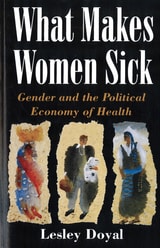
What makes women sick? To an Ecuadorean woman, it’s nervios from constant worry about her children’s illnesses. To a woman working in a New Mexico electronics factory, it’s the solvents that leave her with a form of dementia. To a Ugandan woman, it’s HIV from her husband's sleeping with the widow of an AIDS patient. To a Bangladeshi woman, it’s a fatal infection following an IUD insertion. What they all share is a recognition that their sickness is somehow caused by situations they face every day at home and at work.
In this clearly written and compelling book, Lesley Doyal investigates the effects of social, economic, and cultural conditions on women’s health. The “fault line” of gender that continues to divide all societies has, Doyal demonstrates, profound and pervasive consequences for the health of women throughout the world. Her broad synthesis highlights variations between men and women in patterns of health and illness, and it identifies inequalities in medical care that separate groups of women from each other. Doyal’s wide-ranging arguments, her wealth of data, her use of women’s voices from many cultures—and her examples of women mobilizing to find their own solutions—make this book required reading for everyone concerned with women’s health.
What Makes Women Sick
Gender and the Political Economy of HealthLesley Doyal
Rutgers University Press, 1995
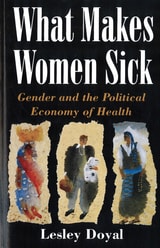
What makes women sick? To an Ecuadorean woman, it’s nervios from constant worry about her children’s illnesses. To a woman working in a New Mexico electronics factory, it’s the solvents that leave her with a form of dementia. To a Ugandan woman, it’s HIV from her husband's sleeping with the widow of an AIDS patient. To a Bangladeshi woman, it’s a fatal infection following an IUD insertion. What they all share is a recognition that their sickness is somehow caused by situations they face every day at home and at work.
In this clearly written and compelling book, Lesley Doyal investigates the effects of social, economic, and cultural conditions on women’s health. The “fault line” of gender that continues to divide all societies has, Doyal demonstrates, profound and pervasive consequences for the health of women throughout the world. Her broad synthesis highlights variations between men and women in patterns of health and illness, and it identifies inequalities in medical care that separate groups of women from each other. Doyal’s wide-ranging arguments, her wealth of data, her use of women’s voices from many cultures—and her examples of women mobilizing to find their own solutions—make this book required reading for everyone concerned with women’s health.