Results by title
5 books match the query 'Women's movement'
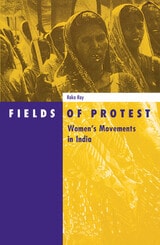
Fields Of Protest
Women’s Movement in IndiaRaka Ray
University of Minnesota Press, 1999
A comparative analysis of women’s struggle for change in India.
The women’s movement in India has a long and rich history in which millions of women live, work, and struggle to survive in order to remake their family, home, and social lives. Whether fighting for safe contraception, literacy, water, and electricity or resisting sexual harassment, they are participating in vibrant and active women’s movements that are thriving in many parts of India today.
Fields of Protest explores the political and cultural circumstances under which groups of women organize to fight for their rights and self-worth. Starting with Bombay and Calcutta, Raka Ray discusses the creation of “political fields”-structured, unequal, and socially constructed political environments within which organizations exist, flourish, or fail. Women’s organizations are not autonomous or free agents; rather, they inherit a “field” and its accompanying social relations, and when they act, they act in response to it and within it. Drawing on the literature of both social movements and feminism, Ray analyzes the striking differences between the movements in these two cities.Using an innovative and comparative perspective, Ray offers a unique look at Indian activist women and adds a new dimension to the study of women’s movements on a global level.
Getting Paid While Taking Time
The Women's Movement and the Development of Paid Family Leave Policies in the United StatesMegan Sholar
Temple University Press, 2016
The United States remains the only industrialized nation in the world that does not provide paid family leave at the national level for either men or women. In the more than two decades since the passage of the Family and Medical Leave Act, there have been numerous unsuccessful attempts to expand family leave benefits nationally. However, in the United States, it is common for innovations in family policies to arise at the state level.
In her timely book, Getting Paid While Taking Time, Megan Sholar explains the development of family leave policies at both the national and state levels in the United States. She provides cogent studies of states that have passed and proposed family leave legislation, and she pays special attention to the ways in which women’s movement actors and other activists (e.g., labor unions) exert pressure on public officials to help influence the policymaking process. In her conclusion, Sholar considers the future of paid family leave policies in the United States and the chances for it ever equaling the benefits in other countries.
Guatemaltecas
The Women's Movement, 1986–2003By Susan A. Berger
University of Texas Press, 2006
After thirty years of military rule and state-sponsored violence, Guatemala reinstated civilian control and began rebuilding democratic institutions in 1986. Responding to these changes, Guatemalan women began organizing to gain an active role in the national body politic and restructure traditional relations of power and gender. This pioneering study examines the formation and evolution of the Guatemalan women's movement and assesses how it has been affected by, and has in turn affected, the forces of democratization and globalization that have transformed much of the developing world.
Susan Berger pursues three hypotheses in her study of the women's movement. She argues that neoliberal democratization has led to the institutionalization of the women's movement and has encouraged it to turn from protest politics to policy work and to helping the state impose its neoliberal agenda. She also asserts that, while the influences of dominant global discourses are apparent, local definitions of femininity, sexuality, and gender equity and rights have been critical to shaping the form, content, and objectives of the women's movement in Guatemala. And she identifies a counter-discourse to globalization that is slowly emerging within the movement. Berger's findings vigorously reveal the manifold complexities that have attended the development of the Guatemalan women's movement.

Moving the Mountain
The Women's Movement in America since 1960Flora Davis
University of Illinois Press, 1999

Women's Movement in international perspective
Latin America and BeyondMaxine Molyneux
University of London Press, 2003