Results by title
3 books match the query 'Women and communism'

Bread and Roses
Gender and Class Under CapitalismAndrea D'Atri
Pluto Press, 2021
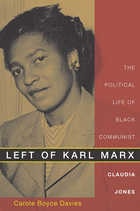
Left of Karl Marx
The Political Life of Black Communist Claudia JonesCarole Boyce Davies
Duke University Press, 2007
Claudia Cumberbatch Jones was born in Trinidad. In 1924, she moved to New York, where she lived for the next thirty years. She was active in the Communist Party from her early twenties onward. A talented writer and speaker, she traveled throughout the United States lecturing and organizing. In the early 1950s, she wrote a well-known column, “Half the World,” for the Daily Worker. As the U.S. government intensified its efforts to prosecute communists, Jones was arrested several times. She served nearly a year in a U.S. prison before being deported and given asylum by Great Britain in 1955. There she founded The West Indian Gazette and Afro-Asian Caribbean News and the Caribbean Carnival, an annual London festival that continues today as the Notting Hill Carnival. Boyce Davies examines Jones’s thought and journalism, her political and community organizing, and poetry that the activist wrote while she was imprisoned. Looking at the contents of the FBI file on Jones, Boyce Davies contrasts Jones’s own narration of her life with the federal government’s. Left of Karl Marx establishes Jones as a significant figure within Caribbean intellectual traditions, black U.S. feminism, and the history of communism.
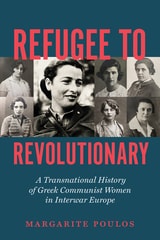
Refugee to Revolutionary
A Transnational History of Greek Communist Women in Interwar EuropeMargarite Poulos
Vanderbilt University Press, 2024
Refugee to Revolutionary examines the national and transnational world the female cadres of the Greek communist movement traversed, situated between their own aspirations, the objectives of the Greek Communist Party (KKE), and the global ambitions of the Comintern. Drawing largely on data contained in the individual files (anketas) of the KKE cadres located in the Comintern archive at the Russian State Archive for Socio-Political History (RGASPI), as well as Greek Communist Party archival materials, this history is told largely in the voice, albeit the “official” voice, of the subjects themselves. These voices reveal much about the personal, cultural, social, and gendered dimensions of their experience. They convey a story of opportunity and sacrifice and the sense of being part of something historic and extraordinary.
The overarching purpose of this book is two-pronged: The first is to address a historiographical void attributable to a combination of factors, which includes the inaccessibility of Soviet archival materials and a persistent hegemonic masculinity that continues to define the historiography of Greek communism. Second, this work is situated within a new literature represented by scholars such as Brigitte Studer, Lisa Kirschenbaum, Francisca De Haan, and others, which destabilizes Cold War paradigms that have long dominated evaluations of agency, identity, and subjectivity in the Western historiography of communism.