Results by title
4 books match the query 'Women and psychoanalysis'
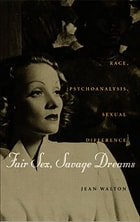
Fair Sex, Savage Dreams
Race, Psychoanalysis, Sexual DifferenceJean Walton
Duke University Press, 2001
Charting the fantasies of racial difference in these women’s writings, Walton establishes that race—particularly during this period—was inseparable from accounts of gender and sexuality. While arguing that these women remained notably oblivious to the racial meanings embedded in their own attempts to rearticulate feminine sexuality, Walton uses these very blindspots to understand how race and sex are deeply imbricated in the constitution of subjectivity. Challenging the notion that subjects acquire gender identities in isolation from racial ones, she thus demonstrates how white-centered psychoanalytic theories have formed the basis for more contemporary feminist and queer explorations of fantasy, desire, power, and subjectivity.
Fair Sex, Savage Dreams will appeal to scholars of psychoanalysis, literary and cinematic modernism, race studies, queer theory, feminist theory, and anthropology.
Hysteric's Guide to the Future Female Subject
Juliet Flower Maccannell
University of Minnesota Press, 1999
Proposes an ethics of the feminine through an examination of women’s writing.
The Hysteric’s Guide to the Future Female Subject was first published in 1999. Minnesota Archive Editions uses digital technology to make long-unavailable books once again accessible, and are published unaltered from the original University of Minnesota Press editions.
How can a girl become a woman today—an ethical woman and a member of society—without being either a victim or a manipulator? Reflecting on this question, Juliet Flower MacCannell takes us for the first time beyond the flawed models for “becoming woman” left to us by Freud and Sade.Having previously explored the logic of feminine sexuality, MacCannell sets out in the Hysteric’s Guide to locate an ethics of the feminine. She does this by examining instances of the (often hysterical) feminine confrontation with (usually perverse) masculine subjects, confrontations that represent crucial scenes in the constitution of female sexuality. Her study takes us into Sadean ethics and the prescriptions of Freudian psychoanalysis; post-Enlightenment colonialism; racism during and after World War I; genocidal fascism in World War II; and the slowing of time and generation during the Cold War.MacCannell treats contemporary art, fiction, and theory, considering works by Arendt, Angelou, Rousseau, Kant, Stendhal, Kleist, Hitchcock, Atwood, Klein, Chodorow, Adorno, and Duras. Ultimately, this book reasserts “becoming woman” as an issue that has, until now, been denied for want of a feminine ethic relevant to contemporary life.
Representing The Woman
Cinema and PsychoanalysisElizabeth Cowie
University of Minnesota Press, 1996

The Future of an Illusion
Film, Feminism, and PsychoanalysisConstance Penley
University of Minnesota Press, 1989
The Future of an Illusion was first published in 1989. Minnesota Archive Editions uses digital technology to make long-unavailable books once again accessible, and are published unaltered from the original University of Minnesota Press editions.
The Future of an Illusion documents the pivotal role Constance Penley has played in the development of feminist film theory. Penley analyzes the primary movements that have shaped the field: the conjunction of feminism, film theory, and psychoanalysis, and the inherent debates surrounding the politics of women and representation. These debates center on the position of women in the classical Hollywood narrative, the construction of the spectator's desire in pornography and eroticism, and the implicitly male bias in psychoanalytically oriented film theory. Essential to anyone studying the sexual policies of representation, The Future of an Illusion ranges from avant-garde films to video, popular cinema, television, literature, and critical and cultural theory.
Constance Penley is associate professor of English and film studies at the University of Rochester. A co-editor of the journal Camera Obscura,she is the editor of Feminism and Film Theory.