Results by title
7 books match the query 'Women and the military'
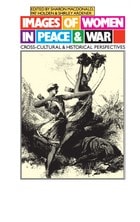
Images of Women in Peace and War
Cross-cultural and Historical PerspectivesSharon Macdonald
University of Wisconsin Press, 1988
As warriors, freedom fighters and victims, as mothers, wives and prostitutes, and as creators and members of peace movements, women are inevitably caught up in the net of war. Yet women’s participation in warfare and peace campaigns has often been underestimated or ignored.
Images of Women in Peace and War explores women’s relationships to war, peace, and revolution, from the Amazons, Inka and Boadicea, to women soldiers in South Africa, Mau Mau freedom fighters and the protestors at Greenham Common. The contributors consider not only the reality of women’s participation but also look at how their actions have been perceived and represented across cultures and through history. They examine how sexual imagery is constructed, how it is used to delineate women’s relation to warfare and how these images have sometimes been subverted in order to challenge the status quo. The book raises important questions about whether women have a special prerogative to promote peace and considers whether the experience of motherhood leads to a distinctive women’s position on war. The authors find that their analyses lead them to deal with arguments on the basic nature of the sexes and to reevaluate our concepts of “peace,” “war,” and “gender.”
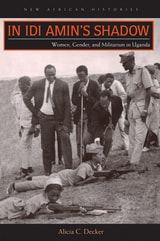
In Idi Amin’s Shadow
Women, Gender, and Militarism in UgandaAlicia C. Decker
Ohio University Press, 2014
Finalist for the 2015 Aidoo-Snyder Prize
In Idi Amin’s Shadow is a rich social history examining Ugandan women’s complex and sometimes paradoxical relationship to Amin’s military state. Based on more than one hundred interviews with women who survived the regime, as well as a wide range of primary sources, this book reveals how the violence of Amin’s militarism resulted in both opportunities and challenges for women. Some assumed positions of political power or became successful entrepreneurs, while others endured sexual assault or experienced the trauma of watching their brothers, husbands, or sons “disappeared” by the state’s security forces. In Idi Amin’s Shadow considers the crucial ways that gender informed and was informed by the ideology and practice of militarism in this period. By exploring this relationship, Alicia C. Decker offers a nuanced interpretation of Amin’s Uganda and the lives of the women who experienced and survived its violence.
Each chapter begins with the story of one woman whose experience illuminates some larger theme of the book. In this way, it becomes clear that the politics of military rule were highly relevant to women and gender relations, just as the politics of gender were central to militarism. By drawing upon critical security studies, feminist studies, and violence studies, Decker demonstrates that Amin’s dictatorship was far more complex and his rule much more strategic than most observers have ever imagined.
Postfeminist War
Women in the Media-Military-Industrial ComplexMary Douglas Vavrus
Rutgers University Press, 2019
Security Disarmed
Critical Perspectives on Gender, Race, and MilitarizationMorgen, Sandra
Rutgers University Press, 2008
In Security Disarmed, scholars, policy planners, and activists come together to think critically about the human cost of violence and viable alternatives to armed conflict. Arranged in four parts--alternative paradigms of security, cross-national militarization, militarism in the United States, and pedagogical and cultural concerns--the book critically challenges militarization and voices an alternative encompassing vision of human security by analyzing the relationships among gender, race, and militarization. This collection of essays evaluates and resists the worldwide crisis of militarizationùincluding but going beyond American military engagements in the twenty-first century.
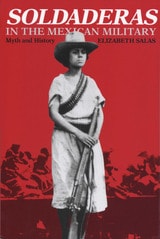
Soldaderas in the Mexican Military
Myth and HistoryBy Elizabeth Salas
University of Texas Press, 1990
Since pre-Columbian times, soldiering has been a traditional life experience for innumerable women in Mexico. Yet the many names given these women warriors—heroines, camp followers, Amazons, coronelas, soldadas, soldaderas, and Adelitas—indicate their ambivalent position within Mexican society. In this original study, Elizabeth Salas explores the changing role of the soldadera, both in reality and as a cultural symbol, from pre-Columbian times up to the present day.
Drawing on military archival data, anthropological studies, and oral history interviews, Salas first explores the real roles played by Mexican women in armed conflicts. She finds that most of the functions performed by women easily equate to those performed by revolutionaries and male soldiers in the quartermaster corps and regular ranks. She then turns her attention to the soldadera as a continuing symbol in Mexican and Chicano culture, examining the image of the soldadera in literature, corridos, art, music, and film.
Challenging many traditional stereotypes, Salas finds that the fundamental realities of war link all Mexican women, regardless of time period, social class, or nom de guerre.

Soldiers' Stories
Military Women in Cinema and Television since World War IIYvonne Tasker
Duke University Press, 2011

War & Terror
Feminist PerspectivesEdited by Karen Alexander and Mary Hawkesworth
University of Chicago Press, 2008