Results by title
3 books match the query 'Women artisans'
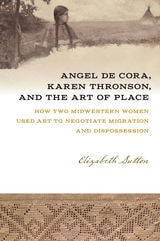
Angel De Cora, Karen Thronson, and the Art of Place
How Two Midwestern Women Used Art to Negotiate Migration and DispossessionElizabeth Sutton
University of Iowa Press, 2020
Angel De Cora (c. 1870–1919) was a Native Ho-Chunk artist who received relative acclaim during her lifetime. Karen Thronson (1850–1929) was a Norwegian settler housewife who created crafts and folk art in obscurity along with the other women of her small immigrant community. The immigration of Thronson and her family literally maps over the De Cora family’s forced migration across Wisconsin, Iowa, and onto the plains of Nebraska and Kansas. Tracing the parallel lives of these two women artists at the turn of the twentieth century, art historian Elizabeth Sutton reveals how their stories intersected and diverged in the American Midwest.
By examining the creations of these two artists, Sutton shows how each woman produced art or handicrafts that linked her new home to her homeland. Both women had to navigate and negotiate between asserting their authentic self and the expectations placed on them by others in their new locations. The result is a fascinating story of two women that speaks to universal themes of Native displacement, settler conquest, and the connection between art and place.
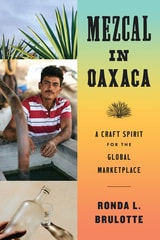
Mezcal in Oaxaca
A Craft Spirit for the Global MarketplaceRonda L. Brulotte
University of Texas Press, 2025
An ethnography of mezcal and how it has become a global, "artisanal" good.
Mezcal is booming. Once considered a peasant drink—the rough, lowbrow cousin of the more refined tequila—the smoky spirit is now prized by connoisseurs the world over. It is also hailed as a savior of Oaxaca, powering a craft industry that can uphold rural economies and Indigenous traditions.
Ronda L. Brulotte traces mezcal’s swift rise and its effects on communities that have distilled and enjoyed the beverage for generations. Only in the late 1990s did mezcal begin to escape its longstanding associations with Indigenous and working-class life, even as these very qualities supply the “authenticity” that elite consumers crave. Through a detailed ethnography of the spirits industry in Oaxaca, Brulotte compares the ideal of the artisanal economy with the reality of participation in global markets. Her findings—focused on tourism-led development and gentrification, the exploitation of women and smallholders, and swelling regional migration pressures—raise troubling questions about the ecological and social sustainability of a new craft imaginary that rebrands rustic products as luxury goods.
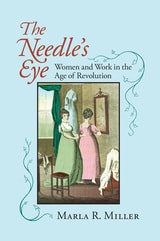
The Needle's Eye
Women and Work in the Age of RevolutionMarla R. Miller
University of Massachusetts Press, 2006
In this book, Marla R. Miller illuminates the significance of women's work in the clothing trades of the early Republic. Drawing on diaries, letters, reminiscences, ledgers, and material culture, she explores the contours of working women's lives in rural New England, offering a nuanced view of their varied ranks and roles—skilled and unskilled, black and white, artisanal and laboring—as producers and consumers, clients and craftswomen, employers and employees. By plumbing hierarchies of power and skill, Miller explains how needlework shaped and reflected the circumstances of real women's lives, at once drawing them together and setting them apart.
The heart of the book brings into focus the entwined experiences of six women who lived in and around Hadley, Massachusetts, a thriving agricultural village nestled in a bend in the Connecticut River about halfway between the Connecticut and Vermont borders. Miller's examination of their distinct yet overlapping worlds reveals the myriad ways that the circumstances of everyday lives positioned women in relationship to one another, enlarging and limiting opportunities and shaping the trajectories of days, years, and lifetimes in ways both large and small. The Needle's Eye reveals not only how these women thought about their work, but how they thought about their world.