Results by title
62 books match the query 'Women artists' and 7 start with a
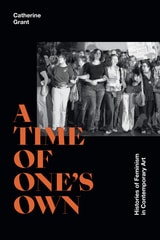
A Time of One's Own
Histories of Feminism in Contemporary ArtCatherine Grant
Duke University Press, 2022
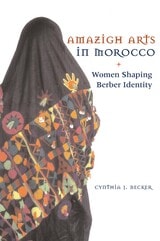
Amazigh Arts in Morocco
Women Shaping Berber IdentityBy Cynthia Becker
University of Texas Press, 2006
In southeastern Morocco, around the oasis of Tafilalet, the Ait Khabbash people weave brightly colored carpets, embroider indigo head coverings, paint their faces with saffron, and wear ornate jewelry. Their extraordinarily detailed arts are rich in cultural symbolism; they are always breathtakingly beautiful—and they are typically made by women. Like other Amazigh (Berber) groups (but in contrast to the Arab societies of North Africa), the Ait Khabbash have entrusted their artistic responsibilities to women. Cynthia Becker spent years in Morocco living among these women and, through family connections and female fellowship, achieved unprecedented access to the artistic rituals of the Ait Khabbash. The result is more than a stunning examination of the arts themselves, it is also an illumination of women's roles in Islamic North Africa and the many ways in which women negotiate complex social and religious issues.
One of the reasons Amazigh women are artists is that the arts are expressions of ethnic identity, and it follows that the guardians of Amazigh identity ought to be those who literally ensure its continuation from generation to generation, the Amazigh women. Not surprisingly, the arts are visual expressions of womanhood, and fertility symbols are prevalent. Controlling the visual symbols of Amazigh identity has given these women power and prestige. Their clothing, tattoos, and jewelry are public identity statements; such public artistic expressions contrast with the stereotype that women in the Islamic world are secluded and veiled. But their role as public identity symbols can also be restrictive, and history (French colonialism, the subsequent rise of an Arab-dominated government in Morocco, and the recent emergence of a transnational Berber movement) has forced Ait Khabbash women to adapt their arts as their people adapt to the contemporary world. By framing Amazigh arts with historical and cultural context, Cynthia Becker allows the reader to see the full measure of these fascinating artworks.

American Women Modernists
The Legacy of Robert Henri, 1910-1945Edited by Marian Wardle
Rutgers University Press, 2005
Seldom recognized, yet contributing significantly to the structure of early American modernism is a group of women who were once the art students of the popular and perhaps most influential American art teacher of the twentieth century, Robert Henri (1865-1929). Henri encouraged an art that was expressive of personal emotions and experience and that was grounded in life. He preached equality among different media and approaches to art. Giving heed to his teachings, his women students engaged in a wide variety of artistic production. Collectively, the stunning variety and power of their work in painting, sculpture, printmaking, textiles, decorative arts, and furniture broadens our understanding of American modernism and illuminates the role of women artists in shaping it. Yet, these women have remained largely unstudied, and virtually unknown, even among art historians.
The seven new essays included in this volume move beyond the famed Ashcan School-the small group of Henri's male students who worked in a narrow range of urban realist subjects-to recover the lesser known work of his women students. The contributors, who include well-known scholars of art history, American studies, and cultural studies demonstrate how these women participated in the "modernizing" of women's roles during this era; how gender controlled their art, productivity, sales, and reception; how their many styles, media, and subjects enrich our understanding of modern American art; and how the work of modern women artists relates to women's involvement in other areas of modern American society and culture, including labor and social reform, patronage, literature, dance, and music.
Lavishly illustrated and complemented by short biographies of more than 400 of Henri's students, this delightful collection adds a long-ignored but deserving dimension to an expanded story of American modernism and to women's contributions to the arts.
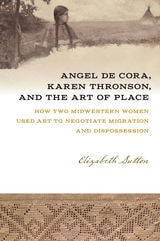
Angel De Cora, Karen Thronson, and the Art of Place
How Two Midwestern Women Used Art to Negotiate Migration and DispossessionElizabeth Sutton
University of Iowa Press, 2020
Angel De Cora (c. 1870–1919) was a Native Ho-Chunk artist who received relative acclaim during her lifetime. Karen Thronson (1850–1929) was a Norwegian settler housewife who created crafts and folk art in obscurity along with the other women of her small immigrant community. The immigration of Thronson and her family literally maps over the De Cora family’s forced migration across Wisconsin, Iowa, and onto the plains of Nebraska and Kansas. Tracing the parallel lives of these two women artists at the turn of the twentieth century, art historian Elizabeth Sutton reveals how their stories intersected and diverged in the American Midwest.
By examining the creations of these two artists, Sutton shows how each woman produced art or handicrafts that linked her new home to her homeland. Both women had to navigate and negotiate between asserting their authentic self and the expectations placed on them by others in their new locations. The result is a fascinating story of two women that speaks to universal themes of Native displacement, settler conquest, and the connection between art and place.
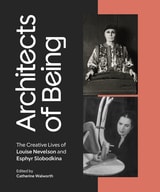
Architects of Being
The Creative Lives of Louise Nevelson and Esphyr SlobodkinaCatherine Walworth
University of Arkansas Press, 2025
Born just nine years apart in Ukraine and Siberia, respectively, Louise Nevelson and Esphyr Slobodkina were both children of Jewish families who fled Russian governmental repression and conflict. Both made early marriages of convenience or convention that were short-lived. Both went to New York in the 1920s, struggling to become artists amid the Great Depression. Both overcame the accepted modes of making, moving between art forms in expansive, category-defying ways. The parallels are poignant, including their similarly fearless devotion to abstract art in an era that had yet to fully embrace it. Architects of Being pays homage to these two women who were direct and dauntless.
Fittingly, this book draws its title from Nevelson’s insight that “there’s something very important about character: character is structure. Character is the architecture of the being.” The connection between inner self and outward manifestation—both one’s art and one’s self-fashioning—is at the heart of Architects of Being. This richly illustrated and expertly researched exhibition catalog celebrates Nevelson’s and Slobodkina’s artistic journeys and architectural affinities, expanding our understanding of how these pioneering figures dissolved boundaries between art forms in ways that prefigured what we see throughout the art world today.

Arijana Lekic-Fridrih
All Art Is a Political Statement / Svaka Umjetnost Je Politicka IzavaRebekah Modrak
Disobedience Press, 2024
Arijana Lekić-Fridrih: All Art is a Political Statement introduces audiences to the work of Croatian artist Arijana Lekić-Fridrih and, in particular, to her Silent Mass, a performance resisting the “Be Manly” movement, a series of mass prayer events held in Croatian public squares by a battalion of men who pray for the abolition of women’s rights, for women’s “chastity,” and for men’s “masculine authority.” All Art is a Political Statement links the erosion of women’s rights across intercontinental boundaries and offers Lekić-Fridrih’s multimedia art as a guide for activism against retrograde restrictions on the freedom of women.
Arijana Lekić-Fridrih: Svaka umjetnost je politička izjava upoznaje publiku s radom hrvatske umjetnice Arijane Lekić-Fridrih, a posebno s njezinom Tihom misom, performansom otpora pokretu “Budi muško”, nizu masovnih molitvenih događanja koje na hrvatskim javnim trgovima održava bataljun muškaraca moleći za ukidanje ženskih prava, za žensku “čednost”, a za muškarce “muški autoritet”. Svaka umjetnost je politička izjava spaja eroziju ženskih prava preko interkontinentalnih granica i nudi multimedijsku umjetnost Lekić-Fridrih kao vodič za aktivizam protiv nazadnih ograničenja slobode žena.
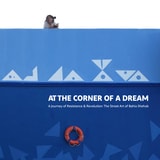
At the Corner of a Dream
A Journey of Resistance and Revolution: The Street Art of Bahia ShehabBahia Shehab
Gingko, 2019
At the Corner of a Dream offers extensive documentation of Shehab’s powerful street paintings. It also chronicles the stories of the people she meets along her journeys and includes her observations from the streets of each new city she visits. Shehab’s work is a manifesto, a cry for freedom and dignity, and a call to never stop dreaming.