Results by title
5 books match the query 'Women consumers'
Come Buy, Come Buy
Shopping and the Culture of Consumption in Victorian Women’s WritingKrista Lysack
Ohio University Press, 2008
From the 1860s through the early twentieth century, Great Britain saw the rise of the department store and the institutionalization of a gendered sphere of consumption. Come Buy, Come Buy considers representations of the female shopper in British women’s writing and demonstrates how women’s shopping practices are materialized as forms of narrative, poetic, and cultural inscription, showing how women writers emphasize consumerism as productive of pleasure rather than the condition of seduction or loss. Krista Lysack examines works by Christina Rossetti, Mary Elizabeth Braddon, George Eliot, and Michael Field, as well as the suffragette newspaper Votes for Women, in order to challenge the dominant construction of Victorian femininity as characterized by self-renunciation and the regulation of appetite.
Come Buy, Come Buy considers not only literary works, but also a variety of archival sources (shopping guides, women’s fashion magazines, household management guides, newspapers, and advertisements) and cultural practices (department store shopping, shoplifting and kleptomania, domestic economy, and suffragette shopkeeping). With this wealth of sources, Lysack traces a genealogy of the woman shopper from dissident domestic spender to aesthetic connoisseur, from curious shop-gazer to political radical.
Consuming Motherhood
Taylor, Janelle S
Rutgers University Press, 2004
Consuming Motherhood addresses the provocative question of how motherhood and consumption—as ideologies and as patterns of social action—mutually shape and constitute each other in contemporary North American and European social life. Ideologically, motherhood and consumption are often constructed in opposition to each other, with motherhood standing in as a naturalized social relation that is thought to be uniquely free of the calculating instrumentality that dominates commercial relations. Yet, in social life, motherhood and consumption are inseparable. Whether shopping for children’s clothing or childbirth services, or making decisions about adopting children, becoming a mother (and maternal practice more generally) is deeply influenced by consumption. How can the relationship between motherhood and consumption be revealed, and critically analyzed? Consuming Motherhood brings together a group of sociologists, anthropologists, and religious studies scholars to address this question through carefully grounded ethnographic studies. This insightful book reveals how mothers negotiate the contradictory forces that position them as both immune from and the target of consumerist tendencies in contemporary global society.
Sentimental Materialism
Gender, Commodity Culture, and Nineteenth-Century American LiteratureLori Merish
Duke University Press, 2000
The phenomenon of female consumption was capitalism’s complement to male production: It created what Merish calls the “Other Protestant Ethic,”a feminine and sentimental counterpart to Max Weber’s ethic of hard work, economic rationality, and self-control. In addition, driven by the culture’s effort to civilize the “cannibalistic” practices of ethnic, class, and national otherness, appropriate female consumerism, marked by taste and refinement, identified certain women and their families as proper citizens of the United States. The public nature of consumption, however, had curiously conflicting effects: While the achievement of cultured material circumstances facilitated women’s civic agency, it also reinforced stereotypes of domestic womanhood.
Sentimental Materialism’s inquiry into middle-class consumption and accompanying ideals of womanhood will appeal to readers in a variety of disciplines, including American studies, cultural studies, feminist theory, and cultural history.
The Female Economy
The Millinery and Dressmaking Trades, 1860-1930Wendy Gamber
University of Illinois Press, 1997
The Female Economy explores that lost world of women's dominance, showing how independent, often ambitious businesswomen and the sometimes imperious consumers they served gradually vanished from the scene as custom production gave way to a largely unskilled modern garment industry controlled by men. Wendy Gamber helps overturn the portrait of wage-earning women as docile souls who would find fulfillment only in marriage and motherhood. She combines labor history, women's history, business history, and the history of technology while exploring topics as wide-ranging as the history of pattern-making and the relationship between entrepreneurship and marriage.
A volume in the series The Working Class in American History, edited by David Brody, Alice Kessler-Harris, David Montgomery, and Sean Wilentz, and in the series Women in American History, edited by Anne Firor Scott, Nancy A. Hewitt, and Stephanie Shaw
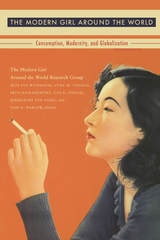
The Modern Girl Around the World
Consumption, Modernity, and GlobalizationThe Modern Girl Around the World Research Group
Duke University Press, 2008
Scholars of history, women’s studies, literature, and cultural studies follow the Modern Girl around the world, analyzing her manifestations in Germany, Australia, China, Japan, France, India, the United States, Russia, South Africa, and Zimbabwe. Along the way, they demonstrate how the economic structures and cultural flows that shaped a particular form of modern femininity crossed national and imperial boundaries. In so doing, they highlight the gendered dynamics of interwar processes of racial formation, showing how images and ideas of the Modern Girl were used to shore up or critique nationalist and imperial agendas. A mix of collaborative and individually authored chapters, the volume concludes with commentaries by Kathy Peiss, Miriam Silverberg, and Timothy Burke.
Contributors: Davarian L. Baldwin, Tani E. Barlow, Timothy Burke, Liz Conor, Madeleine Yue Dong, Anne E. Gorsuch, Ruri Ito, Kathy Peiss, Uta G. Poiger, Priti Ramamurthy, Mary Louise Roberts, Barbara Sato, Miriam Silverberg, Lynn M. Thomas, Alys Eve Weinbaum