Results by title

5 books match the query 'Women educators'
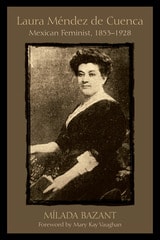
cover of Laura Méndez de Cuenca: Mexican Feminist, 1853–1928

Laura Méndez de Cuenca

Mexican Feminist, 1853–1928

Mílada Bazant; Foreword by Mary Kay Vaughan

University of Arizona Press, 2018

Laura Méndez de Cuenca—poet, teacher, editor, writer, and feminist—dared to bypass the cultural traditions of her time.

In the early 1870s, when conservative religious thought permeated all aspects of Mexican life, she was one of very few women to gain admission to an extraordinary constellation of male poets, playwrights, and novelists, who were also the publicists and statesmen of the time. She entered this world through her poetry, intellect, curiosity, assertiveness, but her personal life was fraught with tragedy: she had a child out of wedlock by poet Manuel Acuña, who killed himself shortly thereafter. She later married another poet, Agustín Fidencio Cuenca, and had seven other children. All but two of her children died, as did Agustín.

As a penniless young widow facing social rejection, Laura became a teacher and an important force in Mexico’s burgeoning educational reform program. She moved abroad—first to San Francisco, then St. Louis, then Berlin. In these places where she was not known and women had begun to move confidently in the public sphere, she could walk freely, observe, mingle, make friends across many circles, learn, think, and express her opinions. She wrote primarily for a Mexican public and always returned to Mexico because it was her country’s future that she strove to create.

Now, for the first time in English, Mílada Bazant shares with us the trajectory of a leading Mexican thinker who applied the power of the pen to human feeling, suffering, striving, and achievement.
[more]
cover of The Erotic as Rhetorical Power: Archives of Romantic Friendship between Women Teachers

The Erotic as Rhetorical Power

Archives of Romantic Friendship between Women Teachers

Pamela VanHaitsma

The Ohio State University Press, 2024

Winner, 2025 Marie Hochmuth Nichols Award from the National Communication Association’s Public Address Division

The Erotic as Rhetorical Power offers a queer feminist history of rhetoric that recovers the civic contributions of women teachers in same-sex romantic friendships. Extending perspectives from ancient rhetoric to nineteenth-century progressivism, from Audre Lorde’s Black lesbian feminist theory to its present-day uptakes, Pamela VanHaitsma conceives of the erotic as an interanimation of desires that, in being passionately shared, becomes imbued with the power to forge connection and foment change.

VanHaitsma’s theory of the erotic as rhetorical power emerges from both historiographic and imaginative engagements with more than twenty archives of romantic friendships between women: Sallie Holley and Caroline Putnam, Irene Leache and Anna Wood, Gertrude Buck and Laura Wylie, and Rebecca Primus and Addie Brown. VanHaitsma considers how even as the erotic in these romantic friendships fueled the women’s rhetorical activities toward transformational ends—whether working toward the abolition of slavery, greater educational access, or voting rights—it also energized rhetorical activities that sometimes challenged but also reinforced troubling power dynamics. The Erotic as Rhetorical Power uncovers the erotic’s significance as a conflicted site of power that is central to rhetorical theory and history as well as feminist and LGBTQ+ studies.
[more]
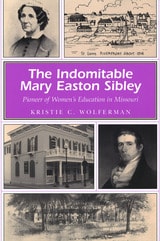
cover of The Indomitable Mary Easton Sibley: Pioneer of Women's Education in Missouri

The Indomitable Mary Easton Sibley

Pioneer of Women's Education in Missouri

Kristie C. Wolferman

University of Missouri Press, 2008
Acknowledged as a significant figure in the history of women on the early western frontier, Mary Easton Sibley may be little known to many modern readers. Yet she was involved in most of the important events in nineteenth-century Missouri, pursued and practiced educational innovations, and founded a school that continues to thrive today. This first biography of Sibley sheds new light on this important pioneer.
            Kristie Wolferman retraces the course of an exciting life, beginning with four-year-old Mary’s arrival in St. Louis in 1804 when her father was appointed attorney general for the District of Louisiana—and the Eastons became one of the first American families to settle in this bustling French town. At fifteen, Mary married George Champlin Sibley, the factor of Fort Osage in Western Missouri, where the young bride lived among the Indians on the edge of the frontier and took up her teaching vocation. She then went on to found Linden Wood in St. Charles, the first college for women west of the Mississippi, and she also taught classes for African American and immigrant children. Throughout the story, Wolferman shows us a life intimately entwined with the history of the state, as Mary witnessed St. Louis in its primitive years and frontier life at Fort Osage, as well as changes in Indian policy and citizenship for former slaves.
Although Sibley’s life has been told in older accounts, Wolferman’s is the first to draw fully on Mary and George Sibley’s journals and letters, with Mary’s journal especially shedding light on her views regarding women’s social and political roles, slavery, temperance, religion, and other topics. By reconstructing Sibley’s inner life as well as her career, Wolferman depicts not merely a frontier heroine and educational pioneer but an assertive woman who did not hesitate to express unconventional views.
            Today, Lindenwood University is a major coeducational institution that continues to honor Mary Sibley’s philosophy and dedication. This biography not only brings to life one of Missouri’s most remarkable women educators but also demonstrates how her story reflects educational, religious, and social developments in both the state and the nation. The Indomitable Mary Easton Sibley recognizes her as a key player on the frontier and as a major part of Missouri’s heritage.
[more]
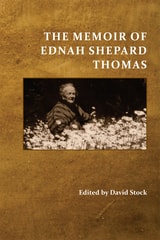
cover of The Memoir of Ednah Shepard Thomas

The Memoir of Ednah Shepard Thomas

Ednah Shepard Thomas

University Press of Colorado, 2017
The Memoir of Ednah Shepard Thomas offers an in-depth look at what it was to be a Writing Program Administrator during the period from after World War II up to the time of the early 1970s, a time for which we have little in the way of documentation for the work of early WPAs. Written at a time when the civil rights movement and the women's movement were just beginning to influence the way one thought and wrote about issues of race, class, and gender, this memoir offers insights into a period of time when the field was only beginning to come into focus. A foreword by Susan McLeod, an introduction and extensive footnotes by David Stock, and an afterword by David Fleming contextualize the memoir and highlight its relevance to scholars, teachers, and program administrators in composition-rhetoric. As a local history of writing program administration in its pre-professional era, the memoir offers a vital counternarrative to David Fleming's (2011) award-winning account of the abolition of UW-Madison's Freshman English program in 1969-70.
 
[more]
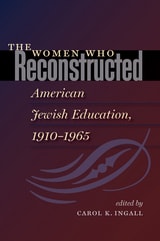
cover of The Women Who Reconstructed American Jewish Education, 1910-1965

The Women Who Reconstructed American Jewish Education, 1910-1965

Edited by Carol K. Ingall

Brandeis University Press, 2010

The conventional history of Jewish education in the United States focuses on the contributions of Samson Benderly and his male disciples. This volume tells a different story—the story of the women who either influenced or were influenced by Benderly or his closest friend, Mordecai Kaplan. Through ten portraits, the contributors illuminate the impact of these unheralded women who introduced American Jews to Hebraism and Zionism and laid the foundation for contemporary Jewish experiential education. Taken together, these ten portraits illuminate the important and hitherto unexamined contribution of women to the development of American Jewish education.
[more]