Results by title
11 books match the query 'Women foreign workers'
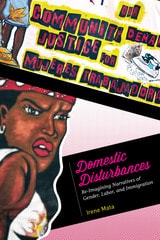
Domestic Disturbances
Re-Imagining Narratives of Gender, Labor, and ImmigrationBy Irene Mata
University of Texas Press, 2014
The issue of immigration is one of the most hotly debated topics in the national arena, with everyone from right-wing pundits like Sarah Palin to alternative rockers like Zack de la Rocha offering their opinion. The traditional immigrant narrative that gained popularity in the nineteenth and twentieth centuries continues to be used today in describing the process of the “Americanization” of immigrants. Yet rather than acting as an accurate representation of immigrant experiences, this common narrative of the “American Dream” attempts to ideologically contain those experiences within a story line that promotes the idea of achieving success through hard work and perseverance.
In Domestic Disturbances, Irene Mata dispels the myth of the “shining city on the hill” and reveals the central truth of hidden exploitation that underlies the great majority of Chicana/Latina immigrant stories. Influenced by the works of Latina cultural producers and the growing interdisciplinary field of scholarship on gender, immigration, and labor, Domestic Disturbances suggests a new framework for looking at these immigrant and migrant stories, not as a continuation of a literary tradition, but instead as a specific Latina genealogy of immigrant narratives that more closely engage with the contemporary conditions of immigration. Through examination of multiple genres including film, theatre, and art, as well as current civil rights movements such as the mobilization around the DREAM Act, Mata illustrates the prevalence of the immigrant narrative in popular culture and the oppositional possibilities of alternative stories.
Domestic Economies
Women, Work, and the American Dream in Los AngelesSusanna Rosenbaum
Duke University Press, 2017
Families Apart
Migrant Mothers and the Conflicts of Labor and LoveGeraldine Pratt
University of Minnesota Press, 2012
In a developing nation like the Philippines, many mothers provide for their families by traveling to a foreign country to care for someone else’s. Families Apart focuses on Filipino overseas workers in Canada to reveal what such arrangements mean for families on both sides of the global divide.
The outcome of Geraldine Pratt’s collaboration with the Philippine Women Centre of British Columbia, this study documents the difficulties of family separation and the problems that children have when they reunite with their mothers in Vancouver. Aimed at those who have lived this experience, those who directly benefit from it, and those who simply stand by and watch, Families Apart shows how Filipino migrant domestic workers—often mothers themselves—are caught between competing neoliberal policies of sending and receiving countries and how, rather than paying rich returns, their ambitions as migrants often result in social and economic exclusion for themselves and for their children. This argument takes shape as an open-ended series of encounters, moving between a singular academic voice and the “we” of various research collaborations, between Vancouver and the Philippines, and between genres of “evidence-based” social scientific research, personal testimony, theatrical performance, and nonfictional narrative writing.
Through these experiments with different modes of storytelling, Pratt seeks to transform frameworks of perception, to create and collect sympathetic witnesses—in short, to promote a wide-ranging public discussion and debate about a massive worldwide shift in family (and nonfamily) relations of intimacy and care.
Follow the Maid
Domestic Worker Migration from IndonesiaOlivia Killias
National University of Singapore Press, 2017
This fascinating study unveils the workings of the Indonesian migration regime, one that sends hundreds of thousands of women abroad as domestic workers each year. Drawing on extended ethnographic research since 2007, the book literally follows migrant women from one particular village in Central Java and tracks the moral, social, economic and legal processes by which they are turned into ‘maids’. From recruitment by local brokers to the ‘training’ received in secluded camps in Jakarta, employment in gated middle-class homes in Malaysia and back home again, Olivia Killias highlights the implications of the migration process on gendered practices of labour mobility (and immobilisation). She also reveals the disciplinary power that states, recruitment agencies and employers exercise over migrant domestic workers as well as highlighting frictions within the system. Killias’s analysis demonstrates that ironically, the “legalisation” of the migration industry, under the joint pressures of the Indonesian migration bureaucracy and international humanitarian agencies, does not automatically improve the situation of the women who embark on the migration adventure. Rather, Killias unmasks the gendered moralizing discourses on “illegal” migration and “trafficking” as legitimizing indentured labour and constraining migrant mobility. By exploring the workings of the Indonesian state’s overseas legal labour migration regime for migrants, she brings the reader directly into the nerve-racking lives of migrant village women, and reveals the richness and ambiguity of their experiences, going beyond stereotypical representations of them as “victims of trafficking”.
Immigrant Women Workers in the Neoliberal Age
Edited by Nilda Flores-Gonzalez, Anna Romina Guevarra, Maura Toro-Morn, and Grace Chang
University of Illinois Press, 2013
Laboring in the Shadow of Empire
Race, Gender, and Care Work in PortugalCeleste Vaughan Curington
Rutgers University Press, 2024
Winner of the ASA Race, Gender, and Class section's Distinguished Contribution to Scholarship Award
Winner of the ASA Racial and Ethnic Minorities section’s Oliver Cromwell Cox Book Award
Laboring in the Shadow of Empire: Race, Gender, and Care Work in Portugal examines the everyday lives of an African-descendant care service workforce that labors in an ostensibly “anti-racial” Europe and against the backdrop of the Portuguese colonial empire. While much of the literature on global care work has focused on Asian and Latine migrant care workers, there is comparatively less research that explicitly examines African care workers and their migration histories to Europe. Sociologist Celeste Vaughan Curington focuses on Portugal—a European setting with comparatively liberal policies around family settlement and naturalization for migrants. In this setting, rapid urbanization in the late twentieth century, along with a national push to reconcile work and family, has shaped the growth of paid home care and cleaning service industries. Many researchers focus on informal work settings, where immigrant rights are restricted and many workers are undocumented or without permanent residence status. Curington instead examines workers who have accessed citizenship or permanent residence status and also explores African women’s experiences laboring in care and service industries in the formal market, revealing how deeply colonial and intersectional logics of a racialized and international division of reproductive labor in Portugal render these women “hyper-invisible” and “hyper-visible” as “appropriate” workers in Lisbon.
Peripheral Labour Mobilities
Tanja Višic
Campus Verlag, 2022
The precarious situation in the successor states of Yugoslavia created a specific dynamic in the field of labor mobility. Still, little research has been done in this region on how women, who are older care workers from Serbia or Bosnia commute—often via illegal border crossings—to German households to look after the elderly. In Peripheral Labor Mobilities, Tanja Višic explores this gender-specific migration pattern in the first expansive ethnography of contemporary cross-border elder care in this region. She takes up questions about how the mobility and work practices of women are integrated into the socio-economic networks of the informal care work sector while also looking at worker confrontations with labor laws and border regimes. Illustrative case studies clearly detail culturally specific patterns of perception of care work, family relationships, and the mobility demanded by these labor arrangements.
Ready-to-Wear and Ready-to-Work
A Century of Industry and Immigrants in Paris and New YorkNancy L. Green
Duke University Press, 1997
Green focuses on issues of fashion and fabrication as they involve both the production and consumption of clothing. Traditionally, much of the urban garment industry has been organized around small workshops and flexible homework, and Green emphasizes the effect this labor organization had on the men and mostly women who have sewn the garments. Whether considering the immigrant Jews, Italians, Puerto Ricans, Dominicans, and Chinese in New York or the Chinese-Cambodians, Turks, Armenians, and Russian, Polish, and Tunisian Jews in Paris, she outlines similarities of social experience in the shops and the unions, while allowing the voices of the workers, in all their diversity to be heard.
A provocative examination of gender and ethnicity, historical conflict and consensus, and notions of class and cultural difference, Ready-to-Wear and Ready-to-Work breaks new ground in the methodology of comparative history.
Solidarity & Care
Domestic Worker Activism in New York CityAlana Lee Glaser
Temple University Press, 2023
Solidarity & Care examines the political mobilization of diverse care workers who joined together and supported one another through education, protests, lobbying, and storytelling. Domestic work activists used narrative and emotional appeals to build a coalition of religious communities, employers of domestic workers, labor union members, and politicians to first pass and then to enforce the new law.
Through oral history interviews, as well as ethnographic observation during DWU meetings and protest actions, Glaser chronicles how these women fought (and continue to fight) to improve working conditions. She also illustrates how they endure racism, punitive immigration laws, on-the-job indignities, and unemployment that can result in eviction and food insecurity.
The lessons from Solidarity & Care along with the DWU’s precedent-setting legislative success have applications to workers across industries.
All royalties will go directly to the Domestic Workers United

Soviet Signoras
Personal and Collective Transformations in Eastern European MigrationMartina Cvajner
University of Chicago Press, 2019
Cvajner details the personal and collective changes brought about by the experience of migration for these women: from the first hours arriving in a new country with no friends, relatives, or existing support networks, to later remaking themselves for their new environment. In response to their traumatic displacement, the women of Soviet Signoras—nearly all of whom found work in their new Western homes as elder care givers—refashioned themselves in highly sexualized, materialistic, and intentionally conspicuous ways. Cvajner’s focus on overt sexuality and materialism is far from sensationalist, though. By zeroing in on these elements of personal identity, she reveals previously unexplored sides of the social psychology of migration, coloring our contemporary discussion with complex shades of humanity.
Women's Labor in the Global Economy
Speaking in Multiple VoicesHarley, Sharon
Rutgers University Press, 2007
Globalization is not a new phenomenon; women throughout the world have been dealing with the circumstances and consequences of an international economy long before the advent of the transnational corporate conglomerate. However, in a mercenary example of the tried clich "the more things change, the more they stay the same," women-particularly those of color-continue to be relegated to the lowest rung of the occupational ladder, where their indispensable contributions to global market capitalism are downplayed or invalidated completely through the perpetuation of stereotypes and the denial of access to better job opportunities and resources.
How women of color around the world adapt and challenge the economic, political, and social effects of globalization is the subject of this broad-minded and incisive anthology. From Mexico, Jamaica, Ghana, Zimbabwe, and Sri Lanka, to immigrant and non-immigrant communities in the United States-the women documented in these essays are agricultural and factory workers, artists and entrepreneurs, mothers and activists. Their stories bear stark witness to how globalization continues to develop new sites and forms of exploitation, while its apparent victims continue to be women, men, and children of color.