Results by title
5 books match the query 'Women labor leaders'
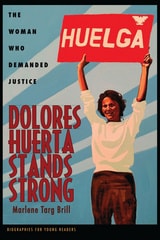
Dolores Huerta Stands Strong
The Woman Who Demanded JusticeMarlene Targ Brill
Ohio University Press, 2018
Selected as a Bank Street College of Education Best Children’s Book of the Year for 2018 (Category: Twelve–Fourteen)
“A biography for the times … An excellent read for anyone hoping to believe one person can make a difference.” —Kirkus (starred review)
“This well-told, age-appropriate account of a vital and essential activist deserves a place in all middle grade collections.” —School Library Journal (starred review)
Today, we know Dolores Huerta as the cofounder, with Cesar Chavez, of the National Farmworkers Association, which later became the United Farm Workers of America. We know her as a tireless advocate for the rights of farmworkers, Mexican American immigrants, women, and LGBTQ populations. And we know her as the recipient of the Presidential Medal of Freedom from Barack Obama in 2012.
Before all that, though, Huerta was a child in the farming community of Stockton, California, and then a teenager whose teachers underestimated her because she was Chicana. When she became a teacher herself, she witnessed her students coming to school shoeless and hungry. Many took days off from school to work in the farm fields to help feed their families. What could she do to help them? A young mother at the time, Huerta quit her teaching job to organize their parents. That began her journey to educate a nation about who produces our food and the conditions under which they work.
Dolores Huerta Stands Strong follows Huerta’s life from the mining communities of the Southwest where her father toiled, to the vineyards and fields of California, and across the country to the present day. As she worked for fair treatment for others, Dolores earned the nation’s highest honors. More important, she found her voice.
Doña María's Story
Life History, Memory, and Political IdentityDaniel James
Duke University Press, 2000
Doña María’s testimony is grounded in both the local context (based on the author’s thirteen years of historical and ethnographic research in Berisso) and a broader national narrative. In this way, it differs from the dominant genre of women’s testimonial literature, and much recent ethnographic work in Latin America, which have often neglected historical and communal contextualization in order to celebrate individual agency and self-construction. James examines in particular the ways that gender influences Doña María’s representation of her story. He is careful to acknowledge that oral history challenges the historian to sort through complicated sets of motivations and desires—the historian’s own wish to uncover “the truth” of an informant’s life and the interviewee’s hope to make sense of her or his past and encode it with myths of the self. This work is thus James’s effort to present his research and his relationship with Doña María with both theoretical sophistication and recognition of their mutual affection.
While written by a historian, Doña María’s Story also engages with concerns drawn from such disciplines as anthropology, cultural studies, and literary criticism. It will be especially appreciated by those involved in oral, Latin American, and working-class history.
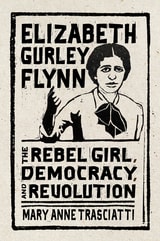
Elizabeth Gurley Flynn
The Rebel Girl, Democracy, and RevolutionMary Anne Trasciatti
Rutgers University Press, 2025
International Labor History Association Honorable Mention Book Award for 2025
Elizabeth Gurley Flynn was involved in almost every major campaign of the U.S. Left in the first two thirds of the twentieth century. An outstanding orator, writer, and tactician, Flynn is one of the most important figures in the history of the American labor movement. Inspired by the Irish freedom struggle and appalled by the exploitation and grinding poverty she saw around her, she devoted her life to the advancement of civil liberties. Here, Mary Anne Trasciatti traces Flynn’s personal and political life to explore the broader social issues of a fraught era.
Born in 1890, Flynn began her activist career by joining the Industrial Workers of the World (IWW) when she was just sixteen, and she ended it as the first female chair of the American Communist Party, a position she held from 1961 until her death in 1964. In the intervening years she organized workers into unions, led strikes, championed women’s rights, supported anti-imperialist movements around the globe, protested deportation, advocated for prison reform, and fought for Black liberation. Above all, she showed absolute devotion to workers and their struggles.
Slandered as an “un-American” in the anticommunist fervor of the 1940s and 1950s, Flynn was eventually ousted from the very organization she helped found, the American Civil Liberties Union, and imprisoned for two years. Though her own movement abandoned her, her commitment to the cause never wavered. This stirring biography illuminates Flynn’s inspiring life and worldview and returns her to her rightful place at the heart of labor and civil liberties history.

Showers of Blessings
Myrtle Lawrence, Notable Sharecropper and Union OrganizerElizabeth Anne Payne
University of Arkansas Press, 2023
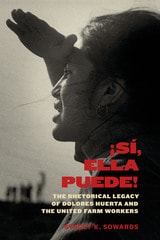
Sí, Ella Puede!
The Rhetorical Legacy of Dolores Huerta and the United Farm WorkersBy Stacey K. Sowards
University of Texas Press, 2019
Winner, Marie Hochmuth Nichols Award, Public Address Division, National Communication Association, 2020
Outstanding Book Award, Latina/o Communication Studies Division, National Communication Association, 2020
Since the 1950s, Latina activist Dolores Huerta has been a fervent leader and organizer in the struggle for farmworkers’ rights within the Latina/o community. A cofounder of the United Farm Workers union in the 1960s alongside César Chávez, Huerta was a union vice president for nearly four decades before starting her own foundation in the early 2000s. She continues to act as a dynamic speaker, passionate lobbyist, and dedicated figure for social and political change, but her crucial contributions and commanding presence have often been overshadowed by those of Chávez and other leaders in the Chicana/o movement. In this new study, Stacey K. Sowards closely examines Huerta’s rhetorical skills both in and out of the public eye and defines Huerta’s vital place within Chicana/o history.
Referencing the theoretical works of Pierre Bourdieu, Chela Sandoval, Gloria Anzaldúa, and others, Sowards closely analyzes Huerta’s speeches, letters, and interviews. She shows how Huerta navigates the complex intersections of race, ethnicity, gender, language, and class through the myriad challenges faced by women activists of color. Sowards’s approach to studying Huerta’s rhetorical influence offers a unique perspective for understanding the transformative relationship between agency and social justice.