Results by title
11 books match the query 'Women labor union members'

"Rights, Not Roses"
Unions and the Rise of Working-Class Feminism, 1945-80Dennis A. Deslippe
University of Illinois Press, 2000
Educated, white collar professional women carried the most visible banners of feminism. But working class women were a powerful force in the campaign for gender equality. Dennis A. Deslippe explores how unionized wage-earning women led the struggle to place women's employment rights on the national agenda, decisively influencing both the contemporary labor movement and second-wave feminism.
Deslippe's account unravels a complex history of how labor leaders accommodated and resisted working women's demands for change. Through case studies of unions representing packinghouse and electrical workers, Deslippe explains why gender equality emerged as an issue in the 1960s and how the activities of wage-earning women in and outside of their unions shaped the content of the debate. He also traces the fault lines separating working-class women--who sought gender equality within the parameters of unionist principles such as seniority--from middle-class women--who sought an equal rights amendment that would guarantee an abstract equality for all women.
Thoughtful and detailed, "Rights, Not Roses" offers a new look at the complexities of working-class feminism.
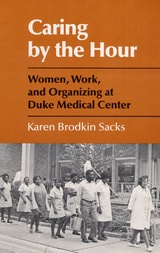
Caring by the Hour
Women, Work, and Organizing at Duke Medical CenterKaren Brodkin Sacks
University of Illinois Press, 1988
In addition to an analysis of the dynamics of women's activism, Caring by the Hour provides a comparative study of Duke Medical Center's treatment of both black and white female workers. Sacks links patterns of racial segregation in clerical jobs to the relationship between race, working conditions, and unequal opportunities for black and white women, and to their differing work cultures and patterns of public militance. She also discusses recent changes in service, clerical, and professional work and their effects on white and black women, placing them in the context of national changes in health funding and policies.
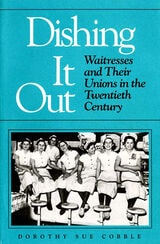
Dishing It Out
Waitresses and Their Unions in the Twentieth CenturyDorothy Sue Cobble
University of Illinois Press, 1991
Back when SOS or Adam and Eve on a raft were things to order if you were hungry but a little short on time and money, nearly one-fourth of all waitresses belonged to unions. By the time their movement peaked in the 1940s and 1950s, the women had developed a distinctive form of working-class feminism, simultaneously pushing for equal rights and pay and affirming their need for special protections.
Dorothy Sue Cobble shows how sexual and racial segregation persisted in wait work, but she rejects the idea that this was caused by employers' actions or the exclusionary policies of male trade unionists. Dishing It Out contends that the success of waitress unionism was due to several factors: waitresses, for the most part, had nontraditional family backgrounds, and most were primary wage-earners. Their close-knit occupational community and sex-separate union encouraged female assertiveness and a decidedly unromantic view of men and marriage. Cobble skillfully combines oral interviews and extensive archival records to show how waitresses adopted the basic tenets of male-dominated craft unions but rejected other aspects of male union culture. The result is a book that will expand our understanding of feminism and unionism by including the gender conscious perspectives of working women.
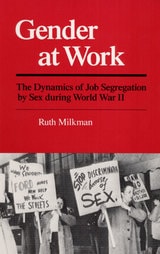
Gender at Work
The Dynamics of Job Segregation by Sex during World War IIRuth Milkman
University of Illinois Press, 1987
Women's entry into so-called men's work during World War II sparked conflicts at the time and when men returned at war's end. Ruth Milkman delves into the issues in play and the prewar origins of traditional patterns of gender segregation in the workplace. Ranging from the dynamics on the shop floor to hiring patterns, Milkman pays particular attention to automobile and electrical manufacturing. She analyzes a number of persistent questions, including management's decision to re-embrace gender segregation after the war; women's lack of protest; the failure of unions to protect women; and how related employer strategies helped control labor by maintaining women's place as workers paid less than men.
Gendering Labor History
Alice Kessler-Harris
University of Illinois Press, 2006
This collection represents the thirty-year intellectual trajectory of one of today’s leading historians of gender and labor in the United States. The seventeen essays are divided into four sections, narrating the evolution and refinement of Alice Kessler-Harris's central project: showing gender’s fundamental importance in the shaping of United States history and working class culture.
The first section considers women and organized labor while the second pushes this analysis toward a gendered labor history as the essays consider the gendering of male as well as female workers and how gender operates with and within the social category of class. Subsequent sections broaden this framework to examine U.S. social policy as a whole, the question of economic citizenship, and wage labor from a global perspective. While each essay represents an important intervention in American historiography in itself, the collection taken as a whole shows Kessler-Harris continuing to push the field of American history to greater levels of inclusion and analysis.
Marching Together
Women of the Brotherhood of Sleeping Car PortersMelinda Chateauvert
University of Illinois Press, 1998
The Brotherhood of Sleeping Car Porters (BSCP) was the first national trade union for African Americans. Standard BSCP histories focus on the men who built the union. Yet the union's Ladies' Auxiliary played an essential role in shaping public debates over black manhood and unionization, setting political agendas for the black community, and crafting effective strategies to win racial and economic justice.
Melinda Chateauvert explores the history of the Ladies' Auxiliary and the wives, daughters, and sisters of Pullman porters who made up its membership and used the union to claim respectability and citizenship. As she shows, the Auxiliary actively educated other women and children about the labor movement, staged consumer protests, and organized local and national civil rights campaigns ranging from the 1941 March on Washington to school integration to the Montgomery Bus Boycott. Chateauvert also sheds light on the plight of Pullman maids, who—relegated to the Auxiliary—found their problems as working women neglected in favor of the rhetoric of racial solidarity.
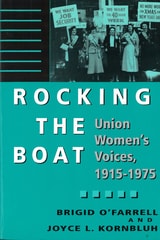
Rocking the Boat
Union Women's Voices, 1915-1975O'Farrell, Brigid
Rutgers University Press, 1996
Rocking the Boat is a celebration of strong, committed women who helped to build the American labor movement. Through the stories of eleven women from a wide range of backgrounds, we experience the turmoil, hardships, and accomplishments of thousands of other union women activists through the period spanning the Great Depression, the New Deal, World War II, the McCarthy era, the civil rights movement, and the women's movement. These women tell powerful stories that highlight and detail women's many roles as workers, trade unionists, and family members. They all faced difficulties in their personal lives, overcame challenges in their unions, and individually and collectively helped improve women's everyday working lives.
Maida Springer-Kemp came from New York City's Harlem, Local 22 of the International Ladies' Garment Workers' Union, to represent the AFL-CIO in Africa. In Chicago, Alice Peurala fought for her job in the steel mill and her place in the steel workers' union. Jessie De La Cruz organized farm workers in California. Esther Peterson, organizer, educator, and lobbyist, became an advisor to four U.S. presidents. In chapters based on oral history interviews, these women and others provide new perspectives and practical advice for today's working women. They share an idealistic and practical commitment to the labor movement. As Dorothy Haener of the United Auto Workers and a founding member of the National Organization of Women said, "You have to take a look at how to rock the boat. You don't want to spill yourself out if you can avoid it, but sometimes you have to rock the boat." From these women we, too, learn how to rock the boat.
Social Justice for Women
The International Labor Organization and WomenCarol Riegelman Lubin and Anne Winslow
Duke University Press, 1990
Carol Riegelman Lubin, a staff member of ILO for seventeen years, and Anne Winslow, for twenty-two years editor for the Carnegie Endowment, explore the important role played by women of the American and British trade union movement in the founding of the ILO. In surveying the organization’s history and structure, they ask how the ILO’s concern with women has manifested over the years, if it was faithful to its constitution, how it dealt with conflicting needs of women from industrialized nations and Third World countries, and what its relationship was to the international feminist movement. Drawing on case studies and analyses of literature on women and work, the authors identify the role of other international organizations in response to the ILO in fostering, or sometimes hindering, women’s development in the labor area.
The Rising of Women
Feminist Solidarity and Class Conflict, 1880-1917Meredith Tax
University of Illinois Press, 2001
Through detailed studies of the Woman's Trade Union League, the Illinois Women's Alliance, the New York shirtwaist makers strike of 1909-10, and the 1912 textile workers strike in Lawrence, Massachusetts, Meredith Tax uncovers the circumstances that helped and hindered cross-class and cross-gender cooperation on behalf of women of the working class. In a new introduction to this first Illinois paperback edition, Tax assesses the progress of women's solidarity since the book's original publication.

Union Women
Forging Feminism In The United Steelworkers Of AmericaMary Margaret Fonow
University of Minnesota Press, 2002
How a feminist agenda took hold in a male-dominated union.
For more than a quarter century, steel mills in the United States and Canada have produced more than metal: they have produced a new kind of worker and union activist-"Women of Steel." In an era labeled postfeminist and postindustrial, women have created spaces in this quintessentially male-dominated workforce from which to mobilize for their rights as women and workers. In Union Women, Mary Margaret Fonow captures the stories of the women of the United Steelworkers. She focuses on a tenacious group who used their developing power in the union to challenge sex discrimination and to advocate for women’s rights, and applied their transnational resources to construct a feminist response to globalization and economic restructuring. In the process, they have transformed the organizations, resources, and networks of both the labor and women’s movements, and have in turn transformed themselves into feminists.
In Union Women Fonow uses statistical, archival, and ethnographic research methods to provide a broad historical account of women in the steel industry. Fonow’s sweeping approach allows her to examine several key issues in social movement, feminist, and political theory, and to show that insights from these fields shape each other. She explores how social movements are gendered, how working-class women develop a feminist consciousness, and how this process is informed by intersecting demands of race, class, and gender. As a comparative, cross-national study, Union Women also demonstrates how different political and social cultures affect women’s organizing and strategic decisions. Finally, Fonow emphasizes that economic restructuring and globalization pose immediate challenges for women as laborers and activists, and that, in order to survive, all unions must develop organizing and mobilization strategies informed by feminism and other social movements.
Working Women of Collar City
Gender, Class, and Community in Troy, 1864-86Carole Turbin
University of Illinois Press, 1992
Why have some working women succeeded at organizing in spite of obstacles to labor activity? Under what circumstances were they able to form alliances with male workers?
Carole Turbin explores these and other questions by examining the case of Troy, New York. In the 1860s, Troy produced nearly all the nation's detachable shirt collars and cuffs. The city's collar laundresses were largely Irish immigrants. Their union was officially the nation's first women's labor organization, and one of the best organized. Turbin provides a new perspective on gender and shows that women's family ties are not necessarily a conservative influence but may encourage women's and men's collective action.