Results by title

7 books match the query 'Women mystics'
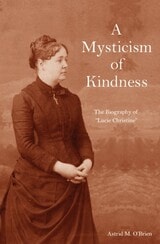
cover of A Mysticism of Kindness: The Lucie Christine Story

A Mysticism of Kindness

The Lucie Christine Story

Astrid M. O’Brien

University of Scranton Press, 2010

On the surface, Lucie Christine—the pseudonym given to a nineteenth-century Frenchwoman named Mathilde Boutle—was a very ordinary upper-middle-class woman, fulfilling her daily responsibilities to her husband and children. But underneath, Lucie Christine was an extraordinary human being. In A Mysticism of Kindness, Astrid M. O’Brien tells the life story of this remarkable woman, revealing how her experiences as a mystic allowed her to persevere as a wife and mother in the midst of constant verbal and physical abuse from her alcoholic husband. Her story will inspire all those who struggle to find a way to live a strong spiritual life in an often difficult and troubling world.
[more]
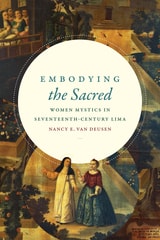
cover of Embodying the Sacred: Women Mystics in Seventeenth-Century Lima

Embodying the Sacred

Women Mystics in Seventeenth-Century Lima

Nancy E. van Deusen

Duke University Press, 2018
In seventeenth-century Lima, pious Catholic women gained profound theological understanding and enacted expressions of spiritual devotion by engaging with a wide range of sacred texts and objects, as well as with one another, their families, and ecclesiastical authorities. In Embodying the Sacred, Nancy E. van Deusen considers how women created and navigated a spiritual existence within the colonial city's complex social milieu. Through close readings of diverse primary sources, van Deusen shows that these women recognized the divine—or were objectified as conduits of holiness—in innovative and powerful ways: dressing a religious statue, performing charitable acts, sharing interiorized spiritual visions, constructing autobiographical texts, or offering their hair or fingernails to disciples as living relics. In these manifestations of piety, each of these women transcended the limited outlets available to them for expressing and enacting their faith in colonial Lima, and each transformed early modern Catholicism in meaningful ways.
[more]
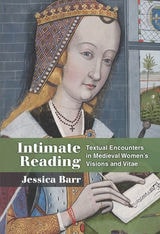
cover of Intimate Reading: Textual Encounters in Medieval Women’s Visions and Vitae

Intimate Reading

Textual Encounters in Medieval Women’s Visions and Vitae

Jessica Barr

University of Michigan Press, 2020

Intimate Reading: Textual Encounters in Medieval Women’s Visions and Vitae explores the ways that women mystics sought to make their books into vehicles for the reader’s spiritual transformation. Jessica Barr argues that the cognitive work of reading these texts was meant to stimulate intensely personal responses, and that the very materiality of the book can produce an intimate encounter with God. She thus explores the differences between mystics’ biographies and their self-presentation, analyzing as well the complex rhetorical moves that medieval women writers employ to render their accounts more effective.
This new volume is structured around five case studies. Chapters consider the biographies of 13th-century holy women from Liège, the writings of Margery Kempe, Gertrude of Helfta, Mechthild of Magdeburg, Marguerite Porete, and Julian of Norwich. At the heart of Intimate Reading is the question of how reading works—what it means to enter imaginatively and intellectually into the words of another. The volume showcases the complexity of medieval understandings of the work of reading, deepening our perception of the written word’s capacity to signify something that lies even beyond rational comprehension.
[more]
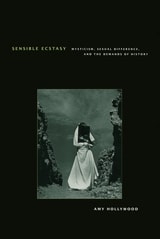
cover of Sensible Ecstasy: Mysticism, Sexual Difference, and the Demands of History

Sensible Ecstasy

Mysticism, Sexual Difference, and the Demands of History

Amy Hollywood

University of Chicago Press, 2001

Sensible Ecstasy investigates the attraction to excessive forms of mysticism among twentieth-century French intellectuals and demonstrates the work that the figure of the mystic does for these thinkers. With special attention to Georges Bataille, Simone de Beauvoir, Jacques Lacan, and Luce Irigaray, Amy Hollywood asks why resolutely secular, even anti-Christian intellectuals are drawn to affective, bodily, and widely denigrated forms of mysticism.

What is particular to these thinkers, Hollywood reveals, is their attention to forms of mysticism associated with women. They regard mystics such as Angela of Foligno, Hadewijch, and Teresa of Avila not as emotionally excessive or escapist, but as unique in their ability to think outside of the restrictive oppositions that continue to afflict our understanding of subjectivity, the body, and sexual difference. Mystics such as these, like their twentieth-century descendants, bridge the gaps between action and contemplation, emotion and reason, and body and soul, offering new ways of thinking about language and the limits of representation.
[more]
cover of The Visions of Sor María de Agreda: Writing Knowledge and Power

The Visions of Sor María de Agreda

Writing Knowledge and Power

Clark Colahan

University of Arizona Press, 1994
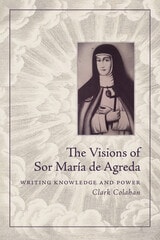
Sor María de Agreda (1602-65) was a Spanish nun and visionary who is best known as the author of the widely read biography of the Virgin Mary, The Mystical City of God, and as the missionary who "bilocated" to the American Southwest, reportedly appearing to Indians there without ever leaving Spain. Her role as advisor to King Philip IV contributed further to her legend. Clark Colahan now offers the first major study of Sor María's writings, including translations of two previously unpublished works: Face of the Earth and Map of the Spheres and the first half of her Report to Father Manero, in which she reflects on her bilocation.
[more]
cover of Women and Religion in Medieval and Renaissance Italy

Women and Religion in Medieval and Renaissance Italy

Edited by Daniel Bornstein and Roberto Rusconi

University of Chicago Press, 1996

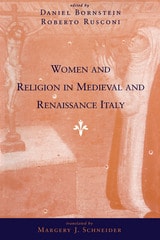
Between the twelfth and the sixteenth centuries, women assumed public roles of unprecedented prominence in Italian religious culture. Legally subordinated, politically excluded, socially limited, and ideologically disdained, women's active participation in religious life offered them access to power in all its forms.

These essays explore the involvement of women in religious life throughout northern and central Italy and trace the evolution of communities of pious women as they tried to achieve their devotional goals despite the strictures of the ecclesiastical hierarchy. The contributors examine relations between holy women, their devout followers, and society at large.

Including contributions from leading figures in a new generation of Italian historians of religion, this book shows how women were able to carve out broad areas of influence by carefully exploiting the institutional church and by astutely manipulating religious percepts.
[more]
cover of Women, Mysticism, and Hysteria in Fin-de-Siècle Spain

Women, Mysticism, and Hysteria in Fin-de-Siècle Spain

Jennifer Smith

Vanderbilt University Press, 2021

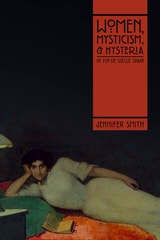
Women, Mysticism, and Hysteria in Fin-de-Siècle Spain argues that the reinterpretation of female mysticism as hysteria and nymphomania in late nineteenth- and early twentieth-century Spain was part of a larger project to suppress the growing female emancipation movement by sexualizing the female subject. This archival-historical work highlights the phenomenon in medical, social, and literary texts of the time, illustrating that despite many liberals' hostility toward the Church, secular doctors and intellectuals employed strikingly similar paradigms to those through which the early modern Spanish Church castigated female mysticism as demonic possession.

Author Jennifer Smith also directs modern historians to the writings of Emilia Pardo Bazán (1851-1921) as a thinker whose work points out mysticism's subversive potential in terms of the patriarchal order. Pardo Bazán, unlike her male counterparts, rejected the hysteria diagnosis and promoted mysticism as a path for women's personal development and self-realization.
[more]