Results by title
8 books match the query 'Women soldiers'
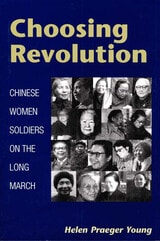
Choosing Revolution
Chinese Women Soldiers on the Long MarchHelen Praeger Young
University of Illinois Press, 2001
Enormously rich in detail, Young's Choosing Revolution reveals the complex interplay between women's experiences and the official, almost mythic version of the Long March. In addition to their riveting stories of the march itself, Young's subjects reveal much about what it meant in China to grow up female and, in many cases, poor during the first decades of the twentieth century. In speaking about the work they did and how they adapted to the demands of being a soldier, these women--both educated individuals who were well-known leaders and illiterate peasants--reveal the Long March as only one of many segments of the revolutionary paths they chose.
Against a background of diverse perspectives on the Long March, Young presents the experiences of four women in detail: one who brought her infant daughter with her on the Long March, one who gave birth during the march, one who was a child participant, and one who attended medical school during the march. Young also includes the stories of three women who did not finish the Long March. Her unique record of ordinary women in revolutionary circumstances reveals the tenacity and resilience that led these individuals far beyond the limits of most Chinese women's lives.
Gender Is a Weapon
Liberalism, Difference, and US CounterinsurgencyElizabeth Mesok
University of Michigan Press, 2026
Following the end of the draft in 1973, the US military increasingly offered women the opportunity to transform their lives—to obtain an education, receive healthcare, provide for their families, and prove their worth to the nation. By the time the US invaded Iraq and Afghanistan at the turn of the twenty-first century, the labor of women—and Black women in particular—was critical to the military’s ability to simultaneously wage two wars. Within the context of counterinsurgencies fought amid civilian populations, the US military discovered the value of women’s gender difference as a weapon of war.
Through ethnographic and archival research with women soldiers and Marines, as well as military and government officials, Gender Is a Weapon contextualizes women’s service in Iraq and Afghanistan against the promises of liberal inclusion unfolding throughout the late twentieth and early twenty-first century. Centered on narratives of Black and Indigenous women, women of color, immigrant women, and queer women, the book analyzes the transformations of martial citizenship; the racialized language of cultural difference in the US’s revitalized counterinsurgency doctrine; the gendered performances of women in combat and civilian engagement missions; and ultimately, the irreparable injuries of body and mind with which these women returned home. The epilogue discusses the recent dismantling of DEI in the military and US government more broadly, reflecting on what we can learn from the violent history of military liberal inclusion to help us better understand our contemporary moment. By carefully attending to both the discursive construction and performative enactment of gender in militarized and securitized contexts, the book advances theoretical frames for studying gender in state militaries, militarism, and late liberalism.
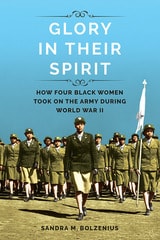
Glory in Their Spirit
How Four Black Women Took On the Army during World War IISandra M Bolzenius
University of Illinois Press, 2018
Inventing Loreta Velasquez
Confederate Soldier Impersonator, Media Celebrity, and Con ArtistWilliam C. Davis
Southern Illinois University Press, 2016
This groundbreaking biography reveals a woman quite different from the public persona she promoted. In her bestselling memoir, The Woman in Battle, Velasquez claimed she was an emphatic Confederate patriot, but in fact she never saw combat. Instead, during the war she manufactured bullets for the Union and persuaded her Confederate husband to desert the Army.
After the Civil War ended, she wore many masks, masterminding ambitious confidence schemes worth millions, such as creating a phony mining company, conning North Carolina residents to back her financially in a fake immigration scheme, and attracting investors to build a railroad across western Mexico. With various husbands, Velasquez sought her fortune both in the American West and in the Klondike, though her endeavors cost one husband his life. She also became a social reformer advocating on behalf of better prison conditions, the Cuban revolt against Spain, and the plight of Cuban refugees. Further, Velasquez was one of the first women to venture into journalism and presidential politics. Always a sensational press favorite, she displayed throughout her life an uncanny ability to manipulate popular media and to benefit from her fame in a way that prefigured celebrities of our own time, including using her testimony in a Congressional inquiry about Civil War counterfeiting as a means of promoting her latest business ventures.
So little has been known of Velasquez’s real life that some postmodern scholars have glorified her as a “woman warrior” and used her as an example in cross-gender issues and arguments concerning Hispanic nationalism. Davis firmly refutes these notions by bringing the historical Velasquez to the surface. The genuine story of Velasquez’s life is far more interesting than misguided interpretations and her own fanciful inventions.
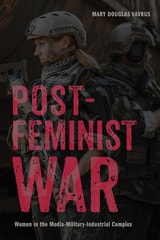
Postfeminist War
Women in the Media-Military-Industrial ComplexMary Douglas Vavrus
Rutgers University Press, 2019
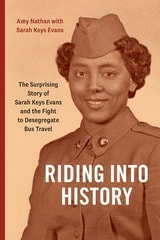
Riding into History
The Surprising Story of Sarah Keys Evans and the Fight to Desegregate Bus TravelAmy Nathan with Sarah Keys Evans
Duke University Press, 2026
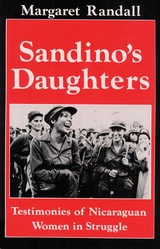
Sandino's Daughters
Testimonies of Nicaraguan Women in StruggleRandall, Margaret
Rutgers University Press, 1995
"A collection of varied and amazing lives, all bent on shaping history. Together, these experienced, undeterred Nicaraguan women offer powerful clues about a truly revolutionary and democratizing feminism."––Adrienne Rich
"If it were not for writers like Margaret, how would women around the world find each other when there is such an institutional effort to keep us apart and silent? Here Margaret brings us the voice of Sandino's daughters, honoring his hat and wearing their own, wiser now, having been part of political and personal revolution."––Holly Near
"Powerful, moving, and challenging. Everyone interested in decency and justice will want to read Sandino's Daughters Revisited."––Blanche Wiesen Cook
Sandino's Daughters, Margaret Randall's conversations with Nicaraguan women in their struggle against the dictator Somoza in 1979, brought the lives of a group of extraordinary female revolutionaries to the American and world public. The book remains a landmark. Now, a decade later, Randall returns to interview many of the same women and others. In Sandino's Daughters Revisited, they speak of their lives during and since the Sandinista administration, the ways in which the revolution made them strong––and also held them back. Ironically, the 1990 defeat of the Sandinistas at the ballot box has given Sandinista women greater freedom to express their feelings and ideas.
Randall interviewed these outspoken women from all walks of life: working-class Diana Espinoza, head bookkeeper of a employee-owned factory; Daisy Zamora, a vice minister of culture under the Sandinistas; and Vidaluz Meneses, daughter of a Somozan official, who ties her revolutionary ideals to her Catholicism. The voices of these women, along with nine others, lead us to recognize both the failed promises and continuing attraction of the Sandinista movement for women. This is a moving account of the relationship between feminism and revolution as it is expressed in the daily lives of Nicaraguan women.
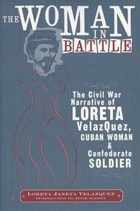
The Woman in Battle
The Civil War Narrative of Loreta Janeta Velazquez, Cuban Woman and Confederate SoldierLoreta Janeta Velazquez
University of Wisconsin Press, 2003
Originally published in 1876 as The Woman in Battle, this Civil War narrative offers Velazquez’s seemingly impossible autobiographical account, as well as a new critical introduction and glossary by Jesse Alemán. Scholars are divided between those who read the book as a generally honest autobiography and those who read it as mostly fiction. According to Alemán’s critical introduction, the book also reads as pulp fiction, spy memoir, seduction narrative, travel literature, and historical account, while it mirrors the literary conventions of other first-person female accounts of cross-dressing published in the United States during wartime, dating back to the Revolutionary War. Whatever the facts are, this is an authentic Civil War narrative, Alemán concludes, that recounts how war disrupts normal gender roles, redefines national borders, and challenges the definition of identity.