Results by title

4 books match the query 'Women textile workers'
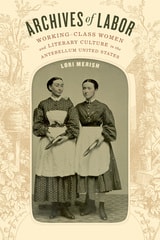
cover of Archives of Labor: Working-Class Women and Literary Culture in the Antebellum United States

Archives of Labor

Working-Class Women and Literary Culture in the Antebellum United States

Lori Merish

Duke University Press, 2017
In Archives of Labor Lori Merish establishes working-class women as significant actors within literary culture, dramatically redrawing the map of nineteenth-century US literary and cultural history. Delving into previously unexplored archives of working-class women's literature—from autobiographies, pamphlet novels, and theatrical melodrama to seduction tales and labor periodicals—Merish recovers working-class women's vital presence as writers and readers in the antebellum era. Her reading of texts by a diverse collection of factory workers, seamstresses, domestic workers, and prostitutes boldly challenges the purportedly masculine character of class dissent during this era. Whether addressing portrayals of white New England "factory girls," fictional accounts of African American domestic workers, or the first-person narratives of Mexican women working in the missions of Mexican California, Merish unsettles the traditional association of whiteness with the working class to document forms of cross-racial class identification and solidarity. In so doing, she restores the tradition of working women's class protest and dissent, shows how race and gender are central to class identity, and traces the ways working women understood themselves and were understood as workers and class subjects.
[more]
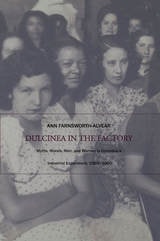
cover of Dulcinea in the Factory: Myths, Morals, Men, and Women in Colombia's Industrial Experiment, 1905-1960

Dulcinea in the Factory

Myths, Morals, Men, and Women in Colombia's Industrial Experiment, 1905-1960

Ann Farnsworth-Alvear

Duke University Press, 2000

Before it became the center of Latin American drug trafficking, the Colombian city of Medellín was famous as a success story of industrialization, a place where protectionist tariffs had created a “capitalist paradise.” By the 1960s, the city’s textile industrialists were presenting themselves as the architects of a social stability that rested on Catholic piety and strict sexual norms. Dulcinea in the Factory explores the boundaries of this paternalistic order by investigating workers’ strategies of conformity and resistance and by tracing the disciplinary practices of managers during the period from the turn of the century to a massive reorganization of the mills in the late 1950s.

Ann Farnsworth-Alvear’s analyses of archived personnel records, internal factory correspondence, printed regulations, and company magazines are combined with illuminating interviews with retired workers to allow a detailed reconstruction of the world behind the mill gate. In a place where the distinction between virgins and nonvirgins organized the labor market for women, the distance between chaste and unchaste behavior underlay a moral code that shaped working women’s self-perceptions. Farnsworth-Alvear challenges the reader to understand gender not as an opposition between female and male but rather as a normative field, marked by “proper” and “improper” ways of being female or male. Disputing the idea that the shift in the mills’ workforce over several decades from mainly women to almost exclusively men was based solely on economic factors, the author shows how gender and class, as social practices, converged to shape industrial development itself.

Innovative in its creative employment of subtle and complex material, Dulcinea in the Factory addresses long-standing debates within labor history about proletarianization and work culture. This book’s focus on Colombia will make it valuable to Latin Americanists, but it will also appeal to a wide readership beyond Latin American and labor studies, including historians and sociologists, as well as students of women’s studies, social movements, and anthropology.
[more]
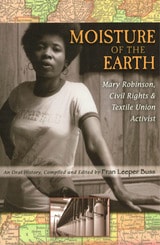
cover of Moisture of the Earth: Mary Robinson, Civil Rights and Textile Union Activist

Moisture of the Earth

Mary Robinson, Civil Rights and Textile Union Activist

An Oral History, Compiled and Edited by Fran Leeper Buss

University of Michigan Press, 2009

In Moisture of the Earth, Mary Robinson recounts her journey from picking cotton in rural Alabama to becoming an outspoken community leader and labor activist. The daughter of sharecroppers, Robinson came of age at the peak of the civil rights movement and took a job in J. P. Stevens's Montgomery plant when the textile manufacturing giant was forced to admit African American workers. She soon became part of the historic organizing struggle by the Amalgamated Clothing and Textile Workers Union, finding her voice as an outspoken activist and union organizer. This is a riveting narrative of determination and defiance in the face of poverty and racial injustice, and a rare, behind-the-scenes account of union organizing drives in the South, from the vantage point of a black woman. Based on twenty-three years of interviews between Mary Robinson and oral historian Fran Leeper Buss, this book reveals the intertwined effects of race, class, and gender on the lives of lower-income women during segregation and after; sheds light on African American resistance movements in the twentieth century and the roles of religious traditions and storytelling to struggles for social justice; and highlights women's important roles in community activism and the labor movement.
[more]
cover of Radicals of the Worst Sort: Laboring Women in Lawrence, Massachusetts, 1860-1912

Radicals of the Worst Sort

Laboring Women in Lawrence, Massachusetts, 1860-1912

Ardis Cameron

University of Illinois Press, 1993

Ardis Cameron focuses on the textile workers' strikes of 1882 and 1912 in this examination of class and gender formation as drawn from the experience and language of the working-class neighborhoods of Lawrence, Massachusetts. Using the neighborhood perspective to explore the role of women in worker militancy, Cameron reveals the importance of female networks and organizational life in working-class culture and politics. Unionized women were labeled "radicals of the worst sort" because, in fighting for equality, they also rebelled against traditional economic and sexual hierarchies. Oral histories and detailed maps illuminate the setting and the dramatic story behind the famous Bread and Roses strike of 1912.
[more]