Results by title
4 books match the query 'Work-Related Health'
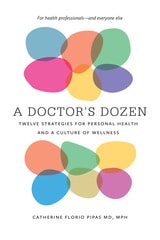
A Doctor's Dozen
Twelve Strategies for Personal Health and a Culture of WellnessCatherine Florio Pipas
Dartmouth College Press, 2018
Burnout affects a third of our population and over half of our health professionals. For the second group, the impact is magnified, as consequences play out not only on a personal level, but also on a societal level and lead to medical errors, suboptimal care, low levels of patient satisfaction, and poor clinical outcomes. Achieving wellbeing requires strategies for change. In this book, Dr. Pipas shares twelve lessons and strategies for improved health that she has learned from patients, students, and colleagues over her twenty years working as a family physician. Each lesson is based on observation and research, and begins with a story of an exemplary patient whose challenges and successes reflect the theme of the lesson. Along with the lessons, the author offers plans for action, which taken together create the framework for a healthy life. Each lesson concludes with resources and a “health challenge.”
[more]
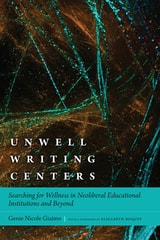
Unwell Writing Centers
Searching for Wellness in Neoliberal Educational Institutions and Beyondby Genie Nicole Giaim, foreword by Elizabeth Boquet
Utah State University Press, 2022
Unwell Writing Centers focuses on the inroads the wellness industry has made into higher education. Following graduate and undergraduate writing tutors during a particularly stressful period (2016–2019), Genie Nicole Giaimo examines how top-down and bottom-up wellness interventions are received and taken up by workers. Engaging sociocultural research on how workers react to and experience workplace conflict, Giaimo demonstrates the kinds of interventions welcomed by workers as well as those that fall flat, including the “easy” fixes to workplace issues that institutions provide in lieu of meaningful and community-based support.
The book is broken into sections based on journeying: searching for wellness, finding wellness, and imagining a “well” future that includes a sustainable model of writing center work. Each chapter begins with a personal narrative about wellness issues in writing centers, including the author’s experiences in and responses to local emergencies. She shares findings from a longitudinal assessment study on non-institutional interventions in writing centers and provides resources for administrators to create more ethical "well" writing centers. The book also includes an appendix of training documents, emergency planning documents, and several wellness-specific interventions developed from anti-racist, anti-neoliberal, and organizational theories.
Establishing the need for a field-specific response to the austerity-minded eruption of wellness-focused interventions in higher education, Unwell Writing Centers is a critical text for graduate students and new directors that can easily be applied in workplaces in and outside of higher education.
[more]

Well-Being and Creative Careers
What Makes You Happy Can Also Make You SickMark Deuze
Intellect Books, 2025
The creative industry’s best-kept secret? Burnout is part of the business model.
The media and creative industries thrive on passion, but that passion often comes at a cost. Behind the glamour of journalism, filmmaking, games, music, advertising, and online content creation lies a growing crisis—one of burnout, anxiety, substance abuse, and exhaustion. Why do so many creative professionals report feeling both deeply fulfilled and profoundly unwell?
Mark Deuze investigates the systemic issues that make creative work both exhilarating and unsustainable. Drawing on extensive research and in-depth interviews with media professionals, he notes the hidden downsides of doing what you love and offers a candid analysis of how workplace structures, high workloads, and perceived injustices contribute to mental and physical distress.
But this book is not just about what’s broken; it’s about what can be done. Deuze provides a roadmap for rethinking the culture of creative industries and offers strategies for balancing passion with sustainability. A practical resource for media scholars and those navigating the highs and lows of a creative career, this work challenges us to imagine a healthier future for our labor of love.
[more]
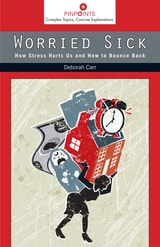
Worried Sick
How Stress Hurts Us and How to Bounce BackCarr, Deborah
Rutgers University Press, 2014
Comments like “I’m worried sick” convey the conventional wisdom that being “stressed out” will harm our health. Thousands of academic studies reveal that stressful life events (like a job loss), ongoing strains (like burdensome caregiving duties), and even daily hassles (like traffic jams on the commute to work) affect every aspect of our physical and emotional well-being. Cutting through a sea of scientific research and theories, Worried Sick answers many questions about how stress gets under our skin, makes us sick, and how and why people cope with stress differently. Included are several standard stress and coping checklists, allowing readers to gauge their own stress levels.
We have all experienced stressful times—maybe a major work deadline or relocating cross-country for a new job—when we came out unscathed, feeling not only emotionally and physically healthy, but better than we did prior to the crisis. Why do some people withstand adversity without a scratch, while others fall ill or become emotionally despondent when faced with even a seemingly minor hassle? Without oversimplifying the discussion, Deborah Carr succinctly provides readers with key themes and contemporary research on the concept of stress. Understanding individuals’ own sources of strength and vulnerability is an important step toward developing personal strategies to minimize stress and its unhealthy consequences. Yet Carr also challenges the notion that merely reducing stress in our lives will help us to stay healthy. Many of the stressors that we face in everyday life are not our problems alone; rather, they are symptoms of much larger, sweeping problems in contemporary U.S. society.
To readers interested in the broad range of chronic, acute, and daily life stressors facing Americans in the twenty-first century, as well as those with interest in the many ways that our physical and emotional health is shaped by our experiences, this brief book will be an immediate and quick look at these significant issues.
View a three minute video of Deborah Carr speaking about Worried Sick.
[more]