Results by title

5 books match the query 'Work-life balance'
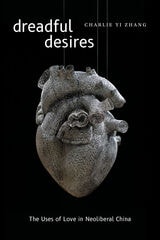
cover of Dreadful Desires: The Uses of Love in Neoliberal China

Dreadful Desires

The Uses of Love in Neoliberal China

Charlie Yi Zhang

Duke University Press, 2022
In Dreadful Desires Charlie Yi Zhang examines how the Chinese state deploys affective notions of love to regulate the population and secure China’s place in the global economy. Zhang shows how the state frames love as a set of desires that encompass heteronormative intimacy, familial and communal attachment, upward mobility, and private property ownership. These desires—as circulated in performance in the nationalistic ceremony, same-sex romantic fan fiction, the wildly popular reality television dating show If You Are the One, and the cult of patriarchal personality around Xi Jinping—are explicitly based in oppressive systems of gender, class, and sexuality. Zhang contends that such desires connect love to economic survival and gender normativity in ways that underwrite Chinese neoliberalism at the expense of individual flourishing. By outlining how state-framed forms of love create desires that cannot be fulfilled, Zhang places China at the forefront of using affective attachments to nation, leader, and family in the global shifts toward exploitation and authoritarianism.
[more]
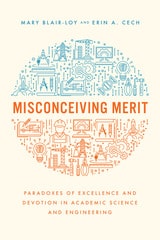
cover of Misconceiving Merit: Paradoxes of Excellence and Devotion in Academic Science and Engineering

Misconceiving Merit

Paradoxes of Excellence and Devotion in Academic Science and Engineering

Mary Blair-Loy and Erin A. Cech

University of Chicago Press, 2022

An incisive study showing how cultural ideas of merit in academic science produce unfair and unequal outcomes.
 
In Misconceiving Merit, sociologists Mary Blair-Loy and Erin A. Cech uncover the cultural foundations of a paradox. On one hand, academic science, engineering, and math revere meritocracy, a system that recognizes and rewards those with the greatest talent and dedication. At the same time, women and some racial and sexual minorities remain underrepresented and often feel unwelcome and devalued in STEM. How can academic science, which so highly values meritocracy and objectivity, produce these unequal outcomes?
 
Blair-Loy and Cech studied more than five hundred STEM professors at a top research university to reveal how unequal and unfair outcomes can emerge alongside commitments to objectivity and excellence. The authors find that academic STEM harbors dominant cultural beliefs that not only perpetuate the mistreatment of scientists from underrepresented groups but hinder innovation. Underrepresented groups are often seen as less fully embodying merit compared to equally productive white and Asian heterosexual men, and the negative consequences of this misjudgment persist regardless of professors’ actual academic productivity. Misconceiving Merit is filled with insights for higher education administrators working toward greater equity as well as for scientists and engineers striving to change entrenched patterns of inequality in STEM.
 
[more]
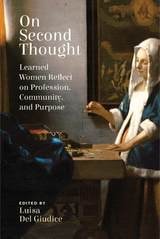
cover of On Second Thought: Learned Women Reflect on Profession, Community, and Purpose

On Second Thought

Learned Women Reflect on Profession, Community, and Purpose

Luisa Del Giudice

University of Utah Press, 2017

In these dynamic essays, thirteen wise women review their lives for meaning and purpose, striving to integrate both head and heart. They consider how their spiritual paradigms have shaped their vocations as teachers, scholars, guides, mentors, and advocates and how these roles have been integral to their life’s work, not merely to their work life. With courageous and insightful testimonies they narrate the intersecting relationships of work, family, students, patients, and colleagues, weaving them together rather than compartmentalizing them. Challenges inside and outside the academy and other professional settings are revealed, to tell of suffering and transformation, to tally hard-earned life lessons and to share wisdom achieved. 

Lives and words are gathered and generously shared, allowing these women to make sense of their own lives while mentoring a wider circle of younger and older readers alike. These “travel tales” of journeys through knowledge and self-knowledge will inform, challenge, surprise, entertain, and inspire. 

[more]
cover of Summers Off?: A History of U.S. Teachers' Other Three Months

Summers Off?

A History of U.S. Teachers' Other Three Months

Christine A. Ogren

Rutgers University Press, 2026
Since the nine-month school year became common in the United States during the 1880s, schoolteachers have never really had summers off. Administrators instructed them to rest, as well as to study and travel, in the interest of creating a compliant workforce. Teachers, however, adapted administrators’ directives to pursue their own version of professionalization and to ensure their financial well-being. Summers Off explores teachers’ summer experiences between the 1880s and 1930s in institutes and association meetings; sessions at teachers colleges, Black colleges, and prestigious universities; work for wages or their family; tourism in the U.S. and Europe; and activities intended to be restful. This heretofore untold history reveals how teachers utilized the geographical and psychological distance from the classroom that summer provided, to enhance not only their teaching skills but also their professional and intellectual independence, their membership in the middle class, and, in the cases of women and Black teachers, their defiance of gender and race hierarchies.
[more]
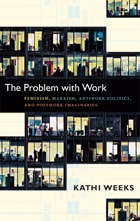
cover of The Problem with Work: Feminism, Marxism, Antiwork Politics, and Postwork Imaginaries

The Problem with Work

Feminism, Marxism, Antiwork Politics, and Postwork Imaginaries

Kathi Weeks

Duke University Press, 2011

In The Problem with Work, Kathi Weeks boldly challenges the presupposition that work, or waged labor, is inherently a social and political good. While progressive political movements, including the Marxist and feminist movements, have fought for equal pay, better work conditions, and the recognition of unpaid work as a valued form of labor, even they have tended to accept work as a naturalized or inevitable activity. Weeks argues that in taking work as a given, we have “depoliticized” it, or removed it from the realm of political critique. Employment is now largely privatized, and work-based activism in the United States has atrophied. We have accepted waged work as the primary mechanism for income distribution, as an ethical obligation, and as a means of defining ourselves and others as social and political subjects. Taking up Marxist and feminist critiques, Weeks proposes a postwork society that would allow people to be productive and creative rather than relentlessly bound to the employment relation. Work, she contends, is a legitimate, even crucial, subject for political theory.
[more]