Results by title

5 books match the query 'Workers' theater'
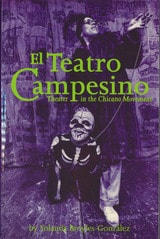
cover of El Teatro Campesino: Theater in the Chicano Movement

El Teatro Campesino

Theater in the Chicano Movement

By Yolanda Broyles-González

University of Texas Press, 1994

Born in 1965 as an organizing tool within César Chávez's United Farm Workers union, El Teatro Campesino became the premier Chicana/o performance ensemble to emerge out of the Chicano movement of the 1960s and 1970s. This study demythologizes and reinterprets the company's history from its origins in California's farm labor struggles to its successes in Europe and on Broadway until the disbanding of the original collective ensemble in 1980 with the subsequent adoption of mainstream production techniques.

Yolanda Broyles-González corrects many misconceptions concerning the Teatro's creation and evolution. She draws from a rich storehouse of previously untapped material, such as interviews with numerous ensemble members, production notes, and unpublished diaries, to highlight the reality of the collective creation that characterized the Teatro's work.

Writing within contemporary cultural studies theory, Broyles-González sheds light on class, gender, race, and cultural issues. Her work situates the Teatro within working-class Mexican performance history, the Chicano movement, gender relations, and recent attempts to mainstream.
[more]
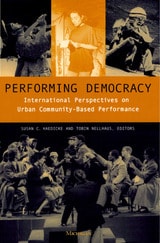
cover of Performing Democracy: International Perspectives on Urban Community-Based Performance

Performing Democracy

International Perspectives on Urban Community-Based Performance

Susan C. Haedicke and Tobin Nellhaus, Editors

University of Michigan Press, 2001
Performing Democracy explores aspects of a developing form of performance that works to change social conditions for marginalized groups or to preserve the traditions and cohesion of the community. The book combines critical analysis with field reports on specific projects and productions to explore the issues that confront community-based performance. The range of topics is impressive, and includes performances in North America, Australia, the Middle East, Bosnia, Taiwan, Korea, England, and the Netherlands. Many articles include production photos. The book's first section focuses on how performance can contribute to the definition, creation, and preservation of community. Next, contributors address issues of authority within the production of community-based performance. A final section considers community-based performance's efforts to encourage individuals to feel empowered in everyday life and in their relation to government. The range of performance genres covered includes community history plays, agitprop, forum theater workshops, puppetry, avant-garde plays, dance, and oral epics. The projects involve many different kinds of communities, including the inner city, youth, seniors, ethnic groups, activists, gays and lesbians, immigrants, and prison inmates.
[more]
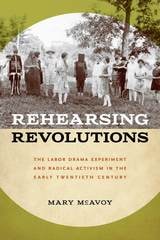
cover of Rehearsing Revolutions: The Labor Drama Experiment and Radical Activism in the Early Twentieth Century

Rehearsing Revolutions

The Labor Drama Experiment and Radical Activism in the Early Twentieth Century

Mary McAvoy

University of Iowa Press, 2019

Choice Outstanding Academic Title, 2019

George Freedley Memorial Award Finalist, 2020

Between the world wars, several labor colleges sprouted up across the U.S. These schools, funded by unions, sought to provide members with adult education while also indoctrinating them into the cause. As Mary McAvoy reveals, a big part of that learning experience centered on the schools’ drama programs. For the first time, Rehearsing Revolutions shows how these left-leaning drama programs prepared American workers for the “on-the-ground” activism emerging across the country. In fact, McAvoy argues, these amateur stages served as training grounds for radical social activism in early twentieth-century America.

Using a wealth of previously unpublished material such as director’s reports, course materials, playscripts, and reviews, McAvoy traces the programs’ evolution from experimental teaching tool to radically politicized training that inspired overt—even militant—labor activism by the late 1930s. All the while, she keeps an eye on larger trends in public life, connecting interwar labor drama to post-war arts-based activism in response to McCarthyism, the Cold War, and the Civil Rights movement. Ultimately, McAvoy asks: What did labor drama do for the workers’ colleges and why did they pursue it? She finds her answer through several different case studies in places like the Portland Labor College and the Highlander Folk School in Tennessee.
[more]
cover of Staging Strikes: Workers' Theatre and the American Labor Movement

Staging Strikes

Workers' Theatre and the American Labor Movement

Collette Hyman

Temple University Press, 1997

In the thirties, those on the political left, Socialists, Communists, artists and writers, educators, and labor movement activists, shared the belief that leisure activities should reflect and promote the interests of working people. Cultural activities should be used to educate workers in bringing about radical social and political changes and to draw people together around shared interests. Workers' theater became a successful vehicle for political education and for involving the audience in the labor movement.

Such plays as "Let Freedom Ring" and "Waiting for Lefty" depicted experiences that paralleled the audiences' own, that entertained and absorbed them, and that showed them the personal, social, economic, and political changes that could be achieved through the struggles of the labor movement.

In clear and moving prose, Hyman traces the history of workers' theater from its grassroots origins to the Federal Theater Project of the WPA under Roosevelt and into unions' recreational programs. Even today, the tradition of workers' theater endures in local and regional productions that reflect current worker concerns or revive significant workers' plays of the Depression period. Hyman shows that the significance of workers' theater lies not only in the plays produced but also in the audiences' experience, in coming together out of common concerns to achieve a solidarity that emphasizes the effectiveness of collective action.
[more]
cover of Taking It to the Streets: The Social Protest Theater of Luis Valdez and Amiri Baraka

Taking It to the Streets

The Social Protest Theater of Luis Valdez and Amiri Baraka

Harry J. Elam, Jr.

University of Michigan Press, 2001

The performances of Luis Valdez's El Teatro Campesino, the farmworkers' theater, and Amiri Baraka's (LeRoi Jones's) Black Revolutionary Theater (BRT) during the 1960s and 1970s, offer preeminent examples of social protest theater during a momentous and tumultuous historical juncture. The performances of these groups linked the political, the cultural, and the spiritual, while agitating against the dominant power structure and for the transformation of social and theatrical practices in the U.S. Founded during the Delano Grape Pickers' Strike and Black Power rebellions of the mid-1960s, both El Teatro and the BRT professed cultural pride and group unity as critical corollaries to self-determination and revolutionary social action. Taking It to the Streets compares the performance methodologies, theories, and practices of the two groups, highlighting their cross-cultural commonalties, and providing insights into the complex genre of social protest performance and its interchange with its audience. It examines the ways in which ritual can be seen to operate within the productions of El Teatro and the BRT, uniting audience and performers in subversive, celebratory protest by transforming spectators into active participants within the theater walls --and into revolutionary activists outside. During this critical historical period, these performances not only encouraged community empowerment, but they inculcated a spirit of collective faith and revolutionary optimism. Elam's critical reexamination and recontextualization of the ideologies and practices of El Teatro and the BRT aid in our understanding of contemporary manipulations of identity politics, as well as current strategies for racial representation and cultural resistance. "A major contribution to our understanding of how social protest came to be so strong and how Black and Chicano theatre contributed to the synergy of those times." --Janelle Reinelt, University of California, Davis Harry J. Elam, Jr., is Associate Professor of Drama and Director of the Committee on Black Performing Arts, Stanford University.
[more]