Results by title
4 books match the query 'Working - Class Women'
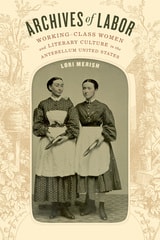
Archives of Labor
Working-Class Women and Literary Culture in the Antebellum United StatesLori Merish
Duke University Press, 2017
Hidden Hands
Working-Class Women and Victorian Social-Problem FictionPatricia E. Johnson
Ohio University Press, 2001
Tracing the Victorian crisis over the representation of working-class women to the 1842 Parliamentary bluebook on mines, with its controversial images of women at work, Hidden Hands argues that the female industrial worker became even more dangerous to represent than the prostitute or the male radical because she exposed crucial contradictions between the class and gender ideologies of the period and its economic realities.
Drawing on the recent work of feminist historians, Patricia Johnson lays the groundwork for a reinterpretation of Victorian social-problem fiction that highlights its treatment of issues that particularly affected working-class women: sexual harassment; the interconnections between domestic ideology and domestic violence; their relationships to male-dominated working-class movements such as Luddism, Chartism, and unionism; and their troubled connection to middle-class feminism.
Uncovering a series of images in Victorian fiction ranging from hot-tempered servants and sexually harassed factory girls to working-class homemakers pictured as beaten dogs, Hidden Hands demonstrates that representations of working-class women, however marginalized or incoherent, reveal the very contradictions they are constructed to hide and that the dynamics of these representations have broad implications both for other groups, such as middle-class women, and for the emergence of working-class women as writers themselves.
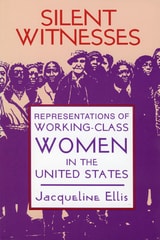
Silent Witnesses
Representations of Working-Class Women in the United StatesJacqueline Ellis
University of Wisconsin Press, 1998
Through detailed analyses of documentary photography and radical literature, Silent Witnesses explores how working-class identity has been repressed and manipulated to fit the expectations of liberal politicians, radical authors, Marxist historians, feminist academics, and contemporary cultural theorists.
Working-Class Women in the Academy
Laborers in the Knowledge FactoryMichelle M. Tokarczyk
University of Massachusetts Press, 1993
The voices of 20 women from working-class backgrounds are heard in this collection of essays. Each of the women has lived through the process of academic socialization—as both student and teacher—and each has thought long and deeply about her experiences from an explicitly feminist perspective.