Results by title
17 books match the query 'Working Poor'

A Jumble of Needs
Women’s Activism and Neoliberalism in the Colonias of the SouthwestRebecca Dolhinow
University of Minnesota Press, 2010
Both Hands Tied
Welfare Reform and the Race to the Bottom in the Low-Wage Labor MarketJane L. Collins and Victoria Mayer
University of Chicago Press, 2010
Both Hands Tied studies the working poor in the United States, focusing in particular on the relation between welfare and low-wage earnings among working mothers. Grounded in the experience of thirty-three women living in Milwaukee and Racine, Wisconsin, it tells the story of their struggle to balance child care and wage-earning in poorly paying and often state-funded jobs with inflexible schedules—and the moments when these jobs failed them and they turned to the state for additional aid.
Jane L. Collins and Victoria Mayer here examine the situations of these women in light of the 1996 national Personal Responsibility and Work Opportunity Reconciliation Act and other like-minded reforms—laws that ended the entitlement to welfare for those in need and provided an incentive for them to return to work. Arguing that this reform came at a time of gendered change in the labor force and profound shifts in the responsibilities of family, firms, and the state, Both Hands Tied provides a stark but poignant portrait of how welfare reform afflicted poor, single-parent families, ultimately eroding the participants’ economic rights and affecting their ability to care for themselves and their children.
Child Care in Black and White
Working Parents and the History of OrphanagesJessie B. Ramey
University of Illinois Press, 2013
Degraded Work
The Struggle at the Bottom of the Labor MarketMarc Doussard
University of Minnesota Press, 2013
Critics on the left and the right typically agree that globalization, the loss of manufacturing jobs, and the expansion of the service sector have led to income inequality and rising numbers of low-paying jobs with poor working conditions.
In Degraded Work, Marc Doussard demonstrates that this decline in wages and working conditions is anything but the unavoidable result of competitive economic forces. Rather, he makes the case that service sector and other local-serving employers have boosted profit with innovative practices to exploit workers, demeaning their jobs in new ways—denying safety equipment, fining workers for taking scheduled breaks, requiring unpaid overtime—that go far beyond wage cuts. Doussard asserts that the degradation of service work is a choice rather than an inevitability, and he outlines concrete steps that can be taken to help establish a fairer postindustrial labor market.
Drawing on fieldwork in Chicago, Degraded Work examines changes in two industries in which inferior job quality is assumed to be intrinsic: residential construction and food retail. In both cases, Doussard shows how employers degraded working conditions as part of a successful and intricate strategy to increase profits. Arguing that a growing service sector does not have to mean growing inequality, Doussard proposes creative policy and organizing opportunities that workers and advocates can use to improve job quality despite the overwhelming barriers to national political action.
Garbage Citizenship
Vital Infrastructures of Labor in Dakar, SenegalRosalind Fredericks
Duke University Press, 2018
Higher Ground
New Hope for the Working Poor and Their ChildrenGreg J. Duncan
Russell Sage Foundation, 2007

Hinterland
America's New Landscape of Class and ConflictPhil A. Neel
Reaktion Books, 2018
Urgent and unsparing, this book opens our eyes to America’s new heart of darkness. Driven by an ever-expanding socioeconomic crisis, America’s class structure is recomposing itself in new geographies of race, poverty, and production. The center has fallen. Riots ricochet from city to city led by no one in particular. Anarchists smash financial centers as a resurgent far right builds power in the countryside. Drawing on his direct experience of recent popular unrest, from the Occupy movement to the wave of riots and blockades that began in Ferguson, Missouri, Phil A. Neel provides a close-up view of this landscape in all its grim but captivating detail. Inaugurating the new Field Notes series, published in association with the Brooklyn Rail, Neel’s book tells the intimate story of a life lived within America’s hinterland.
Laboring Below the Line
The New Ethnography of Poverty, Low-Wage Work, and Survival in the Global EconomyFrank Munger
Russell Sage Foundation, 2002
Making It Work
Low-Wage Employment, Family Life, and Child DevelopmentHirokazu Yoshikawa
Russell Sage Foundation, 2006
Making the Work-Based Safety Net Work Better
Forward-Looking Policies to Help Low-Income FamiliesCarolyn J. Heinrich
Russell Sage Foundation, 2009
Moving Up or Moving On
Who Gets Ahead in the Low-Wage Labor Market?Fredrik Andersson
Russell Sage Foundation, 2005
Old Assumptions, New Realities
Ensuring Economic Security for Working Families in the 21st CenturyRobert D. Plotnick
Russell Sage Foundation, 2011
The Servant Class City
Urban Revitalization versus the Working Poor in San DiegoDavid J. Karjanen
University of Minnesota Press, 2016
San Diego, California, is frequently viewed as a model for American urban revitalization. It looks like a success story, with blight and poverty replaced by high-rises and jobs. But David J. Karjanen shows that the much-touted job opportunities for poor people have been concentrated in low-paying service work as the cost of living in San Diego has soared. The Servant Class City documents how, over a period of three decades, San Diego’s urban transformation actually eroded the economic standing of the city’s working poor.
Karjanen demonstrates that urban policy in San Diego, which has been devoted to increasing tourism, has fostered the creation of jobs that do not actually provide either livable wages or paths to upward mobility. Marshaling a wealth of heretofore uncollected data, he challenges the presumption that decades-long stagnation of job mobility in the united states is a result of insufficient worker training or a “skills mismatch,” or is attributable to various personal qualities of the urban poor.
Karjanen interweaves profiles of people with a compelling presentation of data. Each chapter addresses a significant topic: hospitality industry jobs, retail work, informal employment, “fringe banking,” and economic barriers to mobility. In revealing the true story of the “poverty traps” that are associated with low-wage jobs in the service economy, The Servant Class City complicates the rosy picture of life in an American tourist boomtown.
Unsettled
The Culture of Mobility and the Working Poor in Early Modern EnglandPatricia Fumerton
University of Chicago Press, 2006
Migrants made up a growing class of workers in late sixteenth- and seventeenth- century England. In fact, by 1650, half of England’s rural population consisted of homeless and itinerant laborers. Unsettled is an ambitious attempt to reconstruct the everyday lives of these dispossessed people. Patricia Fumerton offers an expansive portrait of unsettledness in early modern England that includes the homeless and housed alike.
Fumerton begins by building on recent studies of vagrancy, poverty, and servants, placing all in the light of a new domestic economy of mobility. She then looks at representations of the vagrant in a variety of pamphlets and literature of the period. Since seamen were a particularly large and prominent class of mobile wage-laborers in the seventeenth century, Fumerton turns to seamen generally and to an individual poor seaman as a case study of the unsettled subject: Edward Barlow (b. 1642) provides a rare opportunity to see how the laboring poor fashioned themselves, for he authored a journal of over 225,000 words and 147 pages of drawings. Barlow’s journal, studied extensively here for the first time, vividly charts what he himself termed his “unsettled mind” and the perpetual anxieties of England’s working and wayfaring poor. Ultimately, Fumerton explores representations of seamen as unsettled in the broadside ballads of Barlow’s time.
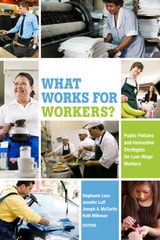
What Works for Workers?
Public Policies and Innovative Strategies for Low-Wage WorkersStephanie Luce
Russell Sage Foundation, 2014

Women, Work, and Representation
Needlewomen in Victorian Art and LiteratureLynn M. Alexander
Ohio University Press, 2003
In Victorian England, virtually all women were taught to sew; needlework was allied with images of domestic economy and with traditional female roles of wife and mother- with home rather than factory. The professional seamstress, however, labored long hours for very small wages creating gowns for the upper and middle classes. In her isolation and helplessness, she provided social reformers with a powerful image of working-class suffering that appealed to the sensibilities of the upper classes and helped galvanize public opinion around the need for reform.
Women, Work, and Representation addresses the use of that image in the reform movement, underscoring the shock to the Victorian public when reports revealed that the profession of needlework was extremely hazardous, even deadly.
Author Lynn M. Alexander traces the development of the symbol of the seamstress through a variety of presentations, drawing from the writings of Charles Dickens, Elizabeth Gaskell, Charlotte Elizabeth Tonna, and George W. M. Reynolds, and on visual representations by Richard Redgrave, Thomas Benjamin Kennington, John Everett Millais, John Leech, John Tenniel, and Hubert von Herkomer.
Written to appeal to Victorian scholars, women's studies scholars, and those interested in semiotics and aestheticism, Women, Work, and Representation includes twenty illustrations, most from periodicals of the day, providing new insights into the lives of working women throughout the Victorian era.
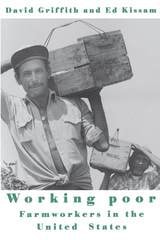
Working Poor
Farmworkers in the United StatesDavid Griffith
Temple University Press, 1995
Working Poor investigates the lives and working conditions of migrant farmworkers in seven regions of the United States. The community studies in this volume include descriptions and analyses of the low-income neighborhoods of Immokalee, Florida; Parlier, California; Weslaco, Texas; and Mayagüez, Puerto Rico, where growers and farm contractors put immigrants to work in fruit and vegetable harvests. The authors link farmworker communities that have winter growing seasons with summer labor supply demand regions in the northern United States, in particular south-western Michigan, New Jersey, and the Delmarva Peninsula of Maryland and Delaware.
The authors investigate ethnic succession in the farm labor market and the ways individual farmworkers, farmworker families, and networks organize these migrations and attach themselves to farming operations by a variety of social relations. Framing the portraits of crowded households, the histories of networks, and the ethnic vignettes are three chapters placing the community studies into historical and theoretical perspectives. This broad framework underscores the importance of housing, transportation, networks, labor contracts, and ethnic relations in the organization of low-wage labor markets.