Results by title
4 books match the query 'Working class writings, English'
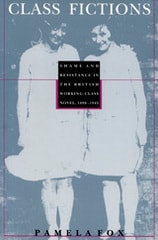
Class Fictions
Shame and Resistance in the British Working Class Novel, 1890–1945Pamela Fox
Duke University Press, 1994
With a focus on certain classics in the working-class literary "canon," such as The Ragged Trousered Philanthropists and Love on the Dole, as well as lesser-known texts by working-class women, Fox uncovers the anxieties that underlie representations of class and consciousness. Shame repeatedly emerges as a powerful counterforce in these works, continually unsettling the surface narrative of protest to reveal an ambivalent relation toward the working-class identities the novels apparently champion.
Class Fictions offers an equally rigorous analysis of cultural studies itself, which has historically sought to defend and value the radical difference of working-class culture. Fox also brings to her analysis a strong feminist perspective that devotes considerable attention to the often overlooked role of gender in working-class fiction. She demonstrates that working-class novels not only expose master narratives of middle-class culture that must be resisted, but that they also reveal to us a need to create counter narratives or formulas of working-class life. In doing so, this book provides a more subtle sense of the role of resistance in working class culture. While of interest to scholars of Victorian and working-class fiction, Pamela Fox’s argument has far-reaching implications for the way literary and cultural studies will be defined and practiced.
Hidden Hands
Working-Class Women and Victorian Social-Problem FictionPatricia E. Johnson
Ohio University Press, 2001
Tracing the Victorian crisis over the representation of working-class women to the 1842 Parliamentary bluebook on mines, with its controversial images of women at work, Hidden Hands argues that the female industrial worker became even more dangerous to represent than the prostitute or the male radical because she exposed crucial contradictions between the class and gender ideologies of the period and its economic realities.
Drawing on the recent work of feminist historians, Patricia Johnson lays the groundwork for a reinterpretation of Victorian social-problem fiction that highlights its treatment of issues that particularly affected working-class women: sexual harassment; the interconnections between domestic ideology and domestic violence; their relationships to male-dominated working-class movements such as Luddism, Chartism, and unionism; and their troubled connection to middle-class feminism.
Uncovering a series of images in Victorian fiction ranging from hot-tempered servants and sexually harassed factory girls to working-class homemakers pictured as beaten dogs, Hidden Hands demonstrates that representations of working-class women, however marginalized or incoherent, reveal the very contradictions they are constructed to hide and that the dynamics of these representations have broad implications both for other groups, such as middle-class women, and for the emergence of working-class women as writers themselves.
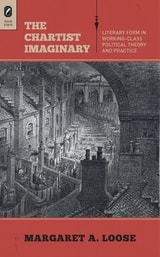
The Chartist Imaginary
Literary Form in Working-Class Political Theory and PracticeMargaret A. Loose
The Ohio State University Press, 2014
The Chartist Imaginary offers close readings of poems and fiction by Chartist figures from Ernest Jones and Thomas Cooper to W. J. Linton, Thomas Martin Wheeler, and Gerald Massey. It also draws on extensive archival research to examine, for the first time, working-class female Chartist poets Mary Hutton, E. L. E., and Elizabeth La Mont. Focusing on the literary form of these works, Loose strongly argues for the political power of the aesthetic in working-class literature.
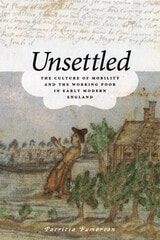
Unsettled
The Culture of Mobility and the Working Poor in Early Modern EnglandPatricia Fumerton
University of Chicago Press, 2006
Migrants made up a growing class of workers in late sixteenth- and seventeenth- century England. In fact, by 1650, half of England’s rural population consisted of homeless and itinerant laborers. Unsettled is an ambitious attempt to reconstruct the everyday lives of these dispossessed people. Patricia Fumerton offers an expansive portrait of unsettledness in early modern England that includes the homeless and housed alike.
Fumerton begins by building on recent studies of vagrancy, poverty, and servants, placing all in the light of a new domestic economy of mobility. She then looks at representations of the vagrant in a variety of pamphlets and literature of the period. Since seamen were a particularly large and prominent class of mobile wage-laborers in the seventeenth century, Fumerton turns to seamen generally and to an individual poor seaman as a case study of the unsettled subject: Edward Barlow (b. 1642) provides a rare opportunity to see how the laboring poor fashioned themselves, for he authored a journal of over 225,000 words and 147 pages of drawings. Barlow’s journal, studied extensively here for the first time, vividly charts what he himself termed his “unsettled mind” and the perpetual anxieties of England’s working and wayfaring poor. Ultimately, Fumerton explores representations of seamen as unsettled in the broadside ballads of Barlow’s time.