Results by title
11 books match the query 'World Economy'
Developing Country Debt and the World Economy
Edited by Jeffrey D. Sachs
University of Chicago Press, 1989
Developing Country Debt and the World Economy contains nontechnical versions of papers prepared under the auspices of the project on developing country debt, sponsored by the National Bureau of Economic Research. The project focuses on the middle-income developing countries, particularly those in Latin America and East Asia, although many lessons of the study should apply as well to other, poorer debtor countries. The contributors analyze the crisis from two perspectives, that of the international financial system as a whole and that of individual debtor countries.
Studies of eight countries—Argentina, Bolivia, Brazil, Indonesia, Mexico, the Philippines, South Korea, and Turkey—explore the question of why some countries succumbed to serious financial crises while other did not. Each study was prepared by a team of two authors—a U.S.-based research and an economist from the country under study. An additional eight papers approach the problem of developing country debt from a global or "systemic" perspective. The topics they cover include the history of international sovereign lending and previous debt crises, the political factors that contribute to poor economic policies in many debtor nations, the role of commercial banks and the International Monetary Fund during the current crisis, the links between debt in developing countries and economic policies in the industrialized nations, and possible new approaches to the global management of the crisis.
From Silver to Cocaine
Latin American Commodity Chains and the Building of the World Economy, 1500-2000Steven Topik, Carlos Marichal, and Zephyr Frank, eds.
Duke University Press, 2006
By focusing on changing patterns of production and consumption over time, the contributors reconstruct complex webs of relationships and economic processes, highlighting Latin America’s central and interactive place in the world economy. They show how changes in coffee consumption habits, clothing fashions, drug usage, or tire technologies in Europe, Asia, and the Americas reverberate through Latin American commodity chains in profound ways. The social and economic outcomes of the continent’s export experience have been mixed. By analyzing the dynamics of a wide range of commodities over a five-hundred-year period, From Silver to Cocaine highlights this diversity at the same time that it provides a basis for comparison and points to new ways of doing global history.
Contributors. Marcelo Bucheli, Horacio Crespo, Zephyr Frank, Paul Gootenberg, Robert Greenhill, Mary Ann Mahony, Carlos Marichal, David McCreery, Rory Miller, Aldo Musacchio, Laura Nater, Ian Read, Mario Samper, Steven Topik, Allen Wells
Inflation, Exchange Rates, and the World Economy
Lectures on International Monetary EconomicsW. Max Corden
University of Chicago Press, 1986
Peasants and Capital
Dominica in the World EconomyMichel-Rolph Trouillot
HAU, 2025
Over thirty-five years ago, Michel-Rolph Trouillot’s debut ethnography, Peasants and Capital: Dominica in the World Economy, dared to regard peasants not as vestiges of premodern economies but as instrumental to, and integrated in, a capitalist world system. Combining historical ethnography with an intimate portrait of a banana-producing eastern Caribbean village, this multi-sited study demonstrates how multinational capital thrives on the surplus production of peasant cultivators. At the same time, it investigates how peasantries generate independent conceptions of value and subsistence in the process of building a new postcolonial state in Dominica. This new edition of Peasants and Capital invites anthropologists to revisit the methodological innovations of this multi-scalar study and readers to meditate on the continued vitality of peasant livelihoods in the Caribbean today.
Ryan Cecil Jobson’s new introduction situates this edition in the context of Trouillot’s remarkable life and career. Jobson reminds us of the book’s enduring theoretical and ethnographic significance and asks us to consider how the entanglement of peasants from Dominica in national and world affairs has been impacted by more recent histories, such as the end of preferential markets for Caribbean bananas, the migration of “banana children” to regional and metropolitan urban centers, and the devastation of Dominica by Hurricane Maria.

Penetration & Protest in Tanzania
Impact Of World Economy On The Pare, 1860-1960Isaria N. Kimambo
Ohio University Press, 1990
The originality of this study of rural transformation stems from the way in which Professor Kimambo has used the oral tradition to reveal the history of the impact of the world economy in northeastern Tanzania. First under the pressures of commodity trade, and later under German and British imperialism, the peasant producers of this region were forced into participation in capitalist production.
These partial changes destroyed the Pare’s balanced subsistence structure. But throughout the colonial period they were frustrated in their efforts to transform themselves fully into capitalist producers. These struggles finally led to open revolt in 1947 and it was three years before the protest ended. Between 1947 and 1960 the colonial government tried to reverse the effects of the revolt without providing the kind of transformation desired by the peasants.
This study illustrates vividly the difference between the intentions of capital and those of the colonized peasantry. The intentions of the two sides seemed to be incompatible. While imperialism would allow for the limited participation that would maximize profits for metropolitan capital, the peasants were struggling for freedom to transform themselves into capitalist producers.

Soviet Natural Resources in the World Economy
Edited by Robert G. Jensen, Theodore Shabad, and Arthur W. Wright
University of Chicago Press, 1983
The authors examine the mineral and forest resources that the Soviet Union has developed and may yet develop to provide exports during the 1980s. They discuss the regional dimension of these resources, especially in Siberia and the Soviet Far East; individual mineral raw materials, such as petroleum, natural gas, timber, iron ore, manganese, and gold; and finally the role of raw materials in Soviet foreign trade.
The authors, representing the United States, Canada, and Great Britain, are primarily geographers, but they include economists, political scientists, and a geologist. Their work is based on primary sources (for most of these reports, current information is no longer being released to researchers) and on interviews with Soviet officials.
The Regionalization of the World Economy
Edited by Jeffrey A. Frankel
University of Chicago Press, 1997
Including both empirical and theoretical studies, this volume addresses several important questions: Why do countries adopt FTAs and other regional trading arrangements? To what extent have existing regional arrangements actually affected patterns of trade? What are the welfare effects of such arrangements? Several chapters explore the economic effects of regional arrangements on patterns of trade, either on price differentials or via the gravity model on bilateral trade flows. In addition, this book examines the theoretical foundation of the gravity model. Making extensive use of the gravity model of bilateral trade, several chapters explore the economic effects of regional arrangements. In addition, this book examines the theoretical foundation of the gravity model.
The United States in the World Economy
Edited by Martin Feldstein
University of Chicago Press, 1988
The World Economy
History & ProspectBy W. W. Rostow
University of Texas Press, 1978
This monumental study is an account of the world economy from the eighteenth century to the twentieth, an analysis and prescription for the future, and a challenge to the neo-Keynesian theories of income determination and growth. It is based on some forty years of research and teaching.
Originally published in 1978, the volume looks back over the nineteenth and twentieth centuries. It includes an analysis of how the world's population expanded from about 1 billion in 1800 to 4 billion in 1976, with some 6.5 billion in sight for the year 2000; an account of the expansion and distribution of industrial production and trade during this period; and an analysis of price and relative price movements since the eighteenth century. Rostow gives a detailed description of the Kondratieff long cycles in the relative scarcity and abundance of food and raw materials and reasons that the world economy entered the fifth Kondratieff upswing at the close of 1972. He also examines the changing pattern of business cycles over the whole sweep of modern economic growth and the failure of the post-1945 world economy to control inflation. The volume also includes short economic histories of twenty national economies responsible for 80 percent of the world's production, based on a collection of computerized aggregate and sectoral data.
Each historical section leads naturally into one or more of the major problems dealt with in the final portion of the book, which looks to the future of the world economy: food, population, energy, raw materials, the environment, and the tasks of national and international policy. Rostow argued, counter to the Limits to Growth doctrine, that the critical period for industrial civilization lay in the last twenty-five years of the twentieth century, rather than in the twenty-first century, and that what we did or failed to do in that generation would determine the shape of the longer future.
No other economic history of this depth and breadth exists. It is a reference for economists, economic historians, and other social scientists as well as the informed lay reader.
Trading Blocs
States, Firms, and Regions in the World EconomyKerry A. Chase
University of Michigan Press, 2005
Trading Blocs is the first book to systematically demonstrate the theoretical significance of economies of scale in domestic pressure for trading blocs, and thereby build on a growing research agenda in areas of political economy and domestic politics.
"Chase has written a superb book that provides us with an innovative and compelling explanation for the development of trading blocs."
--Vinod Aggarwal, Director, Berkeley APEC Study Center, University of California, Berkeley
Kerry A. Chase is Assistant Professor of Political Science at Tufts University.
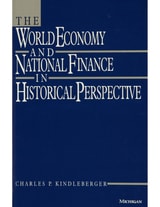
World Economy and National Finance in Historical Perspective
Charles P. Kindleberger
University of Michigan Press, 1995