Results by title

7 books match the query 'World Order'
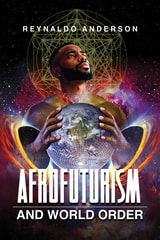
cover of Afrofuturism and World Order

Afrofuturism and World Order

Reynaldo Anderson

The Ohio State University Press, 2025
In Afrofuturism and World Order, Reynaldo Anderson delves into the evolution of Black speculative thought and Afrofuturism from the early twentieth century to the present day. By locating Afrofuturism within an African geography of reason, he situates the past, present, and future of people of African descent at the intersection of speculative philosophy, science fiction, futurology, artificial intelligence, climate change, and geopolitics. Historically, Afrofuturism theorized futures for Black Americans through merging their lived experiences with science fiction, technology, music, and art. Drawing from adaptations in Black culture and speculative thought during the Cold War, Anderson addresses the shifting focus of the genre from American to transnational, as well as the implications of modern existential threats such as the COVID-19 pandemic. By tracing the Black speculative tradition from its overlaps with Africana esotericism and certain African diaspora regions, to its intersections with astroculture and modernism, to the works of Malcolm X, Amiri Baraka, W. E. B. Du Bois, and Octavia Butler, to the aesthetic politics of the Black Speculative Arts movement, and beyond, Anderson illuminates how Afrofuturism participates in an increasingly multipolar world.
[more]
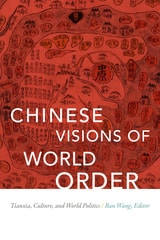
cover of Chinese Visions of World Order: Tianxia, Culture, and World Politics

Chinese Visions of World Order

Tianxia, Culture, and World Politics

Ban Wang, editor

Duke University Press, 2017

The Confucian doctrine of tianxia (all under heaven) outlines a unitary worldview that cherishes global justice and transcends social, geographic, and political divides. For contemporary scholars, it has held myriad meanings, from the articulation of a cultural imaginary and political strategy to a moralistic commitment and a cosmological vision. The contributors to Chinese Visions of World Order examine the evolution of tianxia's meaning and practice in the Han dynasty and its mutations in modern times. They attend to its varied interpretations, its relation to realpolitik, and its revival in twenty-first-century China. They also investigate tianxia's birth in antiquity and its role in empire building, invoke its cultural universalism as a new global imagination for the contemporary world, analyze its resonance and affinity with cosmopolitanism in East-West cultural relations, discover its persistence in China's socialist internationalism and third world agenda, and critique its deployment as an official state ideology. In so doing, they demonstrate how China draws on its past to further its own alternative vision of the current international system.

Contributors. Daniel A. Bell, Chishen Chang, Kuan-Hsing Chen, Prasenjit Duara, Hsieh Mei-yu, Haiyan Lee, Mark Edward Lewis, Lin Chun, Viren Murthy, Lisa Rofel, Ban Wang, Wang Hui, Yiqun Zhou
[more]
cover of Foundations of World Order: The Legalist Approach to International Relations, 1898–1922

Foundations of World Order

The Legalist Approach to International Relations, 1898–1922

Francis Anthony Boyle

Duke University Press, 1999

In Foundations of World Order Francis Anthony Boyle provides the first historically comprehensive analysis of U.S. foreign policy regarding international law and organizations. Examining the period from the Spanish American War to the establishment of the League of Nations and the Permanent Court of International Justice, Boyle argues that the international legal framework created at the beginning of the twentieth century not only influenced the course of American foreign policy but also provided the foundation upon which relations among states were built.
Although both the League of Nations and the Permanent Court of International Justice were rejected by the U.S. Senate, Boyle shows how the early governance of these institutions—precursors, respectively, to the United Nations and the International Court of Justice—informed later efforts to reduce and regulate transnational threats and the use of military force. Delving into such topics as the United States and its initial stance of neutrality in World War I and its imperial policy toward Latin America and the Caribbean, Boyle offers detailed readings of the relevant treaties, tribunals, and conferences, and assesses the political actors involved. Taking up the legalist point of view, he discusses the codification of customary international law, the obligatory arbitration of international disputes, and the creation of a new regime for the settlement of such disputes.
Boyle has provided in Foundations of World Order a compelling portrait of the relationship between political power and law, and of the impact of these forces on U.S. diplomacy. This volume will serve as a valuable resource to students, scholars, and practitioners of international law; it will also be of great interest to historians and political scientists engaged with issues of U.S. foreign policy and diplomatic history.
[more]
cover of Ireland in the World Order: A History of Uneven Development

Ireland in the World Order

A History of Uneven Development

Maurice Coakley

Pluto Press, 2012

Ireland in the World Order examines Ireland’s development from the medieval to the modern era, comparing its unique trajectory with that of England, Scotland and Wales.

Maurice Coakley focuses on key elements that contributed to Ireland’s development, examining its bloody and violent incorporation into the British state, its refusal to embrace the Protestant Reformation and failure to industrialise in the 19th century. Coakley considers the crucial question of why Ireland’s national identity has come to rest on a mass movement for independence.

Cutting through many of the myths – imperialist and nationalist – which have obscured the real reasons for Ireland's course of development, Ireland in the World Order provides a new perspective for students and academics of Irish history.
[more]
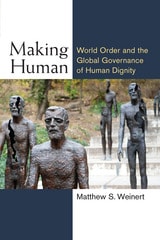
cover of Making Human: World Order and the Global Governance of Human Dignity

Making Human

World Order and the Global Governance of Human Dignity

Matthew S. Weinert

University of Michigan Press, 2015
Differences between human beings have long been used to justify a range of degrading, exclusionary, and murderous practices that strip people of their humanity and dignity. While considerable scholarship has been devoted to such dehumanization, Matthew S. Weinert asks how we might conceive its reverse—humanization, or what it means to “make human.”

Weinert proposes an account of making human centered on five mechanisms: reflection, recognition, resistance, replication of dominant mores, and responsibility. Examining cases such as the UN Security Council’s engagements with crises and the International Court of Justice’s grappling with Kosovo’s unilateral declaration of independence, he illustrates the distinct and contingent ways these mechanisms have been deployed. Theoretically, the cases evince a complex, evolving relationship between state-centric and human-centric views of society, ultimately revealing the normative potentialities of both.

Though the case studies concern specific human relations issues on an international level, Weinert argues in favor of starting from the shared problem of being human and of living in a world in which the humanity of countless groups has been demeaned or denied. Working outward from that point, he proposes, we obtain a more pragmatically grounded understanding of the social construction of the human being.
[more]
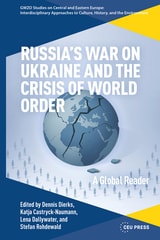
cover of Russia’s War on Ukraine and the Crisis of World Order: A Global Reader

Russia’s War on Ukraine and the Crisis of World Order

A Global Reader

Dennis Dierks

Central European University Press, 2026

Russia’s war on Ukraine has been closely watched and widely debated worldwide. These discussions extend beyond the war itself to encompass its implications for the world order and the future of globalisation. This reader documents that debate by bringing together articles from all regions of the world published in newspapers, journals, magazines, and blogs between Russia’s full-scale invasion of Ukraine in 2022 and Donald Trump’s election victory in 2024. The collection includes texts originally written in English as well as translations from Arabic, Chinese, French, German, Polish, Portuguese, Russian, Serbian, Spanish, Turkish, and Ukrainian. It offers reflections on international law and international organisations; postcolonial and decolonial critiques of power; rearmament, neutrality, and non-alignment; transregional religious solidarities; and the economic and environmental consequences of the war. As part of the series GWZO Studies on Central and Eastern Europe: Interdisciplinary Approaches to Culture, History, and the Environment, this reader seeks to provide new, nuanced, and multifaceted insights into the region within the broader context of global (dis)entanglements.
[more]
cover of The Great Deception: Anglo-American Power and World Order

The Great Deception

Anglo-American Power and World Order

Mark Curtis

Pluto Press, 1998

[more]