Results by title
19 books match the query 'Wrestling'
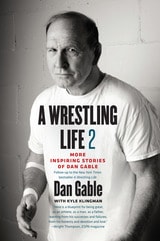
A Wrestling Life 2
More Inspiring Stories of Dan GableDan Gable and Kyle Klingman
University of Iowa Press, 2018
Through stories funny, heartfelt, intense, and always engaging, Gable shares more about the life he has lead and what can be learned from those experiences. He goes on to detail what have come to be known as the Gable Trained principles that he follows to keep his life full of “wins,” the revelations about how to cultivate success at the highest levels, and the reasons behind these steps for living well.
A Wrestling Life spent two months on the New York Times sports bestseller list, and has become an instant classic of sports memoirs. A Wrestling Life 2 is sure to add to Gable’s ever-growing legacy and entertain and inspire wrestling fans everywhere.
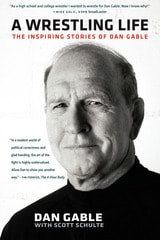
A Wrestling Life
The Inspiring Stories of Dan GableDan Gable and Scott Schulte
University of Iowa Press, 2016
Whether we are athletes or not, we all dream of extreme success and are all looking to make our future the best it can be, but along the way we will undoubtedly need time to recover and rejuvenate. Let these stories inspire you to find your path to strength and achievement along whatever path you take.

Andy Kaufman
Wrestling with the American DreamFlorian Keller
University of Minnesota Press, 2005
In Andy Kaufman, Florian Keller explores Kaufman’s career within a broader discussion of the ideology of the American Dream. Taking as his starting point the 1999 biopic Man on the Moon, Keller brilliantly decodes Kaufman in a way that makes it possible to grasp his radical agenda beyond avant-garde theories of transgression. As an entertainer, Kaufman submerged his identity beneath a multiplicity of personas, enacting the American belief that the self can and should be endlessly remade for the sake of happiness and success. He did this so rigorously and consistently, Keller argues, that he exposed the internal contradictions of America’s ideology of self-invention.
Keller posits that Kaufman offered a radically different—and perhaps more potent—logic of cultural criticism than did more overtly political comedians such as Lenny Bruce. Presenting close readings of Kaufman’s most significant performances, Keller shows how Kaufman mounted—for the benefit of an often uncomprehending public—a sustained and remarkable critique of America’s obsession with celebrity and individualism.
Florian Keller is a fellow at the Institute of Cultural Studies, School of Art and Design, University of Applied Sciences and Arts, Zurich.
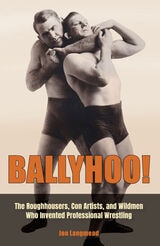
Ballyhoo!
The Roughhousers, Con Artists, and Wildmen Who Invented Professional WrestlingJon Langmead
University of Missouri Press, 2024
Ballyhoo! The Roughhousers, Con Artists, and Wildmen Who Invented Professional Wrestling is a history of professional wrestling’s formative period in the U.S., from roughly 1874 to 1941, and the contested interplay of wrestlers and promoters who built the “sport” as we know it. During this period, the major conventions that would define wrestling to the present day were perfected and codified, as wrestling morphed from a rough sport practiced on farms and at town gatherings to melodramatic mass entertainment that reliably drew large crowds in cities across the nation.
The narrative uses the life and career of Jack Curley—a boxing promoter whose fortune took a turn for the better when he began promoting wrestling matches—as a compass as it charts the development of wrestling. By the late 1910s, Curley’s shows were selling out Madison Square Garden monthly. Ballyhoo chronicles his competition with the other promoters, as well as the lives of colorful athletes like “Strangler” Ed Lewis, Frank Gotch, the “Masked Marvel,” Jim Londos, “Gorgeous George” Wagner, “Farmer” Martin Burns, and “Dynamite” Gus Sonnenberg.
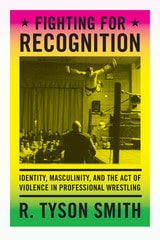
Fighting for Recognition
Identity, Masculinity, and the Act of Violence in Professional WrestlingR. Tyson Smith
Duke University Press, 2014
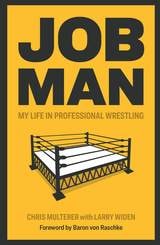
Job Man
My Life in Professional WrestlingChris Multerer
Wisconsin Historical Society Press, 2019
In Job Man, Multerer, along with his friend Larry Widen, shows what life was like for wrestlers outside the spotlight. Long nights on the road, thoughtful takes on some the biggest personalities in the business, and, perhaps most of all, a love for the sport, are as much a part of Multerer’s revealing and remarkable story as his time in the ring.
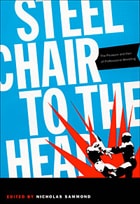
Steel Chair to the Head
The Pleasure and Pain of Professional WrestlingNicholas Sammond, ed.
Duke University Press, 2005
The essayists include scholars in anthropology, psychology, film studies, communication studies, and sociology, one of whom used to wrestle professionally. Classic studies of wrestling by Roland Barthes, Carlos Monsiváis, Sharon Mazer, and Henry Jenkins appear alongside original essays. Whether exploring how pro wrestling inflects race, masculinity, and ideas of reality and authenticity; how female fans express their enthusiasm for male wrestlers; or how lucha libre provides insights into Mexican social and political life, Steel Chair to the Head gives due respect to pro wrestling by treating it with the same thorough attention usually reserved for more conventional forms of cultural expression.
Contributors. Roland Barthes, Douglas L. Battema, Susan Clerc, Laurence de Garis, Henry Jenkins III, Henry Jenkins IV, Heather Levi, Sharon Mazer, Carlos Monsiváis, Lucia Rahilly, Catherine Salmon, Nicholas Sammond, Phillip Serrat, Philip Sewell
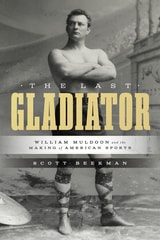
The Last Gladiator
William Muldoon and the Making of American SportsScott Beekman
University of Texas Press, 2025
2026 Honorable Mention in Monographs, North American Society for Sport History (NASSH)
The incredible career of the forgotten but foundational pro wrestler who shaped American sports culture.
William Muldoon was an infamous athlete whose prowess, savvy, and chicanery across his six-decade career led him to wealth, cultural importance, and political power. Muldoon, the child of poor Irish immigrants, began wrestling in the 1870s and quickly became one of the most famous athletes of the post–Civil War era. He started acting and modeling as his popularity grew, making him one of the first sports stars to achieve crossover success. After a triumphant stint rehabilitating fallen boxing heavyweight champion John L. Sullivan in 1889, he retired from the ring and began a new career as a fitness impresario, founding an elite gymnasium and remaking himself as a health authority in the press. He became trainer to the rich, famous, and politically powerful, which led to his appointment as chair of the New York State Athletic Commission in the 1920s. From this position, Muldoon exerted his influence over the rules of boxing and wrestling and weaponized his power to maintain segregation in sport.
The Last Gladiator is a deep, insightful dive into Muldoon’s life and impact, demonstrating the significance of this often-controversial figure in the development of American sports, professional wrestling, and physical and popular culture.

The Sanchez Family
Mexican American High School and Collegiate Wrestlers from Cheyenne, WyominJorge Iber
University of Wyoming Press, 2025
The first members of this particular Sanchez clan arrived in Wyoming during the early decades of the twentieth century. The first-generation American grandchildren of these families—Gilbert, David, Arthur, and Ray—used wrestling to radically alter their social and economic status by attending college with athletic scholarships, graduating, and moving on to professional, middle-class careers. Subsequent generations of the family followed their fathers and uncles to the mats at various institutions, also going on to earn degrees and enter professional occupations. Indeed, Iber contends that wrestling became the family’s “business,” the mechanism by which the Sanchezes extricated themselves from Cheyenne’s working class.
Revealing a previously unstudied aspect of Mexican American life in the state, The Sanchez Family sheds light on another vehicle for the educational, social, and economic advancement of Latinos in other parts of the United States. The first book to examine the role of wrestling in the lives of Mexican Americans, it serves as a foundational text for Latino studies of sports and constructing racial counterscripts.
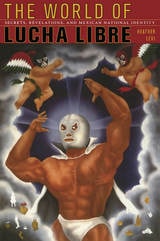
The World of Lucha Libre
Secrets, Revelations, and Mexican National IdentityHeather Levi
Duke University Press, 2008
Levi considers lucha libre in light of scholarship about sport, modernization, and the formation of the Mexican nation-state, and in connection to professional wrestling in the United States. She examines the role of secrecy in wrestling, the relationship between wrestlers and the characters they embody, and the meanings of the masks worn by luchadors. She discusses male wrestlers who perform masculine roles, those who cross-dress and perform feminine roles, and female wrestlers who wrestle each other. Investigating the relationship between lucha libre and the mass media, she highlights the history of the sport’s engagement with television: it was televised briefly in the early 1950s, but not again until 1991. Finally, Levi traces the circulation of lucha libre symbols in avant-garde artistic movements and its appropriation in left-wing political discourse. The World of Lucha Libre shows how a sport imported from the United States in the 1930s came to be an iconic symbol of Mexican cultural authenticity.
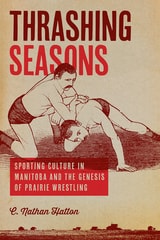
Thrashing Seasons
Sporting Culture in Manitoba and the Genesis of Prairie WrestlingC. Nathan Hatton
University of Manitoba Press, 2016
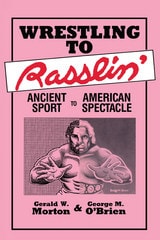
Wrestling to Rasslin'
Ancient Sport to American SpectacleGerald W. Morton and George M. O'Brien
University of Wisconsin Press, 1985
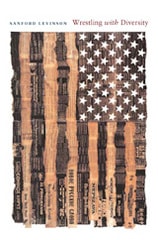
Wrestling with Diversity
Sanford Levinson
Duke University Press, 2003
Although most discussions of diversity have focused on race and ethnicity, Levinson is particularly interested in religious diversity and its implications. Why, he asks, do arguments for racial and ethnic diversity not also counsel a concern to achieve religious diversity within a student body? He considers the propriety of judges drawing on their religious views in making legal decisions and the kinds of questions Senators should feel free to ask nominees to the federal judiciary who have proclaimed the importance of their religion in structuring their own lives. In exploring the sense in which Sandy Koufax can be said to be a “Jewish baseball player,” he engages in broad reflections on professional identity. He asks whether it is desirable, or even possible, to subordinate merely "personal" aspects of one’s identity—religion, political viewpoints, gender—to the impersonal demands of the professional role. Wrestling with Diversity is a powerful interrogation of the assumptions and contradictions underlying public life in a multicultural world.
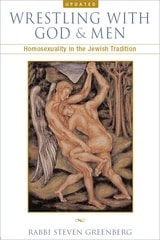
Wrestling with God and Men
Homosexuality in the Jewish TraditionRabbi Steven Greenberg
University of Wisconsin Press, 2005
For millennia, two biblical verses have been understood to condemn sex between men as an act so abhorrent that it is punishable by death. Traditionally Orthodox Jews, believing the scripture to be the word of God, have rejected homosexuality in accordance with this interpretation. In 1999, Rabbi Steven Greenberg challenged this tradition when he became the first Orthodox rabbi ever to openly declare his homosexuality.
Wrestling with God and Men is the product of Rabbi Greenberg’s ten-year struggle to reconcile his two warring identities. In this compelling and groundbreaking work, Greenberg challenges long held assumptions of scriptural interpretation and religious identity as he marks a path that is both responsible to human realities and deeply committed to God and Torah. Employing traditional rabbinic resources, Greenberg presents readers with surprising biblical interpretations of the creation story, the love of David and Jonathan, the destruction of Sodom, and the condemning verses of Leviticus. But Greenberg goes beyond the question of whether homosexuality is biblically acceptable to ask how such relationships can be sacred. In so doing, he draws on a wide array of nonscriptural texts to introduce readers to occasions of same-sex love in Talmudic narratives, medieval Jewish poetry and prose, and traditional Jewish case law literature. Ultimately, Greenberg argues that Orthodox communities must open up debate, dialogue, and discussion—precisely the foundation upon which Jewish law rests—to truly deal with the issue of homosexual love.
This book will appeal not only to members of the Orthodox faith but to all religious people struggling to resolve their belief in the scriptures with a desire to make their communities more open and accepting to gay and lesbian members.
2005 Finalist for the Lambda Literary Awards, for Religion/Spirituality
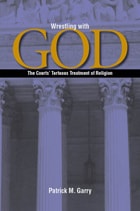
Wrestling with God
The Courts' Tortuous Treatment of ReligionPatrick M. Garry
Catholic University of America Press, 2006

Wrestling with Nature
From Omens to ScienceEdited by Peter Harrison, Ronald L. Numbers, and Michael H. Shank
University of Chicago Press, 2011
When and where did science begin? Historians have offered different answers to these questions, some pointing to Babylonian observational astronomy, some to the speculations of natural philosophers of ancient Greece. Others have opted for early modern Europe, which saw the triumph of Copernicanism and the birth of experimental science, while yet another view is that the appearance of science was postponed until the nineteenth century.
Rather than posit a modern definition of science and search for evidence of it in the past, the contributors to Wrestling with Nature examine how students of nature themselves, in various cultures and periods of history, have understood and represented their work. The aim of each chapter is to explain the content, goals, methods, practices, and institutions associated with the investigation of nature and to articulate the strengths, limitations, and boundaries of these efforts from the perspective of the researchers themselves. With contributions from experts representing different historical periods and different disciplinary specializations, this volume offers a fresh perspective on the history of science and on what it meant, in other times and places, to wrestle with nature.
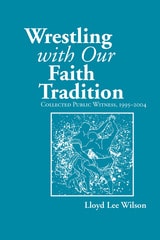
Wrestling with Our Faith Tradition
Lloyd Lee Wilson
QuakerPress, 2005

Wrestling with Starbucks
Conscience, Capital, CappuccinoFellner, Kim
Rutgers University Press, 2008
Armed with an open mind and a sense of humor, Fellner takes readers on an expedition into the muscle and soul of the coffee company. She finds a corporation filled with contradictions: between employee-friendly processes and anti-union practices; between an internationalist vision and a longing for global dominance; between community individuality and cultural hegemony. On a daily basis Starbucks walks a fine line. It must be profitable enough to please Wall Street and principled enough to please social justice advocates. Although observers might argue that the company has done well at achieving a balance, Starbucks's leaders run the risk of satisfying neither constituency and must constantly justify themselves to both.
Through the voices of Central American coffee farmers, officers at corporate headquarters, independent café owners, unionists, baristas, traders, global justice activists, and consumers, Fellner explores the forces that affect Starbucks's worth and worthiness. Along the way, she subjects her own unabashedly progressive perspective to scrutiny and emerges with a compelling and unexpected look at Starbucks, the global economy, our economic convictions, and the values behind our morning cup of joe.

Wrestling with the Left
The Making of Ralph Ellison’s Invisible ManBarbara Foley
Duke University Press, 2010