Results by title
5 books match the query 'Wright, Charles'
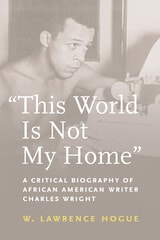
"This World Is Not My Home"
A Critical Biography of African American Writer Charles WrightW. Lawrence Hogue
University of Massachusetts Press, 2023
One of Book Authority's 8 New African-American and Black Biography Books Shaping 2025
In the 1960s, Charles Wright’s (1932–2008) star was on the rise. After dropping out of high school and serving in the Korean War, the young Black writer landed in New York, where he was mentored by Norman Mailer, signed a book deal with a leading publisher, and was celebrated by the likes of Langston Hughes and James Baldwin.
Over the decades to follow, Wright would lead a peripatetic and at times precarious life, moving between Tangier, Veracruz, Paris, and New York, penning a regular column for the Village Voice, living off the goodwill of his friends, and battling addiction and, later, mental health issues. As W. Lawrence Hogue shows, Wright’s innovative fiction stands apart, offering a different vision of outcast Black Americans in the postwar era and using satire to bring agency and humanity to working-class characters. This critical biography—the first devoted to Wright’s significant but largely forgotten story—brings new attention to the writer’s impressive body of work, in the context of a wild, but troubled, life.

Orphic Songs
Dino Campana
Oberlin College Press, 1984
Quarter Notes
Improvisations and InterviewsCharles Wright
University of Michigan Press, 1995
This satisfying collection includes reminiscences and meditations on the details of memory and what it means to visit the past; the vices of titleism and the hydrosyllabic foot in poetry; a comparison of poems and journeys; appreciation of poets Donald Justice and John Crow Ransom; an attempt to define "image"; discussions of the current state of poetry; and various highlights from the Charles Wright Literary Festival.
Charles Wright's books of poetry include The World of the Ten Thousand Things and Country Music: Selected Early Poems. He received the 1993 Ruth Lilly Poetry Prize and the 1992 Award of Merit Medal from the American Academy of Arts and Letters. He is Souder Family Professor of English, University of Virginia.
The Storm & Other Poems
Eugenio Montale
Oberlin College Press, 1978
Uncertainty and Plenitude
Five Contemporary PoetsPeter Stitt
University of Iowa Press, 1997
Stitt's interest in these five poets is intellectual and aesthetic. As he states, “I chose these particular writers because their work continues to interest me deeply, both intellectually and formally, even after years of familiarity.” He uses his understanding of the philosophical implications inherent in modern physics, as they apply to both content and form, as the basis for his close analysis.
Stitt attends to the poets' writerly strategies so that we may discover in their poetry where “surface form” intersects and complements meaning and thus becomes, in John Berryman's terms, “deep form.” He explains what these poets say and how they say it and what relationships lie between. He also shows how humor plays a part in some of their work.