Results by title
4 books match the query 'Wright, Conrad Edick'

Margaret Fuller and Her Circles
Brigitte Bailey
University of New Hampshire Press, 2013
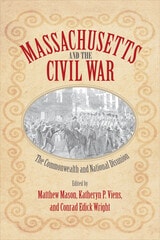
Massachusetts and the Civil War
The Commonwealth and National DisunionMatthew Mason
University of Massachusetts Press, 2015
All states are not created equal, at least not when it comes to their influence on American history. That assumption underlies Massachusetts and the Civil War. The volume's ten essays coalesce around the national significance of Massachusetts through the Civil War era, the ways in which the commonwealth reflected and even modeled the Union's precarious but real wartime unification, and the Bay State's postwar return to the schisms that predated the war. Rather than attempting to summarize every aspect of the state's contribution to the wartime Union, the collection focuses on what was distinctive about its influence during the great crisis of national unity.
In the first section, “The Opposition to Slavery,” essays by John Stauffer, Dean Grodzins, Peter Wirzbicki, and Richard S. Newman demonstrate the central role Massachusetts played in the rise of both the antislavery movement and abolitionism. They show how slavery's foes united, planned, and understood their cause, and how they envisioned a postwar nation free of servitude. In the second section, “The War Years,” Matthew Mason, Carol Bundy, and Ronald J. Zboray and Mary Saracino Zboray investigate how the exigencies of war unified the commonwealth across party lines and over the distance between home and the front. In the final section, “Reconciliation,” Sarah J. Purcell, Amy Morsman, and Kanisorn Wongsrichanalai probe postwar efforts to recover from the war's profound disruptions.
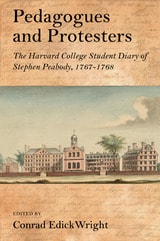
Pedagogues and Protesters
The Harvard College Student Diary of Stephen Peabody, 1767-1768Conrad Edick Wright
University of Massachusetts Press, 2017
Pedagogues and Protesters recounts the year in daily journal entries by Stephen Peabody, a member of the class of 1769. The best surviving account of colonial college life, Peabody's journal documents relationships among students, faculty members, and administrators, as well as the author's relationships with other segments of Massachusetts society. To a full transcription of the entries, Conrad Edick Wright adds detailed annotation and an introduction that focuses on the journal's revealing account of daily life at America's oldest college.
Published in association with Massachusetts Historical Society
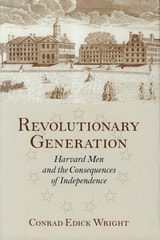
Revolutionary Generation
Harvard Men and the Consequences of IndependenceConrad Edick Wright
University of Massachusetts Press, 2005
Conrad Edick Wright draws on extensive research on the classes that graduated from Harvard immediately before the start of the war to follow their members as they passed through life's common and predictable events from birth and childhood through youth to maturity, careers, marriage, the increasing civic and family responsibilities of midlife, old age, and death. He is also sensitive to his subjects' thoughts and feelings. Unusually articulate and frequently reflective, the men of the Harvard College classes of 1771 through 1774 often revealed their ambitions and concerns through their letters and diaries.
Revolutionary Generation provides the most sustained application of life course and life cycle analysis to be found in any study of late-eighteenth- or early-nineteenth-century America. At the same time, it shows on a personal level through the lives of its subjects many of the most important consequences of the War for Independence.