Results by title
3 books match the query 'Writing Across'
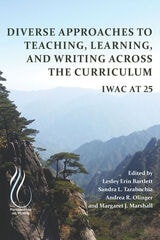
Diverse Approaches to Teaching, Learning, and Writing Across the Curriculum
IWAC at 25Lesley Erin Bartlett
University Press of Colorado, 2020
Developed from presentations at the 2018 International Writing Across the Curriculum conference, this collection documents a key moment in the history of WAC, foregrounding connection and diversity as keys to the sustainability of the WAC movement in the face of new and long-standing challenges. Contributors reflect on the history and ongoing evolution of WAC, honoring grassroots efforts while establishing a more unified structure of collaborative leadership and mentorship. The chapters in this collection offer a rich variety of practices, pedagogies, mindsets, and methodologies for readers who are invested in using writing in a wide range of institutional and disciplinary contexts. Boldly engaging such pressing topics as translingualism, anti-racism, emotional labor, and learning analytics, the eighteen chapters collected here testify to WAC's durability, persistence, and resilience in an ever-changing educational landscape.
[more]
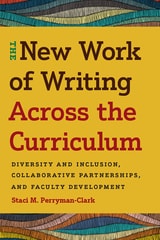
New Work of Writing Across the Curriculum
Diversity and Inclusion, Collaborative Partnerships, and Faculty DevelopmentStaci M. Perryman-Clark
Utah State University Press, 2023
The New Work of Writing Across the Curriculum is a descriptive analysis of how institutions can work to foster stronger intellectual activities around writing as connected to campus-wide diversity and inclusion initiatives. Author Staci M. Perryman-Clark blends theory and practice, grounds disciplinary conversations with practical examples of campus work, and provides realistic expectations for operations with budgetary constraints while enhancing diversity, equity, and inclusion work in higher education.
Many of these initiatives are created in isolation, reinforcing institutional silos that are not used strategically to gain the attention of senior administrators, particularly those working at state-supported public institutions who must manage shrinking institutional budgets. Yet teaching and learning centers and WAC programs gain tremendously from one another by building explicit partnerships on campus-wide diversity initiatives that emphasize cultural competence. In addition, both cultural competence and written proficiency enhance the transferable skills necessary for completing undergraduate education requirements, and this work can be leveraged to draw the attention of senior administrative leadership.
Faculty development and WAC need to make diversity and inclusion initiatives a priority for professional development. The New Work of Writing Across the Curriculum reviews initiatives that point to increased understanding of diversity and inclusion that will be of significance to administrators, WAC specialists, faculty developers, and diversity officers across the spectrum of institutions of higher learning.
[more]
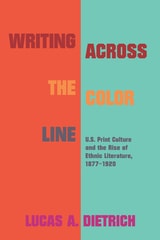
Writing across the Color Line
U.S. Print Culture and the Rise of Ethnic Literature, 1877-1920Lucas A. Dietrich
University of Massachusetts Press, 2020
The turn of the twentieth century was a period of experimental possibility for U.S. ethnic literature as a number of writers of color began to collaborate with the predominantly white publishing trade to make their work commercially available. In this new book, Lucas A. Dietrich analyzes publishers' and writers' archives to show how authors—including María Amparo Ruiz de Burton, Charles W. Chesnutt, Finley Peter Dunne, W. E. B. Du Bois, and Sui Sin Far—drew readers into their texts by subverting existing stereotypes and adapting styles of literary regionalism and dialect writing.
Writing across the Color Line details how this body of literature was selected for publication, edited, manufactured, advertised, and distributed, even as it faced hostile criticism and frequent misinterpretation by white readers. Shedding light on the transformative potential of multiethnic literature and the tenacity of racist attitudes that dominated the literary marketplace, Dietrich proves that Native American, African American, Latinx, Asian American, and Irish American writers of the period relied on self-caricature, tricksterism, and the careful control of authorial personae to influence white audiences.
Writing across the Color Line details how this body of literature was selected for publication, edited, manufactured, advertised, and distributed, even as it faced hostile criticism and frequent misinterpretation by white readers. Shedding light on the transformative potential of multiethnic literature and the tenacity of racist attitudes that dominated the literary marketplace, Dietrich proves that Native American, African American, Latinx, Asian American, and Irish American writers of the period relied on self-caricature, tricksterism, and the careful control of authorial personae to influence white audiences.
[more]