Results by title
3 books match the query 'Wrocław (Poland)'
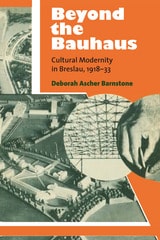
Beyond the Bauhaus
Cultural Modernity in Breslau, 1918-33Deborah Ascher Barnstone
University of Michigan Press, 2016
This richly illustrated volume is the first book in English to address this history, constituting an invaluable addition to the literature on the Weimar period. Its readership includes scholars of German history, art, architecture, urban design, planning, collecting, and exhibition history; of the avant-garde, and of the development of arts academies and arts pedagogy.
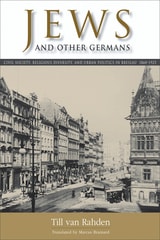
Jews and Other Germans
Civil Society, Religious Diversity, and Urban Politics in Breslau, 1860–1925Till van Rahden
University of Wisconsin Press, 2008
Closely analyzing the political, social, and cultural life in a major German city, van Rahden shows that Jews were a part of a broad urban community that encompassed diversity within unity, at once offering them a large measure of equality while permitting them to remain meaningfully Jewish. Jews and Other Germans also substantially revises the chronology of anti-Semitism in Germany, showing that Jews only began to experience exclusion from Breslau’s social world during World War I.
Yet van Rahden not only illuminates Breslau’s multicultural fabric; he also tells the story of this remarkable city as one of cultural and religious conflict and coexistence. Recounting the experiences of Jews, Protestants, and Catholics within a single narrative, he offers a critical intervention into scholarship on liberalism and civil society in nineteenth- and early twentieth-century Europe.
Lviv – Wroclaw, Cities in Parallel?
Myth, Memory and Migration, c. 1890-PresentJan Fellerer
Central European University Press, 2020
After World War II, Europe witnessed the massive redrawing of national borders and the efforts to make the population fit those new borders. As a consequence of these forced changes, both Lviv and Wrocław went through cataclysmic changes in population and culture. Assertively Polish prewar Lwów became Soviet Lvov, and then, after 1991, it became assertively Ukrainian Lviv. Breslau, the third largest city in Germany before 1945, was in turn "recovered" by communist Poland as Wrocław. Practically the entire population of Breslau was replaced, and Lwów's demography too was dramatically restructured: many Polish inhabitants migrated to Wrocław and most Jews perished or went into exile. The forced migration of these groups incorporated new myths and the construction of official memory projects.
The chapters in this edited book compare the two cities by focusing on lived experiences and "bottom-up" historical processes. Their sources and methods are those of micro-history and include oral testimonies, memoirs, direct observation and questionnaires, examples of popular culture, and media pieces. The essays explore many manifestations of the two sides of the same coin—loss on the one hand, gain on the other—in two cities that, as a result of the political reality of the time, are complementary.