Results by title
4 books match the query 'Yale University'
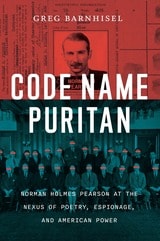
Code Name Puritan
Norman Holmes Pearson at the Nexus of Poetry, Espionage, and American PowerGreg Barnhisel
University of Chicago Press, 2024
Although his impact on twentieth-century American cultural life was profound, few people know the story of Norman Holmes Pearson. Pearson’s life embodied the Cold War alliances among US artists, scholars, and the national-security state that coalesced after World War II. As a Yale professor and editor, he helped legitimize the study of American culture and shaped the public’s understanding of literary modernism—significantly, the work of women poets such as Hilda Doolittle and Gertrude Stein. At the same time, as a spy, recruiter, and cultural diplomat, he connected the academy, the State Department, and even the CIA.
In Code Name Puritan, Greg Barnhisel maps Pearson’s life, from his childhood injury that led to a visible, permanent disability to his wartime counterespionage work neutralizing the Nazis’ spy network to his powerful role in the cultural and political heyday sometimes called the American Century. Written with clarity and informed by meticulous research, Barnhisel’s revelatory portrait of Pearson details how his unique experiences shaped his beliefs about the American character, from the Puritans onward.

On Strike for Respect
The Clerical and Technical Workers' Strike at Yale University, 1984-85Toni Gilpin, Gary Isaac, Dan Letwin, and Jack McKivigan
University of Illinois Press, 1995
It is we who type the letters, mind the office without fail.
And until we get a contract, it is we who'll shut down Yale, For the union
makes us strong.
(To the tune of "John Brown's Body")
"Must reading for anyone who wants to learn what a revitalized labor
movement would look like." -- Labor Notes
"A textbook on solidarity unionism." -- Staughton Lynd
"One of the very best books on labor in the 1970s and 80s."
-- Dana Frank, University of California at Santa Cruz
"There are very few case studies in recent labor history as readable
and provocative as this one." -- Karen Sawislak, Stanford University
On Strike for Respect is a lively account of the 1984-85 strike
by clerical and technical workers at Yale University. Members of Local
34, with a strong female majority, mobilized themselves and the public,
breathing new life into the labor movement as they fought for and won
substantial gains. A short update on current conditions concludes this
volume.
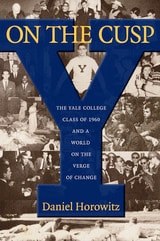
On the Cusp
The Yale College Class of 1960 and a World on the Verge of ChangeDaniel Horowitz
University of Massachusetts Press, 2015
How did the 1950s become “The Sixties”? This is the question at the heart of Daniel Horowitz's On the Cusp. Part personal memoir, part collective biography, and part cultural history, the book illuminates the dynamics of social and political change through the experiences of a small, and admittedly privileged, generational cohort.
A Jewish “townie” from New Haven when he entered Yale College in fall 1956, Horowitz reconstructs the undergraduate career of the class of 1960 and follows its story into the next decade. He begins by looking at curricular and extracurricular life on the all-male campus, then ranges beyond the confines of Yale to larger contexts, including the local drama of urban renewal, the lingering shadow of McCarthyism, and decolonization movements around the world. He ponders the role of the university in protecting the prerogatives of class while fostering social mobility, and examines the growing significance of race and gender in American politics and culture, spurred by a convergence of the personal and the political. Along the way he traces the political evolution of his classmates, left and right, as Cold War imperatives lose force and public attention shifts to the civil rights movement and the war in Vietnam.
Throughout Horowitz draws on a broad range of sources, including personal interviews, writings by classmates, reunion books, issues of the Yale Daily News, and other undergraduate publications, as well as his own letters and college papers. The end product is a work consistent with much of Horowitz's previously published scholarship on postwar America, further exposing the undercurrent of discontent and dissent that ran just beneath the surface of the so-called Cold War consensus.
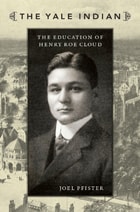
The Yale Indian
The Education of Henry Roe CloudJoel Pfister
Duke University Press, 2009
Roe Cloud’s white-collar activism was entwined with the Progressive Era formation of an Indian professional and managerial class, a Native “talented tenth,” whose members strategically used their contingent entry into arenas of white social, intellectual, and political power on behalf of Indians without such access. His Yale training provided a cross-cultural education in class-structured emotions and individuality. While at Yale, Roe Cloud was informally adopted by a white missionary couple. Through them he was schooled in upper-middle-class sentimentality and incentives. He also learned how interracial romance could jeopardize Indian acceptance into their class. Roe Cloud expanded the range of what modern Indians could aspire to and achieve.