Results by title
7 books match the query 'Yeats'
East-West Literary Imagination
Cultural Exchanges from Yeats to MorrisonYoshinobu Hakutani
University of Missouri Press, 2017
This study traces the shaping presence of cultural interactions, arguing that American literature has become a hybridization of Eastern and Western literary traditions. Cultural exchanges between the East and West began in the early decades of the nineteenth century as American transcendentalists explored Eastern philosophies and arts. Hakutani examines this influence through the works of Emerson, Thoreau, and Whitman. He further demonstrates the East-West exchange through discussions of the interactions by modernists such as Yone Noguchi, Yeats, Pound, Camus, and Kerouac.
Finally, he argues that African American literature, represented by Richard Wright, Ralph Ellison, Alice Walker, Toni Morrison, and James Emanuel, is postmodern. Their works exhibit their concerted efforts to abolish marginality and extend referentiality, exemplifying the postmodern East-West crossroads of cultures. A fuller understanding of their work is gained by situating them within this cultural conversation. The writings of Wright, for example, take on their full significance only when they are read, not as part of a national literature, but as an index to an evolving literature of cultural exchanges.
Movement and Modernism
Yeats, Eliot, Williams, and Early Twentieth-Century DanceTerri A. Mester
University of Arkansas Press, 1997
Poetry in the Museums of Modernism
Yeats, Pound, Moore, SteinCatherine Paul
University of Michigan Press, 2002
Although critics have attested to the importance of the visual arts to literary modernists and have begun to explore the relationships between literary production and social institutions, before now no one has examined the particular institutions in which modernist poets found the artworks, specimens, and other artifacts that inspired their literary innovations. Catherine Paul's book offers the reader a fresh encounter with modernism that will interest literary and art historians, literary theorists, critics, and scholars in cultural studies and museum studies.
Catherine Paul is Associate Professor of English, Clemson University.
The Geometry of Modernism
The Vorticist Idiom in Lewis, Pound, H.D., and YeatsBy Miranda B. Hickman
University of Texas Press, 2006
Addressing both the literature and the visual arts of Anglo-American modernism, The Geometry of Modernism recovers a crucial development of modernism's early years that until now has received little sustained critical attention: the distinctive idiom composed of geometric forms and metaphors generated within the early modernist movement of Vorticism, formed in London in 1914. Focusing on the work of Wyndham Lewis, leader of the Vorticist movement, as well as Ezra Pound, H.D., and William Butler Yeats, Hickman examines the complex of motives out of which Lewis initially forged the geometric lexicon of Vorticism—and then how Pound, H.D., and Yeats later responded to it and the values that it encoded, enlisting both the geometric vocabulary and its attendant assumptions and ideals, in transmuted form, in their later modernist work.
Placing the genesis and appropriation of the geometric idiom in historical context, Hickman explores how despite its brevity as a movement, Vorticism in fact exerted considerable impact on modernist work of the years between the wars, in that its geometric idiom enabled modernist writers to articulate their responses to both personal and political crises of the 1930s and 1940s. Informed by extensive archival research as well as treatment of several of the least-known texts of the modernist milieu, The Geometry of Modernism clarifies and enriches the legacy of this vital period.
Theatre of the Real
Yeats, Beckett, and SondheimGina Masucci MacKenzie
The Ohio State University Press, 2008
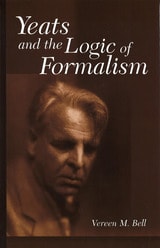
Yeats and the Logic of Formalism
Vereen M. Bell
University of Missouri Press, 2006

Yeats
An Annual of Critical and Textual Studies, Volume XII, 1994Richard J. Finneran, Editor
University of Michigan Press, 1996