Results by title
5 books match the query 'Yellow fever'
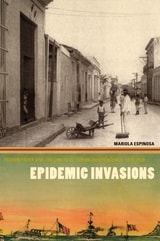
Epidemic Invasions
Yellow Fever and the Limits of Cuban Independence, 1878-1930Mariola Espinosa
University of Chicago Press, 2009
In the early fall of 1897, yellow fever shuttered businesses, paralyzed trade, and caused tens of thousand of people living in the southern United States to abandon their homes and flee for their lives. Originating in Cuba, the deadly plague inspired disease-control measures that not only protected U.S. trade interests but also justified the political and economic domination of the island nation from which the pestilence came. By focusing on yellow fever, Epidemic Invasions uncovers for the first time how the devastating power of this virus profoundly shaped the relationship between the two countries.
Yellow fever in Cuba, Mariola Espinosa demonstrates, motivated the United States to declare war against Spain in 1898, and, after the war was won and the disease eradicated, the United States demanded that Cuba pledge in its new constitution to maintain the sanitation standards established during the occupation. By situating the history of the fight against yellow fever within its political, military, and economic context, Espinosa reveals that the U.S. program of sanitation and disease control in Cuba was not a charitable endeavor. Instead, she shows that it was an exercise in colonial public health that served to eliminate threats to the continued expansion of U.S. influence in the world.
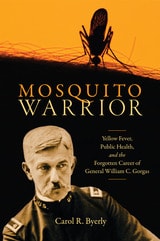
Mosquito Warrior
Yellow Fever, Public Health, and the Forgotten Career of General William C. GorgasCarol R. Byerly
University of Alabama Press, 2024
A compelling biography of General William C. Gorgas, the US Army doctor's campaign against mosquito-borne disease reshaped public health, military medicine, and U. S. power on the world stage.
Mosquito Warrior tells the engrossing story of General William C. Gorgas (1854–1920), the once-renowned pioneer in tropical disease research and public health. His fascinating life illuminates vast transformations in the United States, including the end of the Civil War and the industrialization of the US military and economy, the emergence of germ theory and the modernization of the public health system, and the rise of the United States as a world power.
A scion of Confederate elites, Gorgas came of age amidst war and disease and the politics of racial segregation. He followed his father into military service as an army medical officer, treating troops on America’s western frontier posts. During the US occupation of Cuba, Gorgas applied Walter Reed’s research on the theory of mosquito-borne disease transmission, ending centuries of yellow fever in Havana through the eradication of the deadly Aedes aegypti mosquito. Applying similar strategies on the isthmus of Panama against yellow fever and malaria, Gorgas enabled the completion of the Panama Canal, then the largest engineering project in the world. Hailed a hero, he pursued his fight against mosquito-borne disease throughout the tropics, expanding American interests as he went. Appointed as US Army surgeon general on the eve of World War I, Gorgas resumed work modernizing the army health care system, strengthening US medical and military authority on the world stage.
Celebrated in life, Gorgas’s reputation fell victim to competing political interests and jealousies after his death, a cautionary tale about historical memory and the politics of science and personality. Carol R. Byerly’s balanced and contemporary examination of Gorgas illuminates his complex legacy in medicine and public health, military history, and American ambitions at the dawn of US global ascendency.
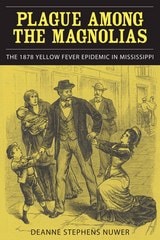
Plague Among the Magnolias
The 1878 Yellow Fever Epidemic in MississippiDeanne Stephens Nuwer
University of Alabama Press, 2009

Quarantine
John Smolens
Michigan State University Press, 2019
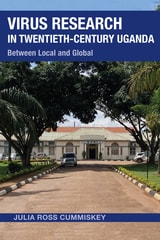
Virus Research in Twentieth-Century Uganda
Between Local and GlobalJulia Ross Cummiskey
Ohio University Press, 2024
Virus Research in Twentieth-Century Uganda presents the stories of scientists at the Uganda Virus Research Institute (UVRI), a biomedical center founded in 1936. The book analyzes the strategies and conditions that allowed the institute to endure and thrive through successive political and scientific regimes of the interwar period, the postwar period, the transition to independence, the conflicts of the 1970s and 1980s, and the Museveni presidency. Julia Ross Cummiskey combines methods and themes from the history of medicine and public health, science and technology studies, and African studies to show that the story of the UVRI and the people who worked there transforms our understanding of the nature of local and international expertise and the evolution of global health research over the course of the twentieth century.
Global health is one of the chief areas in which African and foreign institutions interact today. Billions of dollars are invested in global health projects on the continent, many involving strategically selected “local partners.” In the discourse of these projects, local and global are often framed as complementary but distinct categories of people, institutions, traditions, and practices. But the history of biomedical research at the UVRI shows that these distinctions are unstable and mutable and that people and institutions have mobilized both categories to attract funding, professional prestige, and research opportunities. The book complicates the local/global binary that is implicit (and sometimes explicit) in many studies of colonial, international, and global health and medical research, especially in Africa. Moreover, it challenges assumptions about global health as an enterprise dominated by researchers based in the Global North and recenters the history of biomedicine in Africa.