Results by title
6 books match the query 'Yiddish'

A History of German Jewish Bible Translation
Abigail Gillman
University of Chicago Press, 2018
This book is the first in English to offer a close analysis of German Jewish translations as part of a larger cultural project. Looking at four distinct waves of translations, Abigail Gillman juxtaposes translations within each that sought to achieve similar goals through differing means. As she details the history of successive translations, we gain new insight into the opportunities and problems the Bible posed for different generations and gain a new perspective on modern German Jewish history.
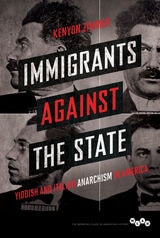
Immigrants against the State
Yiddish and Italian Anarchism in AmericaKenyon Zimmer
University of Illinois Press, 2015
Zimmer focuses on Italians and Eastern European Jews in San Francisco, New York City, and Paterson, New Jersey. Tracing the movement's changing fortunes from the pre–World War I era through the Spanish Civil War, Zimmer argues that anarchists, opposed to both American and Old World nationalism, severed all attachments to their nations of origin but also resisted assimilation into their host society. Their radical cosmopolitan outlook and identity instead embraced diversity and extended solidarity across national, ethnic, and racial divides. Though ultimately unable to withstand the onslaught of Americanism and other nationalisms, the anarchist movement nonetheless provided a shining example of a transnational collective identity delinked from the nation-state and racial hierarchies.
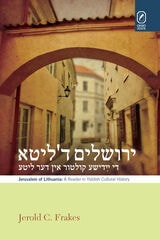
Jerusalem of Lithuania
A Reader in Yiddish Cultural HistoryJerold C. Frakes
The Ohio State University Press, 2011
Yerusholayim d’lite: di yidishe kultur in der lite (Jerusalem of Lithuania: A Reader in Yiddish Cultural History) by Jerold C. Frakes contains cultural, literary, and historical readings in Yiddish that vividly chronicle the central role Vilnius (Lithuania) played in Jewish culture throughout the past five centuries. It includes many examples of Yiddish literature, historiography, sociology, and linguistics written by and about Litvaks and includes work by prominent Yiddish poets, novelists, raconteurs, journalists, and scholars. In addition, Frakes has supplemented the primary texts with many short essays that contextualize Yiddish cultural figures, movements, and historical events.
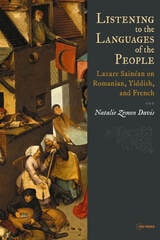
Listening to the Languages of the People
Lazare Sainéan on Romanian, Yiddish, and FrenchNatalie Zemon Davis
Central European University Press, 2022
This tale of great achievements and great disappointments offers a fresh perspective on the interplay between scholarship and political sentiment in the late nineteenth and early twentieth centuries.
Lazăr Șăineanu (1859-1934), linguist and folklorist, was a pioneer in his native Romania, seeking out the popular elements in culture along with high literary ones. He was among the first to publish a study of Yiddish as a genuine language, and he uncovered Turkish features in Romanian language and customs. He also made an index of hundreds of Romanian folktales. Yet when he sought Romanian citizenship and a professorship, he was blocked by powerful figures who thought Jews could not be Romanians and who fancied the origins of Romanian culture to be wholly Latin. Faced with anti-Semitism, some of his friends turned to Zionism. Instead he tried baptism, which brought him only mockery and shame.
Hoping to find a polity to which he could belong, Șăineanu moved with his family to Paris in 1900 and became Lazare Sainéan. There he made innovative studies of French popular speech and slang, culminating in his great work on the language of Rabelais. Once again, he was contributing to the development of a national tongue. Even then, while welcomed by literary scholars, Sainéan was unable to get a permanent university post. Though a naturalized citizen of France, he felt himself a foreigner, an “intruder,” into his old age.
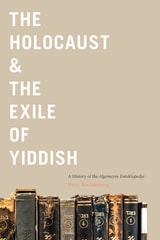
The Holocaust & the Exile of Yiddish
A History of the Algemeyne EntsiklopedyeBarry Trachtenberg
Rutgers University Press, 2022
The Holocaust & the Exile of Yiddish untangles the complicated saga of the Algemeyne entsiklopedye and its editors. The editors continued to publish volumes and revise the encyclopedia’s mission while their primary audience, Eastern European Jews, faced persecution and genocide under Nazi rule, and the challenge of reestablishing themselves in the first decades after World War II. Historian Barry Trachtenberg reveals how, over the course of the middle decades of the twentieth century, the project sparked tremendous controversy in Jewish cultural and political circles, which debated what the purpose of a Yiddish encyclopedia should be, as well as what knowledge and perspectives it should contain. Nevertheless, this is not only a story about destruction and trauma, but also one of tenacity and continuity, as the encyclopedia’s compilers strove to preserve the heritage of Yiddish culture, to document its near-total extermination in the Holocaust, and to chart its path into the future.
Yiddish & English
The Story of Yiddish in AmericaSol Steinmetz
University of Alabama Press, 2001
This is the only book to seriously treat the intriguing linguistic and cultural phenomenon of the intimate contact between Yiddish and English over the past 120 years.
Yiddish arrived in America as the mother tongue of millions of Jewish immigrants from eastern Europe. Not only did this language without a homeland survive in the great American melting pot, it infiltrated the majority language, English, with a wide variety of new words and expressions and helped to establish a new ethnic language called "Jewish English." New Yorkers, in particular, have adopted a long list of Yiddish words, including the well-known "kosher," "chutzpah," "klutz," "yenta," "nosh," "mavin," "schlep," and "shmo."
Yiddish had first developed from language sharing as Jews of northern France and northern Italy migrated into the German-speaking region of the Rhine Valley in the Middle Ages. Sol Steinmetz traces the development of such words as bonhomme from the Old French meaning "good man" to the Yiddish of bonim, or shul for synagogue derived from the German schuol, meaning "school," which had come originally from the Latin schola, for example. With a rich collection of quotations from literature and the press, Steinmetz documents the unusually high lexical, semantic, and intonational exchanges between Yiddish and English in America. He offers more than 1,200 Yiddish words, expressions, idioms, and phrases that have melted into the English vernacular.
Yiddish and English is important for Judaica collections with its two appendixes-one on the romanization of Yiddish and another of Yiddish-origin words, a Jewish-English glossary, a selected bibliography, and an index. But this slim volume is so entertaining and informative for the general reader that it is recommended for anyone who delights in word derivations and language.