Results by title
7 books match the query 'Youth Culture'
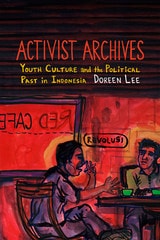
Activist Archives
Youth Culture and the Political Past in IndonesiaDoreen Lee
Duke University Press, 2016
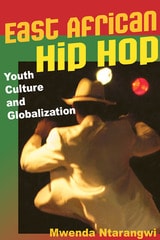
East African Hip Hop
Youth Culture and GlobalizationMwenda Ntarangwi
University of Illinois Press, 2008
In this book, Mwenda Ntarangwi analyzes how young hip hop artists in the East African nations of Kenya, Uganda, and Tanzania showcase the opportunities and challenges brought by the globalization of music. Combining local popular music traditions with American and Jamaican styles of rap, East African hip hop culture reflects the difficulty of creating commercially accessible music while honoring tradition and East African culture. Ntarangwi pays special attention to growing cross-border exchanges within East African hip hop, collaborations in recording music and performances, and themes and messages that transcend local geographic boundaries.
In using hip hop as a medium for discussing changes in East African political, economic, and social conditions, artists vocalize their concerns about economic policies, African identity, and political establishments, as well as important issues of health (such as HIV/AIDS), education, and poverty. Through three years of fieldwork, rich interviews with artists, and analysis of live performances and more than 140 songs, Ntarangwi finds that hip hop provides youth an important platform for social commentary and cultural critique and calls attention to the liberating youth music culture in East Africa.
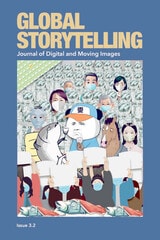
Global Storytelling, vol. 3, no. 2
Satirical Activism and Youth Culture in and Beyond COVID-19 China: Journal of Digital and Moving ImagesSpecial Issue Editor: Haiqing Yu
Michigan Publishing Services, 2024
Haiqing Yu. COVID-19, Satirical Activism, and Chinese Youth Culture: An Introduction
Research Articles
Ying Zhu and Junqi Peng. From Diaosi to Sang to Tangping: The Chinese DST Youth Subculture Online
Shaohua Guo. Moments of "Madness": Cynicism in Times of COVID
Howard Choy. Laughter in the Time of Coronavirus: Epidemic Humor and Satire in Chinese Women's Digital Diaries
Shaoyu Tang. Political In Between: Streaming Stand-Up Comedy and Feminist Reckoning in Contemporary Mainland China
Jingxue Zhang and Charlie Yi Zhang. The Power of Citation: Feminist Counter-Appropriation of State Discourses in Post-Reform China
Book Reviews
Ethan Tussey. Revised Research Methodology for the Age of Media Industries Speculation - Review of Specworld: Folds, Faults, and Fractures in Embedded Creator Industries by John Thornton Caldwell, University of California Press, 2023
Michael Keane. Precarious Creativity and the State in New Era China - Review of Chinese Creator Economies: Labor and Bilateral Creative Workers by Jian Lin, New York University Press, 2023
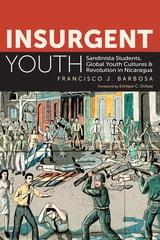
Insurgent Youth
Sandinista Students, Global Youth Cultures, and Revolution in NicaraguaFrancisco J. Barbosa
University Press of Colorado, 2026
This history of the Sandinista student movement is a window into the cultural milieu that produced a revolution where it seemed least likely to occur: among the youth of a country under the firm grip of a US-backed dictatorship whose power was secured by one of the best armed and most highly trained military forces in the region. By examining the articulation of political, gendered, and age-specific identities within the revolutionary process, Insurgent Youth sheds light on the everyday struggles of young Nicaraguans.
In the early 1970s a new emphasis on personal freedom and pleasure, under the influence of a global counterculture, challenged Sandinista gender ideology, especially masculinity, from within. This shift transformed the social world of Nicaraguan youth in general and Sandinista students in particular, eventually affecting the character of clandestine struggle and debates over revolutionary praxis within the Sandinista National Liberation Front (FSLN). Insurgent Youthshows how this new youth identity, which included the classic 1960s triumvirate of “sex, drugs, and rock ‘n’ roll,” constituted a social vernacular among young Nicaraguans of all classes—a common language and array of social practices that ultimately aided FSLN recruitment efforts among working-class youth. At the same time, this new identity posed a danger to the movement in that it embodied a tacit questioning of both mainstream and Sandinista notions of gender and the political, bringing threatening class and ideological contradictions present within the movement to the surface.
Insurgent Youth places what was happening in Nicaragua into the context of the worldwide student movement, challenging patriarchy and colonialism in Latin America and across the globe. This deep dive into the Nicaraguan revolution and the youth culture surrounding it provides a unique perspective on, and understanding of, modern Latin American history.
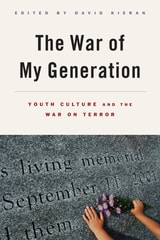
The War of My Generation
Youth Culture and the War on TerrorKieran, David
Rutgers University Press, 2015
The War of My Generation is the first essay collection to focus specifically on how the terrorist attacks and their aftermath have shaped these new generations of Americans. Drawing from a variety of disciplines, including anthropology, sociology, cultural studies, and literary studies, the essays cover a wide range of topics, from graphic war images in the classroom to computer games designed to promote military recruitment to emails from parents in the combat zone. The collection considers what cultural factors and products have shaped young people's experience of the 9/11 attacks, the wars that have followed, and their experiences as emerging citizen-subjects in that moment. Revealing how young people understand the War on Terror—and how adults understand the way young people think—The War of My Generation offers groundbreaking research on catastrophic events still fresh in our minds.
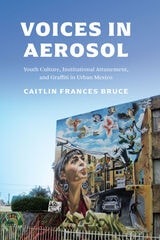
Voices in Aerosol
Youth Culture, Institutional Attunement, and Graffiti in Urban MexicoCaitlin Frances Bruce
University of Texas Press, 2024
2024 Visual Communication Division Award, National Communication Association
2025 Philosophy of Communication, Theory, and Critique Division Distinguished Book Award, National Communication Association
2025 Winans-Wichelns Memorial Award for Distinguished Scholarship in Rhetoric and Public Address, National Communication Association
How a city government in central Mexico evolved from waging war on graffiti in the early 2000s to sanctioning its creation a decade later, and how youth navigated these changing conditions for producing art.
The local government, residents, and media outlets in León, Mexico, treated graffiti as a disease until the state began sponsoring artistic graffiti through a program of its own. In Voices in Aerosol, the first book-length study of state-sponsored graffiti, Caitlin Frances Bruce considers the changing perceptions and recognition of graffiti artists, their right to the city, and the use of public space over the span of eighteen years (2000–2018). Focusing on the midsized city of León, Bruce offers readers a look at the way negotiations with the neoliberal state unfolded at different levels and across decades.
Issues brought to light in this case study, such as graffiti as a threat and graffiti as a sign of gentrification, resonate powerfully with those germane to other urban landscapes throughout the Western Hemisphere and beyond. Combining archival work, interviews, considerations of urban planning, local politics in Mexico, and insights gained by observing graffiti events and other informal artistic encounters, Bruce offers a new lens through which to understand the interplay between sanctioned and unsanctioned forms of cultural expression. Ultimately, Voices in Aerosol builds a strong case for graffiti as a contested tool for "voicing" public demands.
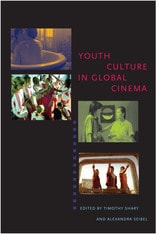
Youth Culture in Global Cinema
Edited by Timothy Shary and Alexandra Seibel
University of Texas Press, 2006
Coming of age is a pivotal experience for everyone. So it is no surprise that filmmakers around the globe explore the experiences of growing up in their work. From blockbuster U.S. movies such as the Harry Potter series to thought-provoking foreign films such as Bend It Like Beckham and Whale Rider, films about youth delve into young people's attitudes, styles, sexuality, race, families, cultures, class, psychology, and ideas. These cinematic representations of youth also reflect perceptions about youth in their respective cultures, as well as young people's worth to the larger society. Indeed, as the contributors to this volume make plain, films about young people open a very revealing window on the attitudes and values of cultures across the globe.
Youth Culture in Global Cinema offers the first comprehensive investigation of how young people are portrayed in film around the world. Eighteen established film scholars from eleven different national backgrounds discuss a wide range of films that illuminate the varied conditions in which youth live. The essays are grouped thematically around the issues of youthful resistance and rebellion; cultural and national identity, including religion and politics; and sexual maturation, including gender distinctions and coming-of-age queer. Some essays engage in close readings of films, while others examine the advertising and reception of films or investigate psychological issues. The volume concludes with filmographies of over 700 youth-related titles arranged by nation and theme.