Results by title
8 books match the query 'Youth and violence'
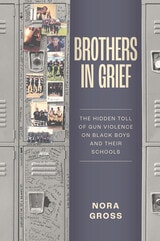
Brothers in Grief
The Hidden Toll of Gun Violence on Black Boys and Their SchoolsNora Gross
University of Chicago Press, 2024
JahSun, a dependable, much-loved senior at Boys’ Prep was just hitting his stride in the fall of 2017. He had finally earned a starting position on the varsity football team and was already weighing two college acceptances. Then, over Thanksgiving, tragedy struck. An altercation at his older sister’s home escalated into violence, killing the unarmed teenager in a hail of bullets. JahSun’s untimely death overwhelmed his entire community, sending his family, friends, and school into seemingly insurmountable grief. Worse yet, that spring two additional Boys’ Prep students would be shot to death in their neighborhood. JahSun and his peers are not alone in suffering the toll of gun violence, as every year in the United States teenagers die by gunfire in epidemic numbers, with Black boys most deeply affected.
Brothers in Grief closely attends to the neglected victims of youth gun violence: the suffering friends and classmates who must cope, mostly out of public view, with lasting grief and hidden anguish. Set at an ambitious urban high school for boys during the heartbreaking year following the death of JahSun, the book chronicles the consequences of untimely death on Black teen boys and on a school community struggling to recover. Sociologist Nora Gross tells the story of students attempting to grapple with unthinkable loss, inviting readers in to observe how they move through their days at school and on social media in the aftermath of their friends’ and classmates’ deaths. Gross highlights the discrepancy between their school’s educational mission and teachers’ and administrators’ fraught attempts to care for students’ emotional wellbeing. In the end, the school did not provide adequate space for grief, making it more difficult for students to heal, reengage with school, and imagine hopeful futures. Even so, supportive relationships deepened among students and formed across generations, offering promising examples of productive efforts to channel student grief into positive community change.
A searing testimony of our collective failure to understand the inner lives of our children in crisis, Brothers in Grief invites us all to wrestle with the hidden costs of gun violence on racial and educational inequity.

Downed by Friendly Fire
Black Girls, White Girls, and Suburban SchoolingSignithia Fordham
University of Minnesota Press, 2016
Most Americans would never willingly revisit their high school experiences; the nation’s school systems reflect the broader society’s hierarchical emphasis on race, class, and gender. While schools purport to provide equal opportunities for all students, this rarely happens in actuality—particularly for girls.
In Downed by Friendly Fire, Signithia Fordham unmasks and examines female-centered bullying in schools, arguing that it is essential to unmask female aggression, bullying, and competition, all of which directly relate to the structural violence embedded in the racialized and gendered social order. For two and a half years, Fordham conducted field research at “Underground Railroad High School,” a suburban high school in upstate New York. Through a series of composite student profiles, she examines the girls’ relationships to academic achievement, social competition, and aggression toward one another. Fordham argues that girls academically “compete to lose,” which only perpetuates their subordination through the misrecognition of their own competitive behaviors. She goes further to expand the meaning of violence to include what is seen as normal, including suffering, humiliation, and social and economic abuse.
Using the concept “symbolic violence,” Fordham theorizes the psychological and social damage suffered especially by black girls in schools. The five narratives in Downed by Friendly Fire ultimately highlight the pain and suffering this violence produces as well as the ways in which it promotes inequality, exclusion, and marginalization among girls.

Jesus and the Gang
Youth Violence and Christianity in Urban HondurasJon Wolseth
University of Arizona Press, 2011
While only a small fraction of youths in a neighborhood are active members of a gang, most young men must learn the styles, ways of communicating, and local geography of gangs in order to survive. Due to the absence of gang prevention programs sponsored by the government or outside non-governmental organizations, Catholic and Pentecostal churches have developed their own ways to confront gang violence in their communities. Youths who participate in church organizations do so not only to alter and improve their communities but also to gain emotional and institutional support.
Offering firsthand accounts of these youths and how they make use of religious discourse, narrative practices, or the inscription of tattooed images and words on the body to navigate dangerous social settings, Jesus and the Gang is an unflinching look at how these young men turn away from perpetuating the cycle of violence and how Christianity serves a society where belonging is surviving.
This book will appeal to readers with an interest in Latin American studies, urban anthropology, and youth studies. With its focus on the lives of young men and women, it’s also a compelling read for anyone interested in the plight of urban youth trying to escape the gang life.

Language of the Gun
Youth, Crime, and Public PolicyBernard E. Harcourt
University of Chicago Press, 2006
Home to over 150 repeat offenders ranging in age from twelve to seventeen, the Catalina Mountain School is made up of a particular stratum of boys—those who have committed the most offenses but will still be released upon reaching adulthood. In an effort to understand the symbolic and emotional language of guns and gun carrying, Harcourt interviewed dozens of these incarcerated Catalina boys. What do these youths see in guns? What draws them to handguns? Why do some of them carry and others not? For Harcourt, their often surprising answers unveil many of the presuppositions that influence our laws and policies.
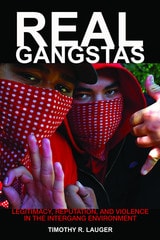
Real Gangstas
Legitimacy, Reputation, and Violence in the Intergang EnvironmentLauger, Timothy R
Rutgers University Press, 2012
Street gangs are a major concern for residents in many inner-city communities. However, gangs’ secretive and, at times, delinquent tendencies limit most people’s exposure to the realities of gang life. Based on eighteen months of qualitative research on the streets of Indianapolis, Real Gangstas provides a unique and intimate look at the lives of street gang members as they negotiate a dangerous peer environment in a major midwestern city.
Timothy R. Lauger interviewed and observed a mix of fifty-five gang members, former gang members, and non-gang street offenders. He spent much of his fieldwork time in the company of a particular gang, the “Down for Whatever Boyz,” who allowed him to watch and record many of their day-to-day activities and conversations. Through this extensive research, Lauger is able to understand and explain the reasons for gang membership, including a chaotic family life, poverty, and the need for violent self-assertion in order to foster the creation of a personal identity.
Although the book exposes many troubling aspects of gang life, it is not a simple descriptive or a sensationalistic account of urban despair and violence. Steeped in the tradition of analytical ethnography, the study develops a central theoretical argument: combinations of street gangs within cities shape individual gang member behavior within those urban settings. Within Indianapolis, members of rival gangs interact on a routine basis within an ambiguous and unstable environment. Participants believe that many of their contemporaries claiming gang affiliations are not actually “real” gang members, but instead are imposters who gain access to the advantages of gang membership through fraud and pretense. Consequently, the ability to discern “real” gang members—or to present oneself successfully as a real gang member—is a critical part of gangland Indianapolis.
Real Gangstas offers an objective and fair characterization of active gang members, successfully balancing the seemingly conflicting idea that they generally seem like normal teenagers, yet are abnormally concerned with—and too often involved in—violence. Lauger takes readers to the edge of an actual gang conflict, providing a rare and up-close look at the troubling processes that facilitate hostility and violence.
Revolutionary Suicide and Other Desperate Measures
Narratives of Youth and Violence from Japan and the United StatesAdrienne Carey Hurley
Duke University Press, 2011

The Future of Youth Violence Prevention
A Mixtape for Practice, Policy, and ResearchPaul Boxer
Rutgers University Press, 2025
Youth Violence
Sex and Race Differences in Offending, Victimization, and Gang MembershipFinn-Aage Esbensen, Dana Peterson, Terrance J. Taylor and Adrienne Freng
Temple University Press, 2010
Violence by and against youth continues to be one of the most challenging subjects facing criminologists. In this comprehensive and integrated analysis of the interrelationships of youth violence, violent victimization, and gang membership, Finn-Aage Esbensen, Dana Peterson, Terrance J. Taylor and Adrienne Freng seek to understand what causes youth violence and what can be done about it. Using the results from an inclusive study they conducted of eighth-graders in eleven American cities, the authors examine how the nature, etiology, and intersections of youth violence are structured by both sex and race/ethnicity.
Youth Violence is pertinent to juvenile justice policy considerations. The authors frame their discussion within the public health perspective, focusing on risk factors associated with violent behavior. Thefindings address prevalence and incidence, as well as the demographic correlates and cumulative effects of the risk factors associated with engagement in violence. Ultimately, the theories and research methodologies here are essential for understanding the dynamics of youth violence.