Results by title
3 books match the query 'Yucatâan (Mexico : State)'
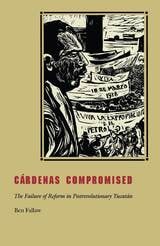
Cárdenas Compromised
The Failure of Reform in Postrevolutionary YucatánBen Fallaw
Duke University Press, 2001
For historical, geographical, and ethnic reasons, Yucatán was the center of large-scale land reform after the Mexican Revolution. A long-standing revolutionary tradition, combined with a harsh division between a powerful white minority and a poor, Maya-speaking majority, made the region the perfect site for Cárdenas to experiment by launching an ambitious top-down project to mobilize the rural poor along ethnic and class lines. The regime encouraged rural peasants to form collectives, hacienda workers to unionize, and urban laborers to strike. It also attempted to mobilize young people and women, to challenge Yucatán’s traditional, patriarchal social structure, to reach out to Mayan communities, and to democratize the political process. Although the project ultimately failed, political dialogue over Cárdenas’s efforts continues. Rejecting both revisionist (anti-Cárdenas) and neopopulist (pro-Cárdenas) interpretations, Fallaw overturns the notion that the state allowed no room for the agency of local actors. By focusing on historical connections across class, political, and regional lines, Fallaw transforms ideas on Cardenismo that have long been accepted not only in Yucatán but throughout Mexico.
This book will appeal to scholars of Mexican history and of Latin American state formation, as well as to sociologists and political scientists interested in modern Mexico.
Land, Labor, and Capital in Modern Yucatan
Essays in Regional History and Political EconomyJeffrey T. Brannon
University of Alabama Press, 1991
Owing to Yucatan’s relative isolation, many assume that the history and economy of the peninsula have evolved in a distinctive way, apart from the central government in Mexico City and insulated from world social and economic factors. The essays in this volume suggest that this has not been the case: the process of development in Yucatan has been linked firmly to national and global forces of change over the past two centuries. The essays are by U.S., Mexican, Canadian, and Belizean social scientists representing both well-established and younger scholars. The result is a perspective on Yucatan’s historical development that is at once international, interdisciplinary, and intergenerational.
Rediscovering The Past at Mexico's Periphery
Essays on the History of Modern YucatanGilbert M. Joseph
University of Alabama Press, 1986
Increasingly, the modern era of Mexican history (c. 1750 to the present) is attracting the attention of Mexican and international scholars. Significant studies have appeared for most of the major regions and Yucatán, in particular, has generated an unusual appeal and an abundant scholarship. This book surveys major trends in Yucatán’s currents in Mexican historiography, and suggest new departures for regional and local-level research.
Rather than compiling lists of sources around given subject headings in the manner of many historiographies, the author seeks common ground for analysis in the new literature’s preoccupation with changing relations of land, labor, and capital and their impact on regional society and culture. Joseph proposes a new periodization of Yucatán’s modern history which he develops in a series of synthetic essays rooted in regional political economy.