Results by title
8 books match the query 'Žižek, Slavoj'
Badiou, Zizek, and Political Transformations
The Cadence of ChangeAdrian Johnston
Northwestern University Press, 2009
Alain Badiou and Slavoj Žižek together have emerged as two of Europe’s most significant living philosophers. In a shared spirit of resistance to global capitalism, both are committed to bringing philosophical reflection to bear upon present-day political circumstances. These thinkers are especially interested in asking what consequences the supposed twentieth-century demise of communism entails for leftist political theory in the early twenty-first century.
Badiou, Žižek, and Political Transformations examines Badiouian and Žižekian depictions of change, particularly as deployed at the intersection of philosophy and politics. The book details the origins of Badiou’s concept of the event and Žižek’s concept of the act as related theoretical visions of revolutionary happenings, delineating a number of difficulties arising from these similar concepts. Johnston finds that Badiou and Žižek tend to favor models of transformation that risk discouraging in advance precisely the efforts at changing the world of today that these uncompromising leftists so ardently desire. Badiou, Žižek, and Political Transformations will surely join Johnston’s Žižek’s Ontology as an instant classic in its field.
Everything You Always Wanted to Know about Literature but Were Afraid to Ask Žižek
SIC 10Russell Sbriglia, editor
Duke University Press, 2017
How Slavoj Became Zizek
The Digital Making of a Public IntellectualEliran Bar-El
University of Chicago Press, 2025
This revised edition corrects several erroneous and insufficient references in the first edition of this book.
Slovenian philosopher bad boy Slavoj Žižek is one of the most famous intellectuals of our time, publishing at a breakneck speed and lecturing around the world. With his unmistakable speaking style and set of mannerisms that have made him ripe material for internet humor and meme culture, he is recognizable to a wide spectrum of fans and detractors. But how did an intellectual from a small Eastern European country come to such popular notoriety? In How Slavoj Became Žižek, sociologist Eliran Bar-El plumbs the emergence, popularization, and development of the phenomenon called “Žižek.”
Beginning with Žižek’s early years as a thinker and political figure in Slovenian civil society, Bar-El traces Žižek’s rise from Marxist philosopher to political candidate to eventual intellectual celebrity, as Žižek perfected his unique performative style and a rhetorical arsenal of “Hegelacanese.” Following 9/11, Žižek’s career as a global op-ed writer and TV commentator married his rhetoric with global events such as the war on terror, the financial crisis of 2008, and the Arab Spring of 2011. Yet, at the same time, this mainstream popularity, as well as a series of politically incorrect views, almost entirely estranged the Slovenian from the normal workings of academia. Ultimately, this account shows how Žižek has harnessed the power of the digital era in his own self-fashioning as a public intellectual.
How Slavoj Became Žižek
The Digital Making of a Public IntellectualEliran Bar-El
University of Chicago Press, 2023
Slovenian philosopher bad boy Slavoj Žižek is one of the most famous intellectuals of our time, publishing at a breakneck speed and lecturing around the world. With his unmistakable speaking style and set of mannerisms that have made him ripe material for internet humor and meme culture, he is recognizable to a wide spectrum of fans and detractors. But how did an intellectual from a remote Eastern European country come to such popular notoriety? In How Slavoj Became Žižek, sociologist Eliran Bar-El plumbs the emergence, popularization, and development of this phenomenon called “Žižek.”
Beginning with Žižek’s early years as a thinker and political figure in Slovenian civil society, Bar-El traces Žižek’s rise from Marxist philosopher to a political candidate to eventual intellectual celebrity as Žižek perfects his unique performative style and a rhetorical arsenal of “Hegelacanese.” Following 9/11, Žižek’s career as a global op-ed writer and TV commentator married his rhetoric with global events such as the War on Terror, the financial crisis of 2008, and the Arab Spring of 2011. Yet, at the same time, this mainstream popularity, as well as a series of politically incorrect views, almost entirely estranged the Slovenian from the normal workings of academia. Ultimately, this account shows how Žižek harnessed the power of the digital era in his own self-fashioning as a public intellectual.

Ontological Catastrophe
Zizek and the Paradoxical Metaphysics of German IdealismJoseph Carew
Michigan Publishing Services, 2014
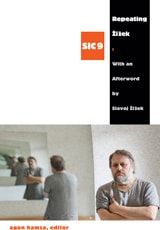
Repeating Žižek
Agon Hamza, ed.
Duke University Press, 2015
Contributors. Henrik Jøker Bjerre, Bruno Bosteels, Agon Hamza, Brian Benjamin Hansen, Adrian Johnston, Katja Kolšek, Adam Kotsko, Catherine Malabou, Benjamin Noys, Geoff Pfeifer, Frank Ruda, Oxana Timofeeva, Samo Tomšic, Gabriel Tupinambá, Fabio Vighi, Gavin Walker, Sead Zimeri, Slavoj Žižek

Slavoj Zizek
A Critical IntroductionIan Parker
Pluto Press, 2004
'This is not simply the best critical introduction to Zizek – in a much more radical sense, this is the only critical introduction to Zizek. Parker's study is much more than an important contribution to the ongoing debate: it redefines its very terms.' Yannis Stavrakakis, author of 'Lacan and the Political'
'A sharp, clear and radical analysis.' Christian Ingo Lenz Dunker, Professor of Psychoanalytic Theory and Lacanian Psychoanalyst, Sao Paulo, Brazil.
Since the publication of his first book in English in 1989, Slavoj Zizek has quickly become one of the most widely read and contentious intellectuals alive today. With dazzling wit and tremendous creativity he has produced innovative and challenging explorations of Lacan, Hegel and Marx, and used his insights to exhilarating effect in analyses of popular culture.
While Zizek is always engaging, he is also elusive and even contradictory. It can be very hard to finally determine where he stands on a particular issue. Is Zizek Marxist or Post-Marxist? How seriously should we take his recent turn to Christianity?
Slavoj Zizek: A Critical Introduction shows the reader a clear path through the twists and turns of Zizek's writings. Ian Parker takes Zizek's treatment of Hegel, Lacan and Marx in turn and outlines and assesses Zizek's interpretation and extension of these thinkers' theories. While Parker is never hastily dismissive of Zizek's innovations, he remains critical throughout, aware that the energy of Zizek's writing can be bewitching and beguiling as well as engaging and profound.
Zizek's Ontology
A Transcendental Materialist Theory of SubjectivityAdrian Johnston
Northwestern University Press, 2008
By taking this avowal seriously, Adrian Johnston finally clarifies the philosophical project underlying Žižek’s efforts. His book charts the interlinked ontology and theory of subjectivity constructed by Žižek at the intersection of German idealism and Lacanian theory. Johnston also uses Žižek’s combination of philosophy and psychoanalysis to address two perennial philosophical problems: the relationship of mind and body, and the nature of human freedom. By bringing together the past two centuries of European philosophy, psychoanalytic metapsychology, and cutting-edge work in the natural sciences, Johnston develops a transcendental materialist theory of subjectivity—in short, an account of how more-than-material forms of subjectivity can emerge from a corporeal being. His work shows how an engagement with Žižek’s philosophy can produce compelling answers to today’s most vexing and urgent questions as inherited from the history of ideas.